
The tool with the clearest inspection workflow may not be the one that keeps an Australian rental portfolio organised. For investors comparing rentcheck vs landlord compliance software australia, the key is the job each system is built to do. Here, RentCheck means the US-based, resident-led inspection app, not the Australian tenant report or the NSW Government’s rent comparison tool.
State-specific obligations, deadlines, inspection records and bond evidence can end up scattered across emails, folders and spreadsheets, whether you manage properties yourself or use an agent. A resident-led inspection app and an owner-side compliance platform serve different workflows. PropAlly brings together state-specific compliance checklists, property records, bond evidence, cash-flow tools and tax tracking in one dashboard.
This comparison looks at the practical differences, the workflows to assess and how to choose a fit for agent-managed or self-managed rentals. Use the criteria below to organise your decision, while keeping software in its proper role: a tool for managing information and tasks, not a substitute for professional advice.
Key Takeaways
- In the rentcheck vs landlord compliance software australia comparison, focus on the workflows each tool supports rather than the number of features listed.
- Assess state-specific compliance needs separately across QLD, NSW, VIC, SA, WA, TAS, NT and ACT; obligations aren’t identical across jurisdictions.
- Map your properties, obligations, evidence gaps and reporting needs before choosing a platform, including who handles each task for agent-managed rentals.
- PropAlly brings compliance checklists and deadline alerts together with property records, bond evidence, cash-flow tools and tax tracking.
RentCheck vs landlord compliance software in Australia: what is being compared?
The rentcheck vs landlord compliance software australia comparison is best understood as a comparison of jobs, not labels. RentCheck is a resident-led inspection app. Landlord compliance software is a broader category of tools designed to help owners organise obligations, dates, records and supporting evidence. A product’s actual functions matter more than its category name.
Organisation is useful, but it isn’t a guarantee of compliance. Software can connect a notice, inspection record or safety-related document to a property and help monitor relevant dates. It doesn’t interpret legislation, confirm that a requirement applies or replace legal, tax or property management advice. Landlord-tenant rules differ between jurisdictions; Landlord-tenant law principles offer general background, not a substitute for Australian state and territory guidance.
Keep compliance tracking distinct from broader property management. A platform can organise evidence and obligations without handling tenant applications, rent collection, maintenance coordination or other day-to-day management tasks. These are separate workflows. Start with the administrative job you need the software to support, rather than comparing products by a long feature list.
What jobs does landlord compliance software help organise?
Look for a way to record an obligation, connect it to a property, add a relevant date and store supporting documents. For example, you may want an inspection notice and related correspondence filed together, or safety-related records easy to retrieve. A useful system should also show whether an item is outstanding, completed or filed for reference. The software organises information; interpreting what an obligation means still requires appropriate guidance.
Consider how you’ll maintain those records. Can you identify the property a document relates to? Can you find it again without searching through emails, shared drives and agent communications? Clear answers matter when you oversee several properties or share tasks with an agent.
Where does RentCheck fit in the comparison?
RentCheck is the resident-led inspection app in this comparison. Its role is distinct from a broader owner-side platform designed to track property obligations, portfolio records and related investor workflows. Compare the tools on the job you need done, rather than assuming they are interchangeable because both relate to rental properties.
An Australian investor’s state or territory, property type and management arrangement all shape the workflow to organise. If an agent manages the tenancy, clarify which records and tasks you still need to track as the owner. If you self-manage, map the tasks you handle directly. In both cases, choose software that supports your record-keeping needs without assuming that it transfers legal responsibilities.
Which Australian compliance workflows should landlord software cover?
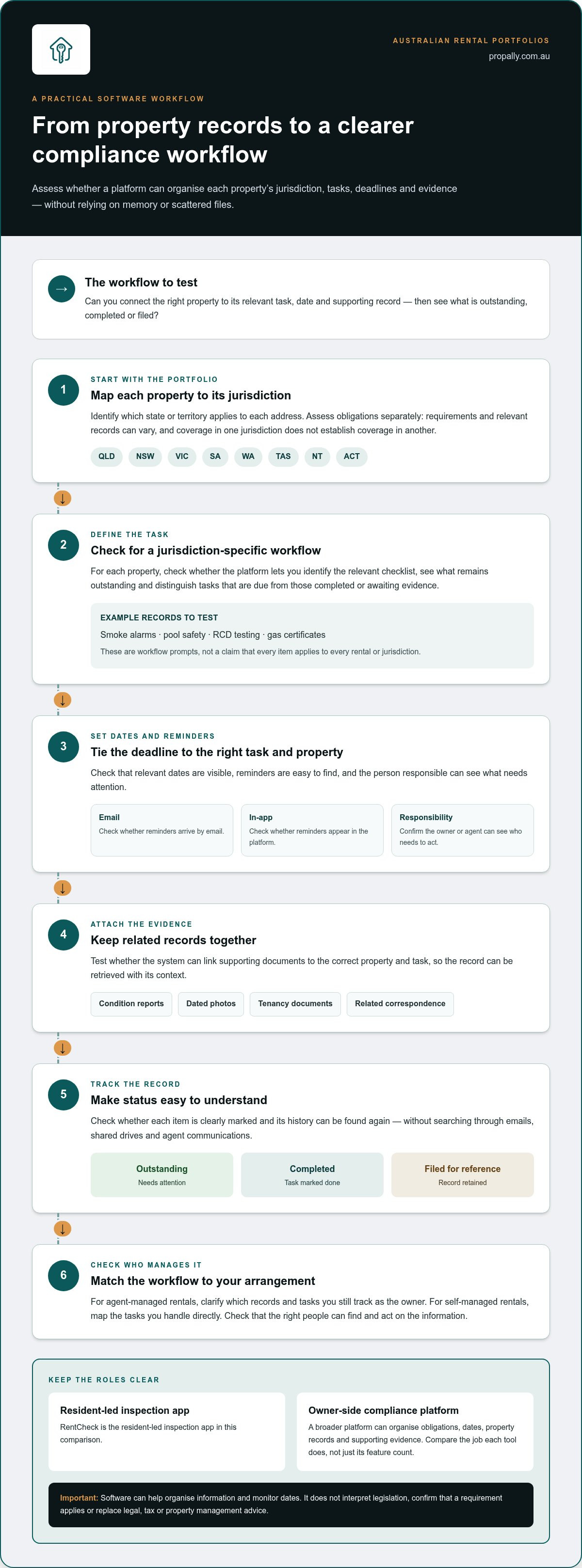
A portfolio that spans state or territory borders needs more than a single undifferentiated task list. Rental requirements and relevant records can vary by jurisdiction, so assess each property against the workflow that applies to its location. Map properties across QLD, NSW, VIC, SA, WA, TAS, NT and ACT. Coverage in one jurisdiction doesn’t establish coverage in another.
State-specific compliance tracking connects each property with the relevant jurisdiction, obligations, dates and records. One generic checklist may not fit every property. Use this as a practical test when comparing tools. Can you identify the checklist for each address, see what remains outstanding and locate supporting documents without relying on memory?
For each workflow, consider the due date, supporting documents, completion status and record history. Alerts also matter when a task needs action. A reminder is most useful when it’s tied to the right property and task, and the owner or agent responsible can see what needs doing.
How to assess state-specific checklists and reminders
Start with one property in each jurisdiction you own in. Check whether the workflow identifies its state or territory, and whether you can distinguish a task that’s due from one that’s completed or awaiting evidence. Check where reminders appear and whether they arrive by email, in-app or both. Then confirm that the task and its supporting information are clear to whoever needs to act on it.
Use examples such as smoke alarms, pool safety, RCD testing and gas certificates to assess how a platform handles different records. These are prompts for checking the workflow, not a claim that every item applies to every rental or jurisdiction. For wider industry context, the Property Investment Association of Australia is a useful reference point for Australian property investment professionals.
How to assess bond and inspection evidence
Check whether condition reports, dated photos and related tenancy documents can be kept together and linked to the correct property. Clear organisation helps owners and agents retrieve records and understand their context, but it can’t guarantee how a dispute will be decided. An Australian investment property compliance checklist can also help you map the records to organise alongside jurisdiction-specific workflows.
Test the same example workflow across your portfolio: record the task, attach its supporting document, mark its status and find it again. Note where the process breaks down, especially if an agent manages some properties while you manage others. PropAlly’s owner-side property portfolio tools bring state-specific compliance checklists together with property and bond records.
RentCheck vs compliance software: compare the workflows, not the feature count
Compare software by the records and workflows it supports, not the length of its feature list. In the rentcheck vs landlord compliance software australia comparison, distinguish a resident-led inspection workflow from the broader needs of an Australian property owner. Use the matrix below to focus on the practical differences and the questions that matter to your portfolio.
Jurisdiction coverage
RentCheck: Resident-led inspection app.
Landlord compliance software: Check whether each property can be linked to its relevant state or territory workflow. Coverage varies by platform.
Reminders
RentCheck: Consider whether inspection tasks are the main reminder workflow you need.
Landlord compliance software: Check whether compliance tasks can be dated and tracked, and whether reminders are available.
Evidence
RentCheck: Consider whether its inspection workflow suits the records you need to organise.
Landlord compliance software: Check whether supporting records can be attached to the relevant property and task, and how documents can be retrieved or exported.
Bond records
RentCheck: Assess whether a resident-led inspection workflow meets your bond evidence needs.
Landlord compliance software: Check whether bond-related records and supporting evidence can be organised alongside property information.
Reporting
RentCheck: Consider whether its inspection records give you the portfolio view you need.
Landlord compliance software: Assess whether reports show task status, outstanding items or evidence records in a useful format.
Portfolio visibility
RentCheck: Consider whether inspection records meet your needs across the portfolio.
Landlord compliance software: Check whether you can view records and task status across relevant properties, rather than opening each record separately.
What to compare in compliance tracking and documentation
Test a representative task from start to finish. Can you associate it with the right property and jurisdiction, record a date, attach supporting material and find it again? Then check whether the portfolio view distinguishes upcoming, outstanding and completed tasks. Treat document storage, exports and evidence packages as distinct capabilities, and compare them with the records you actually need to manage.
For RentCheck, assess how its resident-led inspection workflow fits your use case. For a compliance platform, assess whether it covers the owner-side tasks and records you need. The right comparison is about how each product supports your workflow, not whether it has the longest feature list.
What to compare in investor and property management tools
Advertising, tenant applications, screening, rent ledgers, maintenance boards and tenant communication are tenancy operations, not automatically compliance tracking. Assess them separately. Investors may also value tax categorisation or cash-flow reporting, but those functions support portfolio oversight rather than proving a compliance workflow is suitable. For broader platform-selection context, a guide to property management tools for investors can help distinguish these overlapping categories.
Keep the comparison anchored to your own workflow. A focused inspection app may suit a specific task; a broader platform can bring compliance records into the same view as property and investor information. Neither a feature count nor a product label tells you whether the system fits. Compare each capability with the records you need to organise and review.
How to choose landlord compliance software for your Australian portfolio
A clear shortlist starts with your portfolio, not a product demo. Use these four steps to identify the records and workflows the software needs to support. That gives you a practical basis for comparing RentCheck with broader landlord platforms, without assuming that a longer feature list means a better fit.
- Map your properties. Record each property’s state or territory, property type and management arrangement.
- List the obligations you track. Use your existing records and reliable guidance to identify recurring tasks, relevant dates and the documents you keep. Don’t rely on a generic list as a substitute for jurisdiction-specific advice.
- Identify evidence gaps. Note missing documents, records held in email and information you can’t readily match to a property or task.
- Define reporting needs. Decide what you need to review across the portfolio, such as outstanding tasks, completed records or documents to share with your accountant.
Shortlist tools by jurisdiction, workflow and record-keeping fit, then test those needs against a real property record. This keeps the rentcheck vs landlord compliance software australia decision grounded in day-to-day administration rather than assumptions about what a product name or category includes.
Map properties, jurisdictions and existing records
Build a simple inventory before trialling a platform. For each property, note its state or territory, whether an agent manages it and where current documents are stored. Separate records supplied by the agent from those you maintain directly, such as owner-held correspondence or portfolio notes. Then map the recurring obligations and evidence you already track, using appropriate guidance for your jurisdiction.
This ownership map helps reveal handover gaps. For example, an agent may send a document by email while you keep related records elsewhere. Decide who will file each item and where it belongs in your workflow. Software can support that process, but it doesn’t transfer legal responsibilities from the owner to the platform or agent.
Test a real landlord workflow before committing
Choose one upcoming task for a representative property. Check whether you can record it, attach the relevant document, track its status and locate the entry later. Review how reminders work, then look at a report or export and decide whether it supports your portfolio review and an accountant handover.
Tax records need their own attention. A system may help keep property information organised, but it isn’t tax advice. Use ATO guidance on rental property records to understand the record-keeping context, then assess whether a platform’s reporting and exports work for your process. Start with one property and workflow before moving the entire portfolio. To organise compliance tasks alongside portfolio records, explore PropAlly’s property portfolio platform.
How PropAlly brings landlord compliance and portfolio records together
PropAlly is a property portfolio tracker for Australian residential property investors. Its owner-side dashboard brings property records and compliance workflows together for agent-managed and self-managed rentals. It isn’t a property management service, and its tools don’t replace legal, tax or property management advice. For investors weighing the rentcheck vs landlord compliance software australia question, the key distinction is whether they want to organise compliance alongside other owner-side portfolio information.
ComplianceTracker provides state-specific checklists for QLD, NSW, VIC, SA, WA, TAS, NT and ACT, with automated deadline tracking and email and in-app alerts. It monitors smoke alarms, pool safety, RCD testing and gas certificates, and includes VIC Healthy Homes tracking and QLD tenancy law updates. Owners can organise relevant obligations by jurisdiction and keep task records connected to their portfolio. Tracking supports oversight, but it doesn’t guarantee compliance or confirm that every checklist item applies to a particular property.
How PropAlly connects compliance records with bond evidence
Compliance records are only part of a property file. BondShield supports timestamped entry and exit photos with GPS verification, AI-powered side-by-side damage comparison and one-click PDF evidence packages. It includes state-specific condition-report templates, automatic depreciation calculations for claim items and a shared photo library with InspectAI. These tools help users organise condition information and related visual records; they don’t guarantee a successful bond claim or a particular decision in a dispute.
Keeping compliance and bond records accessible alongside property information can make it easier to find the relevant record when needed. A completed task, an associated document and a set of entry or exit photos serve different purposes, but each can sit within an owner’s wider portfolio workflow. Consider how these records fit your process, including information supplied by a property manager.
PropAlly’s RentSmart, Cashflow and PropertyTax tools support adjacent owner workflows. RentSmart includes a rent ledger, arrears alerts, receipt scanning and tax categorisation, AI extraction from PDF statements, a maintenance request board and 10-year cash-flow projections. Cashflow provides portfolio and property views, scenario testing and printable reports. PropertyTax tracks ATO-categorised expenses, supports depreciation-schedule imports and provides a downloadable tax pack for an accountant. These are organisational tools, not financial or tax advice; investors should rely on appropriately qualified professionals for advice relevant to their circumstances.
How investors can take the next step with PropAlly
Start with the property information you already maintain. Whether an agent manages the tenancy or you handle it yourself, identify the records you want to organise and the tasks you need to monitor. PropAlly supports both arrangements from an owner-side perspective, helping centralise portfolio information without taking over an agent’s role or transferring your responsibilities.
The Free Plan is available for one property. Starter is designed for portfolios of one to four properties, while Pro supports up to ten and Business up to twenty. Paid plans include a seven-day free trial. Explore PropAlly’s portfolio tracker and compare its compliance, bond and portfolio workflows with the records and reporting needs you mapped for your portfolio.
Make your next portfolio decision with confidence
Your software choice should support the way you manage your portfolio as it changes. A new property, a different agent arrangement or a shift to self-management can alter which records you need to access and who needs them. Revisit your workflows when your portfolio or management setup changes, and keep your records aligned with how you operate.
That’s a practical way to apply the rentcheck vs landlord compliance software australia comparison beyond the initial selection. Choose a system that fits your owner-side processes, and keep professional advice separate from the software that organises your information. PropAlly uses bank-level encryption, is Privacy Act compliant and is hosted on Microsoft Azure.
Ready to organise your Australian property records in one place? Explore PropAlly’s portfolio tracker and compare its tools with the workflows you need to manage.
Frequently Asked Questions
Is RentCheck the same as landlord compliance software?
No. RentCheck is a resident-led inspection app, while landlord compliance software describes a broader category. In the rentcheck vs landlord compliance software australia comparison, look at whether you need inspection records, jurisdiction-specific compliance tracking, reminders, document storage or evidence handling. Choose according to the owner-side workflow you need to support.
Can landlord compliance software replace a property manager?
No. Software can help organise records and administrative workflows, but it isn’t a property management service. It won’t take over an agent’s communications or decisions, or the tasks a landlord handles directly. For example, a dashboard may help you review a record while your agent continues managing the tenancy. Keep the roles clear: software supports administration, while your management arrangement and professional advice remain separate.
Does landlord compliance software provide legal advice?
No. A checklist or reminder helps organise information, but it shouldn’t be treated as legal advice or a definitive interpretation of tenancy requirements. The obligations relevant to a rental can depend on its jurisdiction and circumstances, so landlords need to understand what applies to their property. If you’re unsure how a requirement applies or need guidance on a dispute, seek advice from an appropriately qualified professional.
Can PropAlly track properties in more than one Australian state?
Yes. PropAlly’s ComplianceTracker provides state-specific checklists for QLD, NSW, VIC, SA, WA, TAS, NT and ACT, with automated deadline tracking and email and in-app alerts. Investors with properties in different jurisdictions can organise each property’s workflow in the dashboard rather than treating the portfolio as if one set of requirements applies everywhere. Tracking helps keep information structured, but it doesn’t guarantee compliance or confirm that every checklist item applies to a particular property.
Can landlord software organise bond photos and inspection records together?
That depends on the software’s features. Check whether it can associate dated photos, condition reports, inspection notes and tenancy documents with the same property, and whether you can retrieve or export them together. PropAlly’s BondShield supports timestamped entry and exit photos, GPS verification, AI-powered damage comparison and PDF evidence packages. Organised records can help with review, but they don’t guarantee a successful bond claim.
Is landlord compliance software suitable for self-managed landlords?
It can suit self-managed landlords who want a structured way to organise property records and workflows, provided the platform matches how they handle their portfolio. Consider whether you can keep owner-held documents alongside agent correspondence for another property. Check that the chosen system fits your jurisdictions, evidence needs and portfolio size. Software supports administration; it doesn’t take over a landlord’s responsibilities or provide property management services.
Can one landlord platform track compliance, tax and cash flow?
Yes, some platforms combine these investor workflows, but assess each capability rather than assuming every system does. PropAlly brings together ComplianceTracker, PropertyTax and Cashflow with other property modules. Tax categorisation and cash-flow modelling can help organise records and explore scenarios, but they aren’t tax or financial advice. Use appropriately qualified professionals for advice about your individual circumstances, and treat platform outputs as tools for tracking and review.