

Yes. An automated rental property cash flow tracker in Australia can bring rental income and expenses together, then show whether a property has a surplus or shortfall. Track rent by payment date, record each cost once and keep its supporting document with the entry. This makes the cash position easier to review and helps organise records for tax time.
The weekly picture can get blurry when rent, bills and agent statements are stored in different places. A consistent tracking process shows what is coming in, what is going out and which expenses need attention.
This guide explains how to calculate weekly cash flow, what to include in a tracker and how to organise records. It also covers how automated tools can streamline statement tracking across rental properties while keeping figures connected to source documents.
Update: 4 November 2026 — check your loan payment, not just the cash rate
The RBA increased the cash rate target by 0.25 percentage points to 4.85% on 3 November 2026, effective 4 November. This national policy rate is not your individual mortgage rate. Your lender's notice, loan type and repayment terms determine whether and when your payments change.
Before updating your rental-property budget:
- Check your lender's actual rate, repayment amount and effective date.
- Record the full loan payment in your cash-flow budget. Keep principal and interest separate rather than treating the whole payment as a tax deduction.
- Compare the next month's rent receipts with loan payments and dated bills such as rates, insurance and repairs.
- Save the lender's notice with your loan records, then compare the next actual debit with your budget.
This is a record-checking checklist, not personalised financial or tax advice. For tax treatment or loan decisions, consult an appropriately qualified adviser.
Key Takeaways
- Build a worksheet with separate entries for rent received, other rental income, operating costs and loan interest so each transaction has a clear place.
- Calculate cash flow by subtracting cash expenses from rental income, then review both monthly and annual totals to spot the effect of irregular bills.
- Convert rent and expenses to a weekly view to see how vacancy periods and payment timing affect the property’s day-to-day position.
- Keep receipts, statements and invoices alongside recorded figures, and record each cost once. Body corporate charges may already include expenses that shouldn’t be claimed again.
- Use a tracker to bring property records into one organised view; PropAlly’s plans are designed to help Australian investors manage cash flow and related property information.
Blank worksheet for tracking rental income and expenses
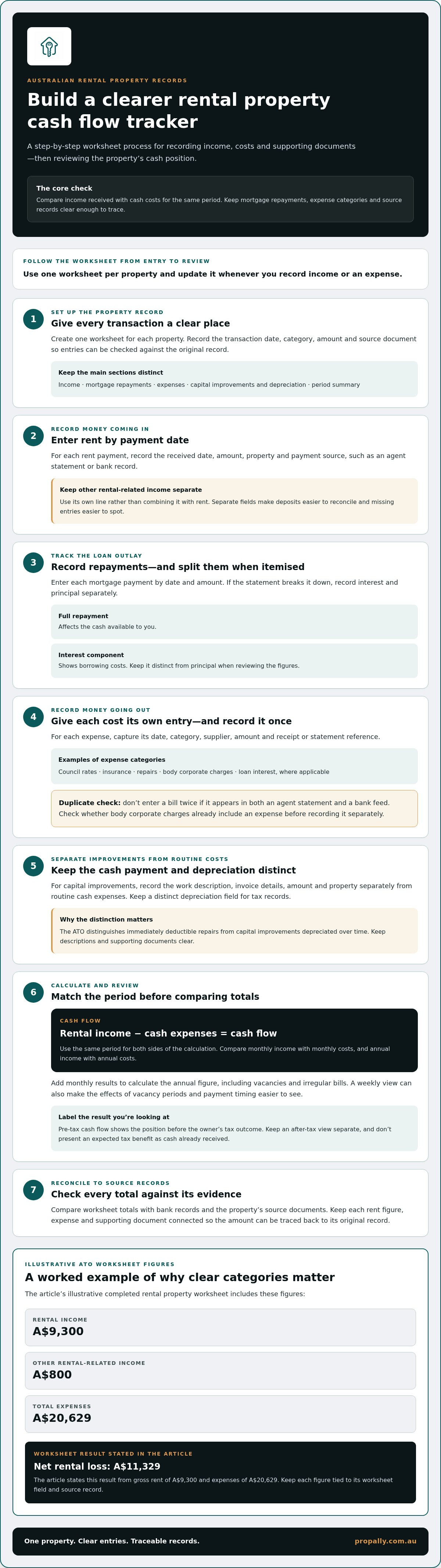
Create one worksheet per property, recording each transaction’s date, category, amount and source document. Keep rental income, mortgage payments and other cash expenses separate so you can review the cash-flow picture clearly.
For depreciation and capital improvements, record the cash payment separately from any depreciation entry. The ATO distinguishes immediately deductible repairs from capital improvements depreciated over time, so keep descriptions and supporting documents clear.
Rental income and related income
Enter each rent payment with its received date, amount, property and source, such as an agent statement or bank record. Add a separate line for other rental-related income rather than combining it with rent. The ATO’s illustrative completed rental property worksheet lists A$9,300 in rental income and A$800 in other rental-related income. These separate fields help property investors reconcile deposits and spot missing entries.
Mortgage repayments and cash flow
Record each mortgage payment by date and amount. Where the statement provides a breakdown, keep the interest component separate from principal repayments. The full repayment affects cash available to you, while the interest figure shows borrowing costs. Compare total rent received with repayments and other costs for the same period to see the property’s cash position without confusing loan movements with rental income.
Rental expenses and cash flow
Give every expense its own category and transaction date. Include items such as council rates, insurance, repairs, body corporate charges and loan interest when they apply. Add the supplier, amount and receipt or statement reference. Avoid entering one bill twice if it appears in both an agent statement and a bank feed. The ATO’s illustrative worksheet records total expenses of A$20,629, showing why clear categories matter when reviewing the annual result.
Depreciation and capital improvements
Record capital improvements separately from routine cash expenses. Note the work, invoice date, amount and property, then keep a distinct depreciation field for tax records. This captures the cash paid without treating an improvement as an ordinary repair in your worksheet.
Use this blank structure for each property, updating it whenever you record income or an expense:
- Income: received date, rental income, other rental-related income and payment source.
- Mortgage: repayment date, total payment, interest and principal amounts where itemised.
- Expenses: date, category, payee, amount and document reference.
- Capital and depreciation: work description, invoice details and separate depreciation entry.
- Period summary: total income, cash expenses and resulting cash flow.
As a final check, compare the worksheet totals with bank records and the property’s source documents. The ATO’s illustrative completed rental property worksheet calculates a net rental loss of $11,329 from gross rent of $9,300 and expenses of $20,629. Keep each figure traceable to its original record.
What is Property Cash Flow?
Property cash flow is rental income minus the cash costs of holding a property. Calculate it by month and year to see how rent, loan payments and operating expenses affect your property portfolio.
Monthly and annual cash flow
For each month, subtract cash expenses from rent and other income received. Add the monthly results to calculate the annual figure, including periods with vacancies or irregular bills.
Compare like periods: monthly income with monthly costs, and annual income with annual costs. This makes changes in management charges, repairs or interest easier to identify across a portfolio.
Pre-tax and after-tax cash flow
Pre-tax cash flow is the income left after deducting cash expenses related to the investment. It shows the property’s position before applying the owner’s tax outcome. An after-tax view adds the tax effect using the investor’s relevant tax information. Keep the figures separate: an expected tax benefit does not reduce a mortgage payment or invoice.
Label each result and period clearly. Don’t present a tax estimate as cash already received.
Net rent and total outlay
Start with gross rent, then subtract vacancy and costs linked to collecting or maintaining that income. The remainder is net rent before financing. Compare net rent with total outgoings, including mortgage payments and property expenses, to see whether the property generates a surplus or shortfall.
Property management also affects the calculation.
Total expenses calculation
Add each cash expense once for the chosen period. Include loan interest, management charges and other property costs recorded for that period. The ATO’s illustrative completed rental property worksheet shows total expenses of A$20,629, illustrating how separate expense categories contribute to an overall total. Use the same period for income and expenses before comparing results.
For loans with fixed and variable splits, record each split separately. Use the statements to capture interest and repayment amounts for each portion, then total them for the property. This helps you compare changing variable interest with fixed repayments without blending the components. Keep actual repayments distinct from interest when calculating total outgoings and reviewing cash flow.
Keeping investment property records organised for tax time
Link each rent figure, expense and supporting document in the property record. Update your spreadsheet throughout the year so tax-time totals don’t depend on reconstructing transactions from memory.
Rental income is generally included in Australian tax reporting, while eligible expenses may be deductible under ATO rules. The ATO distinguishes immediately deductible repairs from capital improvements depreciated over time, so classify and document each cost carefully.
ATO rules shape cash flow tracking because tax treatment can differ from cash paid. Record the amount, date, property and source document for each transaction, then keep tax categories distinct from cash-flow totals.
Organising property records
Create a consistent folder structure for each property, with separate records for rent, loan statements, invoices and receipts. Name documents with the property and transaction date, then use the same labels in your spreadsheet. This makes it easier to match an entry to its source and find missing paperwork. Keep supporting records alongside the figures in your spreadsheet.
Record transactions as they occur instead of rebuilding the year-end record from bank statements. A maintenance invoice, for example, should describe the work and identify the property. Label the payment as a repair, improvement or another expense type, then retain the invoice with the entry.
Cash flow projections
Use actual records as the baseline for estimating future cash flow. Separate regular rent and loan payments from irregular costs such as repairs, and note the assumptions behind each projection. A rent change or new mortgage rate can alter the forecast, so revise the relevant line rather than replacing the entire spreadsheet.
Keep projected cash flow separate from tax deductions and investment returns. A forecast helps assess likely income and outgoings, but it doesn’t establish the tax treatment of a future expense. Record purchase costs such as a deposit separately from recurring property cash flow, so the initial acquisition doesn’t distort operating results.
Tracking multiple properties
Give each property a unique name or reference across spreadsheets, folders and supporting records. Track income and expenses by property first, then combine totals for the portfolio. This shows which property is driving a surplus or shortfall without mixing transactions.
For an investment team, use consistent categories and clear document names when sharing records. Assign responsibility for entering rent, mortgage data or invoices, then review entries against source statements. A shared process helps an accountant or adviser trace each amount to its property and supporting record.
Before preparing tax records, reconcile each property’s spreadsheet against bank and agent statements. Check that every deposit relates to the right property and period, and that expenses haven’t been entered twice. Keep body corporate charges distinct: expenditure already included in those fees cannot be claimed again as a rental expense.
Weekly rental property cash flow
A weekly view connects rent received with the costs reducing available cash. It helps Australian landlords spot timing gaps that monthly or annual totals can smooth over.
Start with rent actually received for the week, not just the amount on the lease. A calculator guide uses A$390 per week as an example rental income input. If a granny flat adds A$50 per week, record it as a separate income line. That keeps the main dwelling’s rent distinct and makes changes easier to track.
Next, subtract the costs paid during that week. For less frequent bills, record the payment when it leaves the account, then set aside a consistent weekly allowance in a separate planning column. Council rates, insurance and maintenance can create uneven outgoings. Showing actual cash movements separately from planned allowances prevents a large bill from disappearing inside an annual average.
- Rent: record the received amount, date and property.
- Mortgage: enter the actual repayment and payment date.
- Operating costs: record invoices, council charges and repairs against their source documents.
- Weekly result: subtract cash paid from income received, then compare it with the planned allowance.
For a practical routine, update the tracker when rent or a bill arrives. Save agent statements and invoices in the property’s records, then match each figure to its source. If a tenant pays late or a repair is paid outside the usual cycle, the weekly view shows which period changes. Keep the transaction date visible rather than shifting it to make weeks appear even.
Record depreciation in a separate non-cash field, not among weekly payments. It can affect tax calculations, but it isn’t money leaving the bank that week. Record a capital improvement with its invoice and date, then keep depreciation details separate from cash expenses. This lets the weekly total show available cash without confusing tax treatment with actual outgoings.
Review the weekly result alongside the property’s longer-period totals. A council bill may create a sharp outflow in one week, while the wider record shows whether income covers costs across the year. Preserve actual payment dates, track recurring allowances separately and keep weekly entries traceable to a statement, invoice or receipt.
What rental income and expenses should an Australian property cash flow tracker include?
Track each income stream and cost against the property, payment date and supporting record. Separate cash movements from tax categories so the tracker shows operating cash flow as well as information for tax reporting.
Start with rent received, recording the amount and the period it covers. Add other rental-related income in a separate field, then reconcile both against agent statements and bank deposits. This helps identify timing differences, missed payments and rent changes without blending different income sources.
Record recurring holding costs and one-off expenses separately. Common recurring costs include council rates, water, insurance, property management and loan interest. For context, property management fees in Australia generally cost 7-10% of gross rent plus GST. Enter the actual charge from the statement, rather than relying on a percentage estimate.
- Rental income: rent received, payment date, rental period and source record.
- Other income: rental-related receipts kept apart from ordinary rent.
- Finance: loan interest and repayments recorded as distinct cash-flow fields.
- Property costs: rates, water, insurance, management charges and maintenance.
- One-off items: repairs, professional services and improvement work, each with its invoice.
Build maintenance into the tracker as both actual spending and a budget line. A common Australian budgeting approach allows 5-8% of annual rental income for maintenance. For a property earning A$24,000 annually, that suggests a planning allowance of A$1,200 to A$1,920 per year. Keep the allowance separate from paid invoices, so forecasts don’t inflate recorded expenses.
Insurance also deserves its own category. Typical Australian building and landlord insurance costs are estimated at A$1,000 to A$1,500 annually. Record the premium from the policy documents and note its coverage period. This makes it easier to compare actual outgoings with the budget when the renewal falls due.
Use a clear category for each transaction and keep its source document. The ATO distinguishes immediately deductible repairs from capital improvements depreciated over time. Work descriptions and invoices help preserve that distinction. Don’t treat a tracker’s cash total as a tax decision: it records amounts and documents for review.
For multiple properties, use the same categories for each address, then compare property-level totals. This helps prevent a repair or council bill from being assigned to the wrong property. A monthly review can flag uncategorised entries, duplicates and costs missing supporting documents before year-end.
Bring rental income and expenses into one organised property view with a rental property cash flow dashboard.
PropAlly: Starter Plan
PropAlly brings rental cash flow, tax records, compliance tasks and bond evidence into one dashboard for Australian investors. Its Starter Plan helps organise property information, while the Business Plan supports broader portfolio tracking. The platform can read agent statements and inbox documents, consolidating information across properties and states for a single view of recorded activity.
Use PropAlly when separate spreadsheets, statements and property records make income and outgoings harder to track. It provides state-specific compliance checklists, bond authority workflows and ATO-aligned tax calculations. These tools organise information; they don’t replace financial or tax advice.
Visit propally.com.au to explore PropAlly’s property tracking options.
Make your next property decision with a clearer view
A reliable cash-flow routine gives your decisions a stronger footing. Use your records to test how changes in rent, financing or property costs could affect available cash, and note the assumptions behind each estimate. This forward view can help you prepare questions before reviewing a purchase, refinancing option or portfolio change.
Choose a rental property cash flow tracker in Australia that connects property figures with supporting records, so updates are easy to follow. PropAlly provides a central dashboard for rental cash flow and related records, offering Australian investors a practical step beyond scattered files.
Explore how it could fit your tracking process, or contact PropAlly about property cash flow. Start with the view you need most, then build a clear, consistent process around it.
Frequently Asked Questions
Is there a tool that automates tracking?
Yes. A rental property cash flow tracker in Australia can automate parts of record capture and organisation. PropAlly can read agent statements and inbox documents, then consolidate property information in its dashboard. Automation can reduce manual entry, but review extracted transactions against original statements before relying on the totals. Keep a clear process for correcting misclassified items, especially when a document covers multiple properties or expense types.
What are the biggest hidden costs?
Landlords often overlook costs because of irregular timing, not unfamiliar categories. A vacancy can interrupt rent while mortgage payments and fixed bills continue. A repair may coincide with an insurance renewal or council charge, creating a larger outflow in one period. Record invoices when paid and keep a separate forecast for future work. This helps distinguish an unexpected bill from a cost already budgeted.
What is the best property tracker app in Australia?
There’s no single best tracker for every Australian landlord; the right fit depends on your property count and record-keeping needs. Check whether a tool separates properties, organises source documents and presents cash flow clearly. PropAlly’s property-investor dashboard has Starter, Pro and Business plans. Compare the features with your workflow, especially if you need to consolidate records across states.
What is rental property cash flow and how do you calculate it in Australia?
Rental property cash flow is the money left after comparing property income with cash outgoings for the same period. Group deposits and paid costs by property, then compare monthly results with the annual position. Keep cash flow separate from taxable income: depreciation can affect tax calculations without being a payment made during that period. Label any tax estimate separately from actual bank movements.
What Australian rental property cash flow spreadsheet templates are available?
Spreadsheet formats vary, so choose one that records transactions by property, date, category and supporting document. Useful additions include reconciliation status, payment period and a notes field for shared bills or adjustments. Create a worksheet for each property, then add a portfolio overview that combines the totals. This supports comparisons without losing the detail needed to trace an entry to its source.
What are the best rental property cash flow tracking apps in Australia and how much do they cost?
Compare tools by property limits, document-processing capacity and the records they bring together, rather than by price alone. Costs vary by provider and plan. PropAlly’s subscription tiers are based on the number of properties, with optional email document add-ons priced by processing volume. Review the current plan details in Australian dollars, including bundled features, before choosing an option for your portfolio.
How should an Australian landlord track mortgage interest, repayments and loan fees?
Use lender statements to match each repayment to its date and loan account. Keep the total cash repayment separate from the interest component, and record loan fees as their own transactions with a statement or invoice reference. If the property has multiple loan splits, maintain a separate line for each. This makes reconciliation clearer and gives you a traceable source for each borrowing cost in your tax records.
How do vacancy, repairs, strata fees, council rates and insurance affect rental property cash flow?
Vacancy reduces rent received, while repairs, strata charges, council rates and insurance add outgoings. Timing matters: a vacant period can coincide with a major repair or annual bill, putting more pressure on available cash than a yearly average suggests. Record each item against the property and payment date, then compare actual spending with your forecast. Separate strata charges from included expenditure to avoid recording the same cost twice.