
For Australian property investors, property investment tax preparation software can organise rental income, expenses and supporting records in one workflow. The Australian Taxation Office says rental-property tax records should be kept for at least five years. Software helps prepare the information, but it doesn’t make every expense deductible.
The details matter. Apportion expenses when a property is partly used privately, and separate loan interest from private borrowing. Repairs that restore an item to its original condition are treated differently from improvements, which are capital expenses claimed over time. Keeping these decisions and their evidence together makes tax preparation more organised and easier to review.
This guide explains how software can help track Australian rental income, apportion expenses, distinguish repairs from improvements and organise records. It also covers where careful categorisation matters, what information to retain and how a central property dashboard can support a clearer view across multiple rentals. The focus is practical: better organised records, with Australian tax treatment kept in view.
Key Takeaways
- Apportion rental expenses when a property is partly used privately, rented for only part of the year or only partly available to tenants.
- Keep repairs that restore an item separate from improvements, which are capital expenses claimed over time.
- Track rental income, expenses and supporting documents in one organised system to make tax preparation easier.
- According to the Australian Taxation Office, the current Australian CGT discount is 50% for assets held over 12 months.
- Plant and equipment assets are covered by Division 40, according to the Federal Register of Legislation.
1. Apportioning expenses for private or partial use
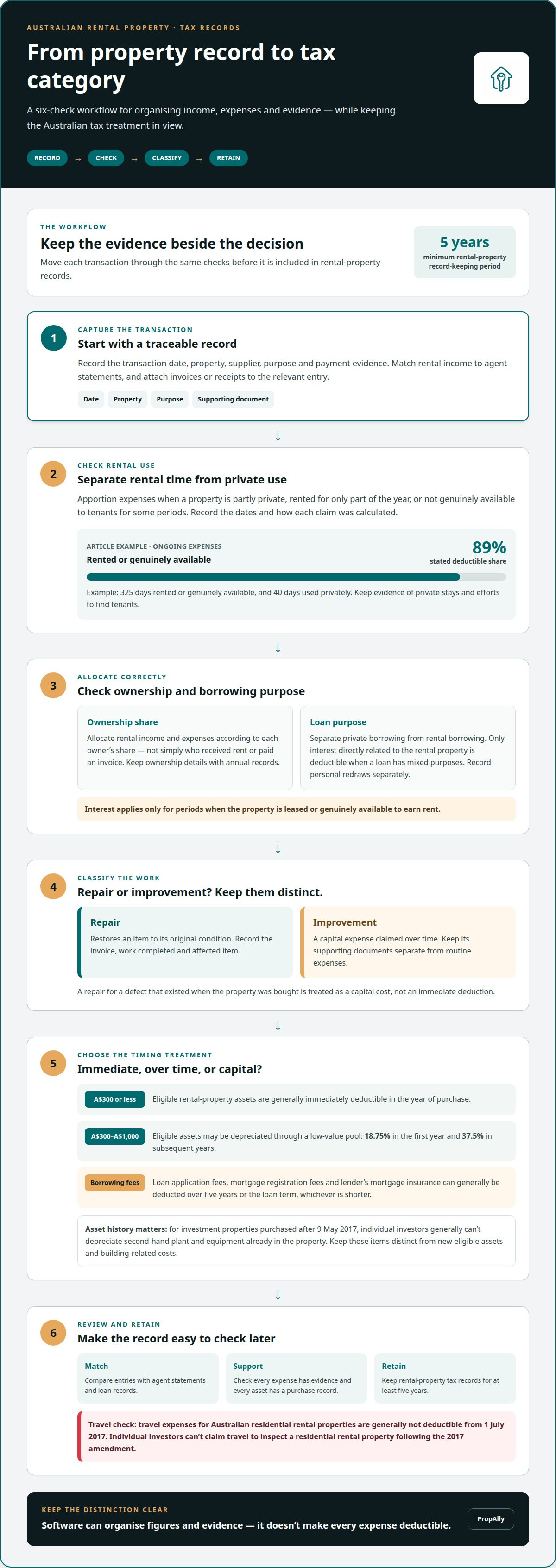
Separate rental use from personal use before recording expenses for an Australian rental property. Don’t include costs relating to private use, non-income-generating use or periods when the property wasn’t genuinely available for rent as rental deductions. Record the dates and how you calculated each claim.
For example, a residential property rented or genuinely available for rent for 325 days and used privately for 40 days has a stated deductible share of ongoing expenses of 89%. Apply the relevant rental-use proportion to ongoing costs, then retain evidence of private stays and efforts to find tenants. Dates matter.
Ownership share matters too. Report rental income and expenses according to each owner’s share, not simply who received the rent or paid an invoice. For a jointly owned property, keep ownership details with the annual records, then allocate income and each expense consistently to the owners’ respective shares.
Separate loan purposes before working out interest. If a loan was partly used for private purposes, only the interest directly related to the rental property is deductible. Record any redraw used for personal spending separately from rental borrowing. Claim interest only for periods when the property was leased or genuinely available to earn rent.
Borrowing expenses follow a different timing rule from ordinary interest. Loan application fees, mortgage registration fees and lender’s mortgage insurance can generally be deducted over five years or the loan term, whichever is shorter. Keep lender statements and fee records together, and track the eligible amount across the relevant period.
Travel needs particular care. Travel expenses for Australian residential rental properties are generally not deductible from 1 July 2017. Individual investors can’t claim travel to inspect a residential rental property following the 2017 amendment. Don’t enter inspection trips as rental expenses; keep property-related records separate from travel costs.
Organise evidence as transactions occur. Match rental income to agent statements, and retain records of bond returns, insurance payouts, letting fees and booking fees. Attach invoices and receipts to the relevant expense entries. If a surveyor assesses property-related work, file the report with the supporting invoice and details of the work.
The risk of using tax software without a registered tax agent is that incorrect or incomplete inputs can produce an incorrect return. Software can organise figures, but it may not resolve complex facts such as mixed-purpose borrowing, private use or a change in ownership share.
Keep sale records separate from annual rental claims. According to the Australian Taxation Office, the current Australian CGT discount is 50% for assets held over 12 months. Purchase and ownership documents can help establish the property’s history when it’s sold, so retain them alongside relevant income-year records.
3. Investment property deduction tracking
Track each property deduction from its original document to its tax category. Record the transaction date, property, supplier, purpose and payment evidence. Then mark whether the amount is immediately deductible, claimed over time or treated as a capital cost. This makes it easier to distinguish an expense from an asset or acquisition cost.
The purchase price and acquisition costs of an Australian investment property aren’t immediately tax-deductible. Some costs may instead be relevant to the capital gains tax calculation when you sell. Keep purchase contracts and settlement records with ownership documents so the amounts can be traced later. A repair for a defect that existed when you bought the property is also treated as a capital cost, not an immediate deduction.
Household assets can be missed when invoices are filed under general maintenance. Record each eligible item separately, including its cost and purchase date. Eligible rental-property assets costing A$300 or less are generally immediately deductible in the year of purchase. Eligible assets costing between A$300 and A$1,000 may be depreciated through a low-value pool, at 18.75% in the first year and 37.5% in subsequent years.
Depreciation needs a clear asset history. For investment properties purchased after 9 May 2017, individual investors generally can’t depreciate second-hand plant and equipment already in the property. List those items separately from new eligible assets and building-related costs. A depreciation schedule can organise eligible deductions over time, but retain the underlying documents that support its figures.
Separate repairs from improvements before classifying a payment. A repair restores an item to its original condition; an improvement is a capital expense claimed over time. Record the invoice, work completed and affected property item. This evidence helps explain why the cost was categorised as a repair or treated as capital, rather than grouped with routine expenses.
Below-market rent can affect the deductions you claim. If you rent an investment property to family members at half the market rental rate, you must halve the deductions claimed. Record the rent charged and the basis for the arrangement alongside the expense entries. This links the rental income to the proportion of costs claimed, rather than leaving the calculation unexplained.
Review the ledger before preparing the return. Check that each expense has a supporting document, each asset has a purchase record, and capital costs haven’t been treated as immediate deductions. Compare the entries with agent statements and loan records. A consistent property-by-property trail helps identify gaps, correct categories and preserve the reason for each deduction.
4. Record-keeping requirements
Keep a clear record trail for every Australian rental property. The Australian Taxation Office says to retain rental-property tax records for at least five years. Store receipts, invoices and statements with the related transaction so each claimed amount has supporting evidence. A bank statement may show payment, while an invoice explains what it covered. Property investment tax preparation software can help link documents to the entries they support.
Use a consistent filing structure. Create a folder for each property, then group records by income year and category. Save agent statements alongside rental income entries, and attach invoices to deductible expenses. Label each document with its date and purpose. This makes it easier to match the property’s records against tax-return figures and spot a missing receipt before preparing the return.
Keep purchase, ownership and sale documents throughout the time you own the property. Retain the purchase contract, settlement records and documents showing ownership changes. When you sell, add sale and transaction records to the same property file. This creates a continuous history from acquisition through annual reporting to disposal, without gaps between tax years.
Digital systems can make this process easier to maintain. Australian investors can use a spreadsheet or professional software as a digital record-keeping system. A spreadsheet may suit a simple portfolio if entries and documents remain organised. For a larger portfolio, property investment tax preparation software can help group transactions and records by property, provided the information stays accessible and complete.
Australian tax software differs in its rental deduction categories, reports and accountant-access options. Compare how each system handles property-level income and expenses, whether it produces usable reports, and how records can be shared with an accountant. The key question is whether it supports your workflow, not how long its feature list is.
Import functions vary too. Some tools support bank transaction feeds or uploaded property-manager statements, while access to ATO data depends on the software’s integrations and permissions. Review imported entries and correct categories where needed. A statement may show a payment without explaining its purpose, so retain the invoice or supporting record that provides context.
Keep depreciation records linked to the relevant asset. File the depreciation schedule with purchase and construction documents, then preserve updated schedules and supporting records for each income year. Clearly mark the eligible portion of a cost when only part relates to earning rental income. This helps distinguish annual claims from capital amounts and supports consistent reporting.
Before preparing a return, reconcile records property by property. Match rental statements to recorded income, compare expense entries with invoices and identify missing documents. Note unresolved items for review instead of assigning an unsupported category. Complete statements, receipts and ownership records provide a more reliable basis for preparing the reported figures.
5. Australian property income and deductions
Start with the income actually earned from the property. Report Australian rental income when it’s paid, including the full rent tenants pay to an agent. Agent fees deducted before the balance reaches your account don’t reduce the rent you report. Keep the agent’s statement beside your income entry, then record the fees separately as expenses.
Software can show whether each property produces a rental loss or surplus by organising income and expense entries and presenting the result for review. With multiple properties, separate transactions by property before viewing the combined portfolio. Negative gearing describes rental expenses exceeding rental income. Software can track that result, but accurate classification and applicable tax rules determine how it’s reported.
Split loan repayments clearly. The principal portion of an investment property loan repayment isn’t deductible; only the interest portion may be deductible. Where a loan has private and investment purposes, link the interest claimed to its investment use. Keep loan statements and repayment records together instead of treating the full repayment as an expense.
Also exclude costs paid by tenants. A landlord can’t claim tenant-paid expenses, such as water bills or repairs, as rental deductions. Record who paid each bill and retain the invoice or property-manager statement. For phone and internet costs, keep evidence showing the portion specifically attributable to managing the rental property.
Building costs and equipment follow different deduction pathways. Australian investment property plant and equipment assets are covered by Division 40, according to the Federal Register of Legislation. Australian property investors may claim capital works deductions under Division 43 for eligible building construction, extensions, alterations, structural improvements and major renovations, according to the Federal Register of Legislation.
Eligible residential buildings whose construction started after 15 September 1987 can generally qualify for capital works deductions at 2.5% per year for up to 40 years. Keep construction records and relevant reports with the property file. These documents help distinguish structural costs from equipment purchases and support the basis for the deduction claimed.
Rental expenses must relate to earning rental income. Personal-use costs and expenses for non-income-generating properties aren’t deductible. For a holiday home, rental deductions apply only when it’s advertised and available for rent or rented out. Record availability periods and private use so claims reflect how the property was actually used.
Good categorisation makes cash-flow reports more useful. Separate rent, agent charges, loan interest, repairs, capital works and equipment, then compare entries with receipts and statements before preparing the return. Software can organise the figures, but each deduction still needs the right category, purpose and supporting evidence.
5. What tax preparation software in Australia supports residential property investment income and expenses?
Australian investors can use a spreadsheet, accounting software or a property-focused platform to organise rental records. The right fit depends on the number of properties, how income arrives and how much supporting evidence needs filing. First, check whether you can keep income and expenses separate for each property instead of combining everything into one portfolio total.
For a single rental, a spreadsheet may be enough to record rent, agent charges, interest and other costs. Add columns for the transaction date, category, property and document reference. For example, match each quarterly property-manager statement to recorded rent, then list management fees separately. This creates a simple trail for reviewing the annual tax return.
With multiple properties, useful software should make it easy to filter transactions by property and income year. Check whether reports show rental income, expenses and net cash flow separately. If you own rentals across different Australian states, state-specific records can help keep property information distinct. Don’t rely on a portfolio-wide figure when an expense or receipt relates to just one property.
Assess how documents enter the system. Some tools let you upload statements and receipts; others may support transaction imports or document reading. Check that imported entries can be reviewed, corrected and assigned to the right property. A bank transaction labelled as a payment may not explain its purpose, so retain the invoice or statement that provides context.
Consider the tax-preparation handover too. Look for reports that group transactions into understandable categories and let you export or share records with an accountant. Check whether the software distinguishes interest from principal, repairs from capital costs, and rental use from private use. These distinctions affect the figures presented, even when a platform helps organise the supporting information.
Before choosing, test a sample workflow with a rent statement, an invoice and a loan statement. Enter each item, attach its document, assign the property, then generate a report. Confirm that the report preserves the original records and makes corrections traceable. This practical test shows whether the software suits your routine better than a spreadsheet alone.
For Australian investors managing several rentals, a property-focused dashboard can bring statements and property records into one view. Use a system that helps organise rental information by property, then review each tax category before preparing figures. Organise your Australian rental property records in a central dashboard.
Retain evidence for bond returns, insurance payouts, letting fees and booking fees. The Australian Taxation Office’s investor toolkit covers investment income from property, shares and crypto assets.
PropAlly: Starter Plan
PropAlly brings rental property information into a dashboard for tracking cash flow, tax, compliance and bond evidence. It can automatically read statements from agents and inboxes, consolidating information across properties and Australian states. This gives investors a more organised view of rental activity and its supporting documents.
PropAlly’s Starter Plan helps investors organise property records, while the Business Plan supports larger portfolios. State-specific compliance checklists, bond authority workflows and ATO-aligned tax calculations help keep key property information together. The platform organises records; it doesn’t replace tax advice or determine whether an expense is deductible.
To bring rental property information into one place, visit propally.com.au and explore PropAlly.
Make your next tax cycle easier to manage
Set up a property record routine that works between tax returns, not just at year end. Choose a consistent way to capture transactions, file supporting documents and review entries as your portfolio changes. Property investment tax preparation software is useful only when its records reflect what happened and remain easy to follow.
Start with a practical step: decide where new property documents will go and how you’ll label them. Make that process part of your regular admin. A clear system can help you approach future reporting with greater control, while keeping tax decisions grounded in the facts of each property.
For a central workspace to organise your Australian rental property information, explore PropAlly’s property dashboard. Take the next step towards a more manageable property record routine.
Frequently Asked Questions
Which Australian tax software handles rental property depreciation schedules and capital works deductions?
PropAlly’s PropertyTax module supports these records by importing depreciation-schedule PDFs and extracting information, while tracking ATO-categorised Division 40 and Division 43 expenses. For example, an investor can upload an existing schedule and organise equipment and building-related figures for review. The tool helps manage the records; the schedule itself and the eligibility of each deduction still depend on the property’s supporting documents and circumstances.
How much do Australian tax software plans for property investors cost?
Plan costs depend on the number of properties tracked and the document-processing volume required. PropAlly offers Free, Starter, Pro and Business plans, with optional email document add-ons. The price depends on the case and is provided after a quote request, with the relevant factors including portfolio size, plan requirements and document-processing needs. Compare what each plan includes against the way you manage property records.
Which ATO rules apply to rental property income and deductible expenses in Australia?
Australian investors report rental income when it’s paid, including the full rent received by an agent before fees are deducted. Report income and expenses according to your ownership share, and claim only costs connected with earning rental income. For example, separate agent fees from rent in your records, then distinguish investment-related loan interest from any private-use portion. Software can organise these figures, but it doesn’t make an ineligible expense deductible.