
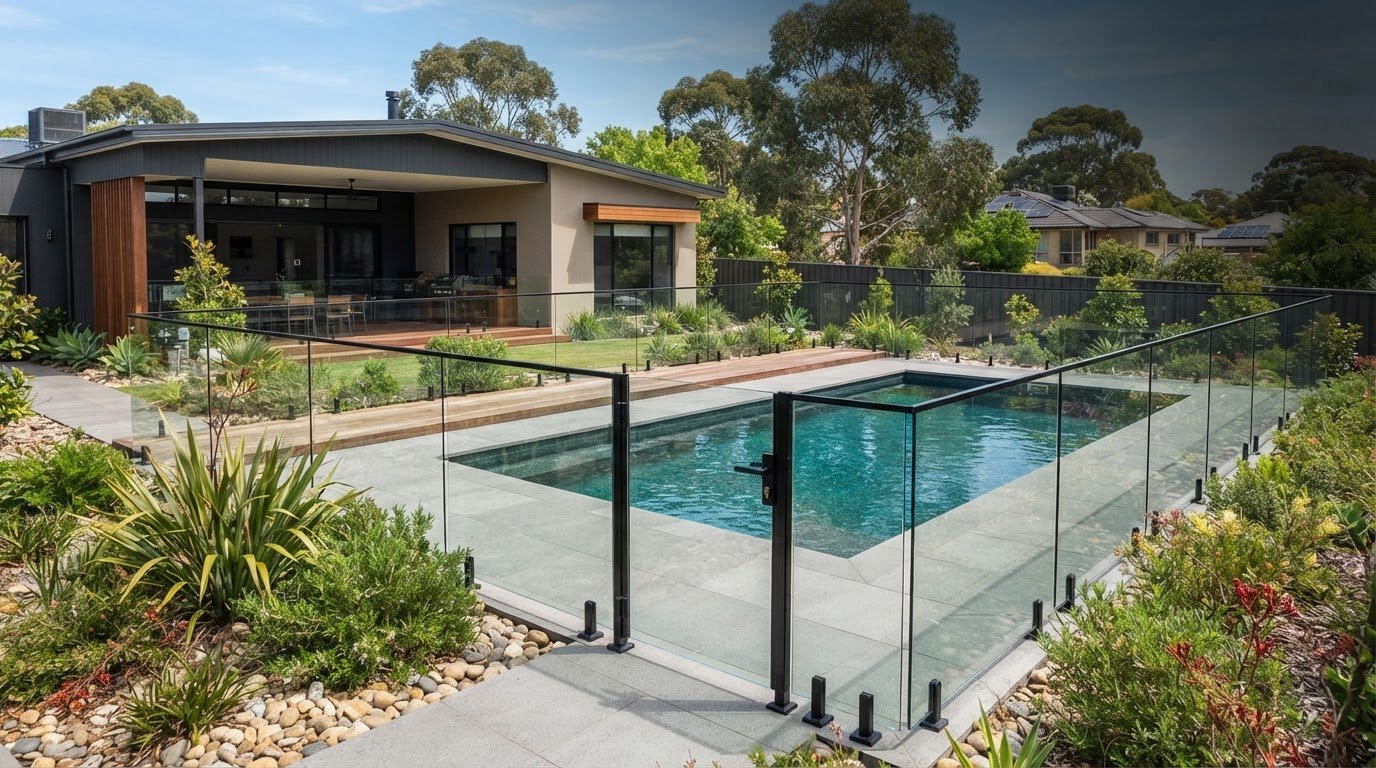
A compliant pool barrier is generally at least 1.2 metres high, with a non-climbable zone and a gate that closes and latches by itself. But the exact rules can depend on the state, the pool’s age and the barrier’s layout. An Australia-wide pool fencing compliance tracker helps organise those details, but it doesn’t replace the rules that apply to your property.
It’s easy to focus on fence panels and miss small gaps, nearby climbable objects or a gate that doesn’t latch properly. These details matter. This guide covers key checks, including common gap and gate requirements, non-climbable zones, South Australian rules and the safety standard for portable swimming pools.
A single national checklist can’t cover every pool. Requirements vary across Australia, and the applicable standard may depend on when the pool was built and which rules apply in your state or territory. Use the checks below to identify what matters and keep your pool compliance records organised.
Key Takeaways
- Test that the gate closes and latches on its own, and swings away from the pool.
- In South Australia, the rules that applied when the construction application was made matter for pools built after July 1993.
- Keep the non-climbable zone clear of objects and plants that could help someone climb over the barrier.
- Portable pools are covered by the Consumer Goods (Portable Swimming Pools) Safety Standard 2013, according to the Australian Competition and Consumer Commission.
- For a rental property portfolio, PropAlly can help organise state-specific compliance information and records in one dashboard.
WHAT IS A COMPLIANT POOL FENCE OR SAFETY BARRIER?
A compliant pool barrier restricts access to the water and meets the rules that apply to the property. In Australia, the required standard can depend on the state, the pool’s age and approval date, and the barrier layout.
Barrier height and climb-resistant areas
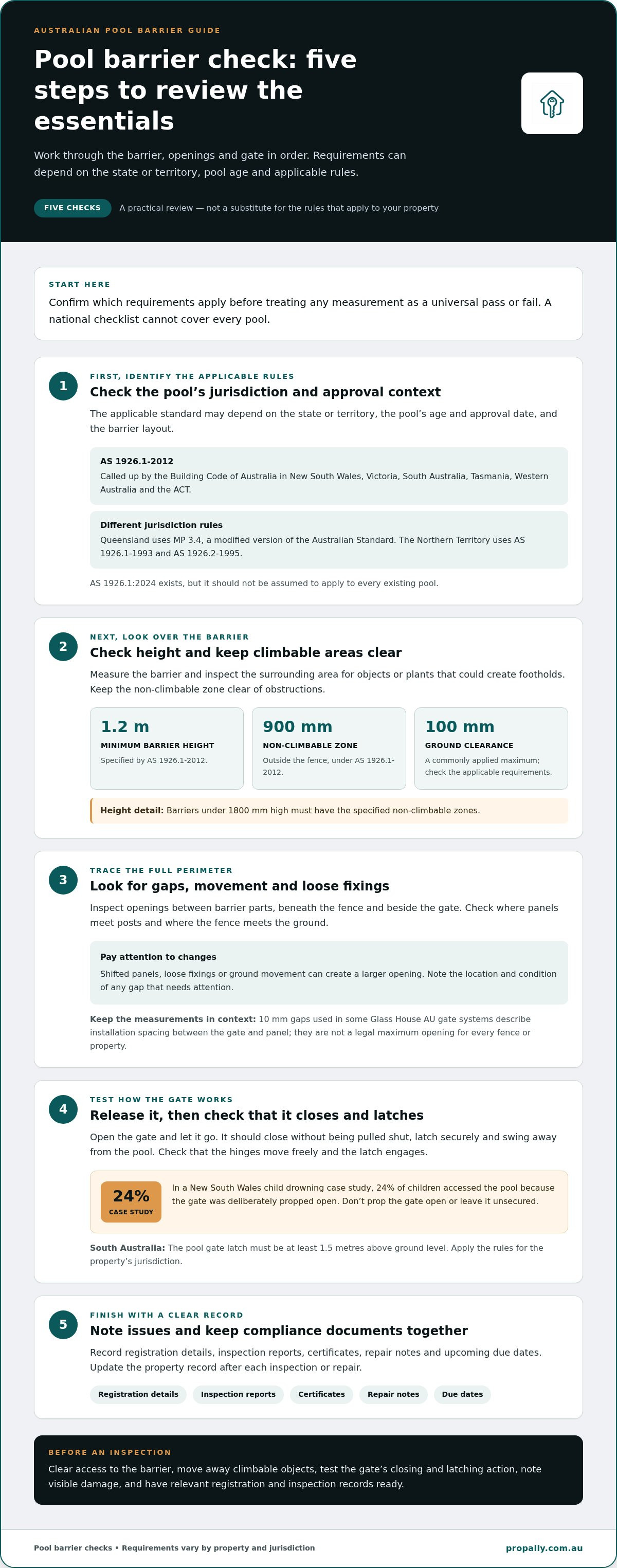
A pool barrier is the fence or other compliant structure that separates a pool from accessible areas. AS1926.1-2012 specifies a minimum barrier height of 1.2 metres and a 900 mm non-climbable zone outside the fence. A commonly applied maximum ground clearance is 100 mm. Barriers under 1800 mm high must have the specified non-climbable zones. Keep nearby objects and plants from creating footholds, and maintain the zone without obstructions.
National and state barrier standards
Pool barrier standards set the design and safety requirements that apply to a pool. AS 1926.1:2024 exists, but it should not be assumed to apply to every existing pool. AS1926-2012 is called up by the Building Code of Australia in New South Wales, Victoria, South Australia, Tasmania, Western Australia and the ACT. Queensland uses MP 3.4, a modified version of the Australian Standard. The Northern Territory uses AS 1926.1 - 1993 and AS 1926.2 - 1995. Check the pool’s approval date and jurisdiction when identifying its applicable requirements.
State registration and barrier inspections
Registration records a pool with the relevant state or local authority; an inspection assesses its barrier against applicable requirements. In Victoria, owners must register pools with their council and arrange mandatory barrier inspections and compliance certificates. Owners generally need a new certificate every four years. Queensland pools and spas must be fenced and registered on the pool safety register. Penalties vary by jurisdiction: Queensland pool owners can be fined up to A$2,356 if their pool is not registered.
Barrier design, construction and maintenance
Barrier design, construction and maintenance cover how the safety barrier is planned, built and kept effective. The pool layout, boundary, gate position and nearby structures all affect whether the barrier restricts access. In Victoria, pool and barrier design, construction and installation are subject to the Building Regulations 2018. Owners and occupants must maintain barriers in working order; damage or changes around the pool can affect compliance.
How much do inspections, certificates and repairs cost? Costs depend on the location, inspection scope, barrier materials and repairs required. Prices are provided after a quote request.
How can owners track inspections, repairs and deadlines? Keep a property record with registration details, inspection reports, certificates, repair notes and upcoming due dates. Update it after every inspection or repair.
How should owners prepare for an inspection? Clear access to the barrier, move away climbable objects, test the gate’s closing and latching action, and note any visible damage. Have relevant registration and inspection records ready.
Fence gaps and gate latching requirements
Small openings and a gate that won’t close can undermine a pool barrier. Check gaps and gate operation separately as part of your pool-area review.
Fence gaps and gate clearances
Fence gaps are openings between barrier components, beneath the fence or beside the gate. Check each opening along the barrier, including where panels meet posts and where the fence meets the ground. A commonly applied maximum ground clearance is 100 mm, but the relevant requirements depend on the pool and jurisdiction.
Don’t treat a product installation gap as the legal limit. For example, 10 mm gaps used in some Glass House AU gate systems describe installation spacing between the gate and panel, not a maximum opening permitted by law. The distinction matters: a fitting dimension doesn’t establish compliance for every fence system or property.
Look for changes that could create a larger opening, such as shifted panels, loose fixings or ground movement. Note the location and condition of any gap needing attention. Inspect the barrier from end to end so you don’t miss a small opening beside a post or gate.
Self-closing and self-latching gates
A self-closing, self-latching gate closes without being pulled shut and secures itself when closed. Australian pool gates must be self-closing and self-latching, and swing away from the pool. These features help keep the barrier closed after someone passes through.
Test the gate’s closing and latching action rather than relying on its appearance. Open it, release it, and check that it closes and latches properly. Repeat the test if you notice a change in movement or alignment. A gate that stops short or fails to latch leaves an access point into the pool area.
The risk is practical, not just technical. In a New South Wales child drowning case study, 24% of children accessed the pool because the gate was deliberately propped open. Don’t prop the gate open for convenience, and make sure household routines don’t leave it unsecured.
Gate latch and hinge requirements
The latch secures the closed gate, while the hinges allow it to swing and support its closing action. Both must work together: a gate may move smoothly but still fail if the latch doesn’t engage.
South Australian rules require a pool gate latch at least 1.5 metres above ground level. Requirements can differ by state, so apply the rule for the property’s jurisdiction rather than assuming one latch position suits every pool. Check the latch catches securely and the hinges allow the gate to close without obstruction.
AS 1926.1:2024 includes revised marking and design requirements for pool-gate latches and hinges. Don’t assume that this edition applies automatically to every existing pool. Keep a record of observed faults, repairs and subsequent checks, especially if the gate starts dragging or the latch no longer catches.
For rental property owners managing records across properties, organising property compliance records can help keep inspection dates and repair notes together.
South Australian requirements by pool construction date
In South Australia, pool requirements depend partly on when construction was approved. The pool’s age helps identify which rules apply, but the barrier must still meet the relevant safety requirements.
South Australian construction-date rules
A construction-date rule links a pool’s barrier requirements to the rules applying when its construction application was made. For pools built before July 1993, South Australia requires a safety barrier meeting current standards, including fencing at least 1.2 metres high.
For pools built after July 1993, the applicable rules are those that applied when the construction application was made. That makes the approval record a useful starting point when assessing an older swimming pool. Find the construction application details, then compare the pool fence and barrier arrangement with the requirements for that application date.
South Australian pools and spas must have a continuous safety barrier, which the owner is responsible for maintaining. A gap, damaged section or alteration can affect whether the barrier remains compliant. Record repairs and keep relevant construction and inspection documents with the pool’s property records.
Boundary fences and the pool boundary
A boundary-fence barrier uses a property boundary fence as part of the barrier around a pool. Australian pool-boundary barriers are commonly treated as 1800 mm high on the pool side, subject to local requirements and site conditions.
Check the pool-facing side, not just how the fence looks from the neighbouring property. Nearby structures, objects or changes in ground level may affect how the barrier works. Rules depend on the site layout and jurisdiction, so don’t assume a boundary fence is compliant simply because it separates two properties.
Victoria registration and new pools
Registration records a pool with the local council, while an inspection assesses whether its barrier complies. In Victoria, pool and spa owners must register with their council, arrange an inspection and submit a certificate of compliance.
Victoria’s Building Regulations 2018 apply to pool, spa and safety-barrier design, construction and installation. Swimming pools, spas and safety barriers must comply with AS1926.1-2012. These requirements also cover indoor pools and apply whether or not children under five live at or visit the property. Before construction, treat registration, barrier design and inspection as connected parts of the project.
Software for tracking pool compliance
Pool compliance software can help organise construction details, inspection reports, repairs and due dates. Tools differ: some focus on checklists and reminders, while property dashboards can keep compliance information alongside records for multiple properties.
When comparing tools, check whether they support state-specific records, store documents against each property and make upcoming tasks easy to review. Software can organise administration, but it can’t determine which construction-date rules apply to a particular South Australian pool.
Non-climbable zones
A non-climbable zone is the clear area around a pool barrier that limits footholds and handholds. Owners need to keep it free of objects and growth that could make climbing easier.
Fence height and climb-resistant zones
The zone and the barrier height work together to reduce access over the fence. The specified non-climbable zones must be present on barriers less than 1800 mm high. AS 1926.1-2012 specifies a 900 mm non-climbable zone surrounding the outside of the pool fence.
Check the whole zone, not just the fence panels. Walk around the barrier’s outside and look for anything that could provide a step or grip. Changes in ground level can affect the clear space around the fence, so include the ground in every review.
AS 1926.1:2024 provides guidance on positioning objects and plants in non-climbable zones. Its existence does not mean that edition applies to every existing pool. The relevant standard depends on the pool’s circumstances and jurisdiction, so keep the applicable requirements with the property’s records.
Climbable objects near pool fences
A climbable object is an item or feature that could help someone gain height beside or over a barrier. A chair against the outside fence, a pot beside a panel or an overhanging branch can change the climbing conditions around a pool.
Check the whole perimeter, including corners, fence joins and the area beside the gate. Move portable items away from the barrier, and assess fixed features as part of the site layout. Trim or reposition plants where they intrude into the clear zone. Then walk the perimeter again to confirm the route stays unobstructed.
Repeat the review after landscaping, changes to outdoor furniture or work near the fence. For example, rearranging a garden might place a planter beside a previously clear section. Note the change and action taken in the property record so it can be followed up at the next review.
The practical check is simple: identify the required zone, inspect it from end to end, and remove or address anything that could assist climbing. Keep dated notes with the barrier records. In Victoria, pool owners must submit a barrier certificate to their local council by the applicable due date. These records can help organise the wider compliance file.
Non-climbable zones need ongoing attention, not just a one-off review. Add a perimeter check to routine property inspections, especially after changes to the garden, ground or outdoor layout. If an inspection identifies an obstruction, record its location, arrange the appropriate corrective action, and document the follow-up. This creates a clear history for owners and supports consistent oversight of pool barrier conditions over time.
What does a pool fence compliance certificate or inspection report include?
A pool barrier inspection report records an inspector’s findings about the barrier at a property. A compliance certificate documents a formal outcome where required by the relevant state process.
Separate the report from the certificate
A report records inspection findings; a certificate has a formal role in the applicable compliance process. Before filing either document, check its type, property address, inspection date and recorded outcome. In Victoria, owners submit a barrier certificate to their council by the applicable due date, so keep proof of submission with the certificate.
An Australia-wide pool fencing compliance tracker can help organise records by property and jurisdiction. It supports record-keeping, while the documents themselves show the inspection result and any formal compliance status.
What to look for in an inspection record
Read the findings to identify what was assessed, any defects and the required follow-up. For example, a report might note a gate that failed to latch. Record the issue’s location, when it was raised, the repair completed and the subsequent check. Keep relevant repair documents with the report; personal notes aren’t an official certificate.
Match each document to the correct property. A clear address and date help distinguish a current report from older paperwork or records for another pool. An Australian pool fencing compliance tracker can keep inspection records and follow-up tasks together, making each item’s status easier to review.
Organise follow-up and deadlines
A compliance file brings together pool inspection documents and follow-up records. Create a separate property record for each address, especially if you manage rentals across jurisdictions. Include construction details, inspection outcomes, repair history and upcoming due dates to keep everything linked to the right pool.
In Victoria, a barrier deemed non-compliant will be reinspected within 60 days. Record the outcome and follow-up, then attach the subsequent inspection record. Before filing, check that dates and findings are legible and note which tasks remain open. This helps distinguish completed repairs from issues still awaiting attention.
For rental property owners, organising property compliance records in one dashboard can help keep documents and follow-up dates together.
PropAlly: Starter Plan
PropAlly helps Australian property investors organise compliance records alongside cash flow, tax and bond evidence for rental properties. Its dashboard brings property information together and provides state-specific compliance checklists to keep relevant records in view. Use it to organise inspection reports, repair documents and due dates. Pool barrier requirements still depend on the property and jurisdiction.
PropAlly’s plans include Starter and Business options. Choose the plan that suits how you manage property records; the platform supports oversight across properties and states.
To organise your Australian property compliance records, visit propally.com.au.
Make pool compliance part of your property routine
Make pool safety administration a repeatable property task. Set up a clear record for each rental, assign responsibility for follow-ups and keep documents easy to find. A pool fencing compliance tracker for Australian property owners can support this workflow by keeping compliance information linked to the right property.
PropAlly brings property records into one dashboard, helping investors organise compliance information across properties and states. The Starter, Pro and Business plans support broader property record-keeping. The aim is practical: keep administration organised so you can focus on the next task instead of searching through scattered files.
Ready to bring your property records together? Contact PropAlly about pool compliance and take the next step towards a more organised routine. You can build a clearer process one property at a time.
Frequently Asked Questions
What are the current pool fencing laws and safety standards in Australia?
Australian pool fencing rules combine state and territory laws with adopted building standards, so one standard doesn’t automatically govern every existing pool. Requirements can turn on the pool’s construction or approval date, barrier type and site layout. Structures capable of holding water deeper than 300 mm are covered by pool-barrier laws in Australia. Portable pools are also covered by the Consumer Goods (Portable Swimming Pools) Safety Standard 2013, according to the Australian Competition and Consumer Commission.
What pool fence requirements apply in each Australian state and territory?
Requirements vary across jurisdictions. Queensland uses MP 3.4 and requires pools and spas to be registered; NSW applies the Swimming Pools Act 1992 and Australian Standard 1926. Victoria requires registration and barrier certificates. South Australia’s construction-application date helps determine applicable rules. Western Australia has local-government barrier inspections. Tasmania applies Australian Standard 1936.1 and 2, while the Northern Territory uses modified Australian and community safety standards. The ACT has its own building-law certification framework.
How often must a pool fence and safety barrier be inspected in Australia?
There’s no single national inspection interval. In Victoria, owners generally need a new barrier compliance certificate every four years. Western Australian local governments inspect private pool and spa barriers at intervals of no more than four years. According to QBCC, Queensland pool safety certificates are valid for one year for shared pools and two years for non-shared pools. Elsewhere, inspections commonly occur at installation and at sale or lease, with local rules setting the process.
What are common pool fence compliance failures and how can owners prevent them?
Common issues include a gate that fails a closing test, an obstruction beside the barrier or a yard change that affects access. Make checks part of routine property maintenance: test the gate, walk the perimeter, note changes after landscaping or repairs, and record follow-up work. After moving outdoor furniture, for example, recheck the nearby fence section. Keep records for each property so unresolved issues aren’t mistaken for completed repairs.
What pool fencing compliance tracking apps or software are available in Australia, and how do they compare?
PropAlly can organise state-specific compliance information and property records in one dashboard for rental portfolios. The material provides no basis for comparing it with other apps or software.