

The most hands-off option isn’t always the best fit. Cozy property management alternatives in Australia include short-stay management services, traditional property managers, self-management and landlord software. The right choice depends on whether you want someone to manage tenancy tasks, tools to organise the workload, or a combination of both.
Compare more than headline convenience: each option gives you a different level of control and responsibility. This guide explains how the main approaches compare for Australian property owners, including what platform services can help with and what they don’t replace. You’ll see the trade-offs for short-term and long-term rentals, then get a practical way to match an option to your property and preferred level of involvement.
Key Takeaways
- Match the management approach to your rental model: short-stay accommodation and long-term tenancies have different operational needs.
- Compare what a platform service handles with the tasks and decisions that remain yours, including guest communication and property oversight.
- Self-management offers direct control, while a property manager takes on more of the day-to-day tenancy workload.
- Choose landlord software around the records and workflows you need to organise, especially across multiple properties or states.
- PropAlly’s Starter Plan is a next step for Australian investors who want a central place to track property cash flow, tax, compliance and bond evidence.
Platform management services and owner benefits
Platform management services sit between full self-management and traditional property management. For an Australian short-stay rental, a service may coordinate listings, guest messages, bookings, cleaning and check-in. The owner still supplies the property and sets priorities. As the division of work depends on the service agreement, map each task before comparing options.
Start with the rental model. Australian short-term stays can involve frequent guest turnover, while long-term rentals typically run for six to twelve months or more, with different communication and maintenance routines. A short-stay service can organise recurring guest tasks; a long-term manager focuses on tenancy administration. Corporate housing is another model, offering furnished accommodation for professionals staying for a month or longer.
Convenience is useful only when the service matches the property. A short-stay manager can coordinate cleaning between bookings and respond to guest questions. Round-the-clock guest support is worth considering, particularly when arrivals happen outside standard business hours. Corporate tenants may also expect practical facilities such as high-speed internet, a workspace, a fully equipped kitchen and laundry facilities.
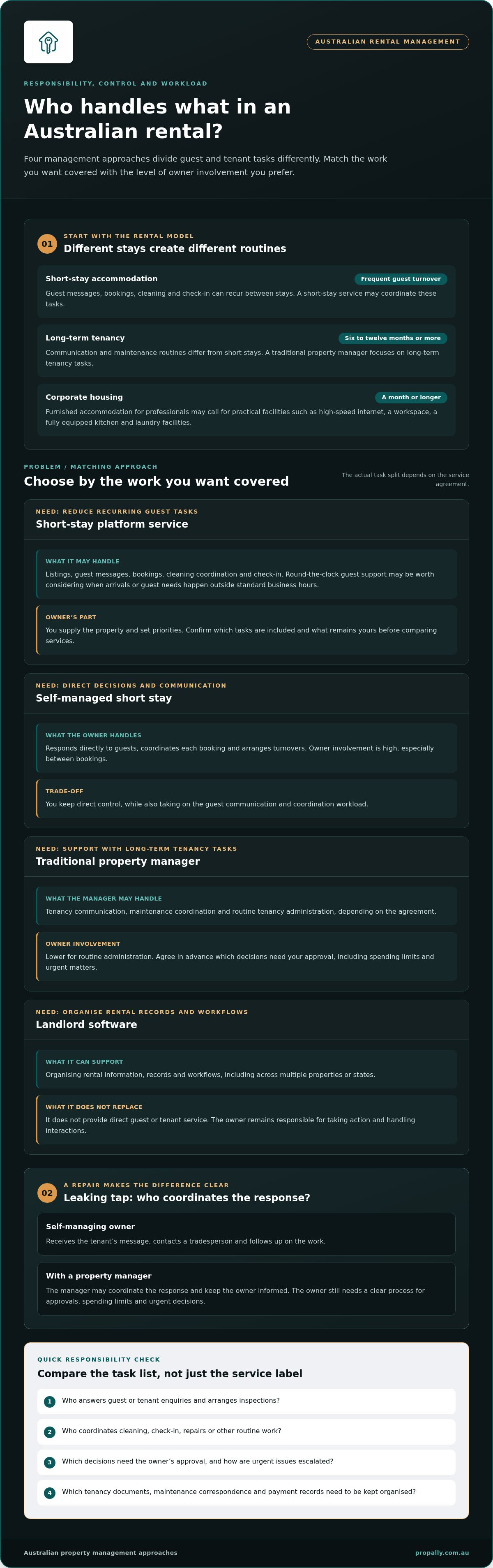
Compare options by responsibility, not by label. For an apartment, a platform service that handles guest messages and cleaner scheduling may reduce the owner’s daily workload. A self-managed listing leaves decisions with the owner, who also coordinates each booking and handover. A traditional property manager suits owners seeking support with long-term tenancy tasks. Landlord software can help organise rental information, while owners may still need to handle guest or tenant interactions themselves.
| Option | Guest or tenant contact | Routine coordination | Owner involvement |
|---|---|---|---|
| Short-stay platform service | May handle guest messages | May coordinate cleaning and check-in | Depends on agreed task split |
| Self-managed short stay | Owner responds directly | Owner arranges turnovers | High, especially between bookings |
| Traditional property manager | Manager supports tenancy communication | Focused on long-term rental tasks | Lower for routine administration |
| Landlord software | No direct guest or tenant service | Organises records and workflows | Owner remains responsible for action |
Before choosing, list the tasks you want removed: guest enquiries, arrival instructions, cleaning coordination or after-hours support. Then compare each service’s responsibilities against that list. An owner with a short-stay apartment and limited time may value managed guest communication; an owner who wants direct control may prefer self-management with software for records. A 24/7 support feature matters most when guest needs can arise beyond daytime hours.
Choose the option whose task coverage suits your rental model and the level of owner involvement you want.
Self-management versus using a property manager
Self-management keeps decisions and communication directly with the owner. A property manager takes on agreed tasks, such as coordinating maintenance, handling tenant enquiries and managing routine tenancy administration. The trade-off is straightforward: less day-to-day work can mean less direct control over how each interaction is handled. For an owner with one suburban rental, that difference may matter most during a maintenance request or a vacant period.
Map a typical tenancy from listing to handover. A self-managing owner prepares the listing, responds to enquiries, organises inspections and communicates with the tenant. During the tenancy, they track rent, respond to issues and arrange repairs. A property manager can coordinate some of these steps, but the agreement sets the scope. Read it as a task list, not just a service label.
Use a repair scenario to compare the workload. If a tenant reports a leaking tap, a self-managing owner receives the message, contacts a tradesperson and follows up on the work. With a property manager, the manager may coordinate the response and keep the owner informed. The owner still needs a clear process for approvals, spending limits and urgent decisions. Agreeing on these details early reduces confusion when an issue arises.
Self-management can suit owners who have time for regular communication and want direct oversight. A property manager may suit owners who live away from the rental, have a demanding schedule or prefer to delegate administration. Either way, keep clear records. For example, store tenancy documents, maintenance correspondence and payment records in an organised place.
Compare responsibilities using these practical questions:
- Who prepares and updates the rental listing?
- Who answers tenant enquiries and arranges inspections?
- Who coordinates repairs and keeps records of completed work?
- Which decisions need the owner’s approval, and how are they escalated?
These questions also help identify a middle ground. An owner could handle tenant contact but delegate selected administrative tasks, if the manager’s agreement allows it. Another owner might manage the tenancy directly while using digital tools to organise property records. A system for rental records and property workflows can support that organisation, but it doesn’t replace tenant communication or property management.
Before choosing, estimate the time each recurring task takes in your own week. Then compare that workload with the control you want to retain. For a local owner comfortable coordinating inspections and repairs, self-management may feel practical. For an interstate owner balancing several rentals, delegated administration may be more valuable. The best fit is the arrangement that clearly assigns each task and keeps the owner informed.
Australian landlord software alternatives
Choose software by the work it supports, not its feature count. For Australian landlords, state-by-state rental obligations make compliance tracking an important comparison point.
Features and customer reviews
Compare platforms by their workflows, then check whether reviews describe those features in use. NSW rental reform changes are covered across 2024 to 2026, making organised, state-specific records relevant to landlords tracking obligations. Reviews can help assess setup and navigation, but focus on detailed examples rather than broad praise. A review describing how an owner organises property documents is more useful than an unsupported claim that software is easy to use.
Rent collection and property tasks
Self-management platforms can help landlords record rent and organise maintenance information, while property managers can handle agreed tenancy tasks. Which option handles rent collection, inspections, maintenance and tenant screening? A property manager may coordinate these tasks, depending on the agreement; software can support records and workflows, but doesn't conduct inspections or assess tenants. Compare each task separately, including who records follow-up and keeps the relevant documents.
Single- and multi-property support
Self-management tools and property managers can suit landlords with one rental or multiple properties, depending on the work they need covered. For one property, a focused rent ledger may meet the owner's record-keeping needs. A portfolio across states calls for separate property files and clear task tracking. Compare how each platform handles multiple records rather than assuming a product designed for one rental will organise a portfolio effectively.
State and tenancy support
Australian landlords need to compare state and tenancy support against each rental's location. Queensland lease agreement changes are covered across 2024 to 2025, illustrating why a general checklist may not suit every property. Which alternatives support state rules and rental payment requirements? Property managers can apply their tenancy processes, while software can organise state-specific checklists and payment records. Owners remain responsible for acting on relevant obligations.
Test a real workflow before choosing, such as recording rent and filing a state-specific compliance document. Check whether the tool separates records by property and makes outstanding tasks easy to spot. For a rental in one state, a simple workflow may be enough; a multi-state portfolio needs clear separation. This test shows whether a platform supports your administration or merely stores information.
Software features may still need to match the tenancy type. Rental software selection should account for whether the property is a short-term rental or a traditional long-term tenancy, because each requires different platform capabilities. Compare alternatives with that distinction in mind, and judge capabilities against the property's actual use rather than assuming the same platform fits both. Making the tenancy type clear before comparing options helps keep the choice aligned with the capabilities the rental needs. Treat it as a selection criterion alongside the state-specific workflow already being considered.
Benefits and challenges for property owners
Each management approach shifts a different part of the workload. For Australian owners, the main considerations are time, control and task coverage. A short-stay service can coordinate guest operations, while self-management keeps decisions directly with the owner. A property manager takes on agreed work, and landlord software organises records without managing the tenancy.
Platform services can reduce the owner’s involvement in guest communication, cleaning coordination and booking handovers. That structure can help with an Airbnb rental that turns over frequently. The trade-off is the share of income paid for the service: some Airbnb management services charge commissions of up to 40% of rental income. Owners should compare that fee against the tasks included and the work they would otherwise handle.
Self-management gives owners direct oversight of decisions and tenant communication. For example, an owner can respond personally to a repair request and choose how to coordinate the work. The challenge is continuity: enquiries, maintenance follow-up and record-keeping still need attention when the owner is busy or away. A written task routine helps keep responsibilities visible.
A property manager can take on agreed tenancy tasks, which may suit an owner who lives far from the rental. Delegation can reduce routine administration, but it doesn’t remove the need for oversight. The owner still needs to understand approval processes, receive updates and know who handles maintenance issues. Clear responsibilities prevent gaps between the manager’s role and the owner’s decisions.
Landlord software brings records and workflows into one organised system. An owner with properties in different Australian states may find it useful to separate documents and tasks by property. However, software organises information rather than conducting physical inspections or speaking with tenants. Owners still need to act on reminders, maintain records and coordinate work at the property.
- Platform service: Compare the service workload with its commission and the owner’s desired involvement.
- Self-management: Set a routine for tenant messages, maintenance records and follow-up.
- Property manager: Define delegated tasks, approval steps and reporting expectations.
- Landlord software: Identify which records it organises and which actions remain with the owner.
Property type can change the balance. Corporate housing, for example, provides furnished accommodation for professionals staying a month or longer, often with employers paying. Owners considering this model need to account for furnishing and practical setup, including a workspace, kitchen equipment and laundry facilities. These requirements add preparation beyond organising tenancy records.
List the tasks you want to retain, delegate or systematise, then compare each option against a real example, such as a tenant reporting a repair. The clearest arrangement shows who receives the message, who coordinates the response and where the record is kept.
How do Cozy Property Management alternatives compare on features and customer reviews?
Compare each option against the work it actually handles, then use customer reviews to assess the user experience. Cozy property management alternatives in Australia include platform services, self-management, property managers and landlord software. These categories solve different problems, so a positive review matters only when it relates to tasks you need covered.
Start with a simple feature check. For a short-stay rental, compare guest communication, booking coordination and cleaning workflows. For a long-term tenancy, look at rent records, inspection notes, maintenance tracking and tenant communication. A property manager may perform agreed tasks, while software generally organises information for the owner. Don’t let a feature list or review blur that distinction.
Customer reviews can reveal practical strengths and frustrations. Look for specific examples, such as how a reviewer recorded a repair or managed several property files. Compare recent comments with your intended use, and distinguish detailed experiences from broad praise or criticism. Reviews reflect individual experiences; they don’t establish that every feature will suit your rental.
- Platform service: Look for comments about guest enquiries, booking coordination and property handovers.
- Self-management: Check whether owners describe a workable process for records and tenant communication.
- Property manager: Focus on examples involving updates, maintenance coordination and clear task ownership.
- Landlord software: Look for practical feedback about organising documents, payments and property information.
Test feature claims against a realistic scenario. Imagine a tenant reports a maintenance issue at an investment property. Can the software store the message and repair record? Does a manager coordinate the response, or does the owner? A review describing that workflow gives more useful context than a general rating without a task example.
For Australian owners, state and tenancy context also matters. Compare whether a tool lets you organise files by property and state, then look for reviews about those workflows. Don’t treat a review as proof of legal compliance. Instead, check whether the described feature helps you organise relevant records for the way you manage each rental.
Use a consistent comparison process: identify essential tasks, match each to a stated feature, then read reviews for examples of that feature in use. An owner with one long-term rental may prioritise inspection records, while an investor with short stays may focus on booking workflows. This keeps the decision grounded in your actual operating needs.
For a clearer view of Australian rental records and property workflows, organise your rental property data alongside your comparison.
For long-term rentals, property managers may handle agreed tasks, while self-managing owners oversee records and tenant communication. Landlord software can organise payment and property information, including rent records, inspection notes and maintenance tracking.
For corporate housing, tenants usually need to be travelling for work, on a government assignment or relocating; proof of employment and company sponsorship is usually required.
PropAlly: Starter Plan
PropAlly helps Australian property owners organise rental data without replacing a property manager. Its dashboard brings together cash flow, tax, compliance and bond evidence across rental properties. It can also read agent statements and inbox documents, helping consolidate records across properties and states.
The Starter Plan is a practical next step if you want clearer oversight while managing a rental yourself or working with an agent. PropAlly also offers the Business Plan for portfolios needing broader platform capacity. Its state-specific compliance checklists and bond authority workflows help organise property administration, while ATO-aligned tax calculations support record-keeping, not financial or tax advice.
Explore PropAlly’s Starter Plan to organise your property records and track your rental administration.
Set up a management approach you can review
Turn your comparison of Cozy property management alternatives in Australia into a working plan. Write down the decisions you want to keep, the tasks you’re prepared to delegate and the records you need at hand. This gives you a clear baseline for managing your rental instead of relying on a broad promise of convenience.
Identify one pressure point to address first. It might be scattered property documents, unclear maintenance follow-up or too much time spent coordinating routine tasks. Choose an approach that tackles that specific friction, then note what should improve in your day-to-day process. Revisit the arrangement when your rental circumstances change, such as adding another property or shifting between short-stay and long-term letting.
Clear records support better oversight, whichever management arrangement you choose. If you’d like to discuss organising your rental property information, contact PropAlly about your rental. A deliberate next step can make property administration feel more manageable.
Frequently Asked Questions
Which Australian property management platforms offer landlord self-management tools?
Australian landlords can use self-management software to organise rent records, maintenance and tenancy administration. PropAlly’s RentSmart includes a rent ledger with arrears alerts, receipt scanning, tax categorisation and a maintenance request board. These tools support owner-led workflows; they don’t replace decisions or actions the landlord must take. Compare platforms by the tasks you want to manage, such as recording rent or tracking a repair from report to completion.
What are the management fees and pricing for Australian property management alternatives?
Costs depend on the option and the tasks it covers. A property manager’s agreement may set charges according to the services provided, while software may use subscription tiers or optional document-processing add-ons. For a platform management service, compare the commission basis with the guest and property tasks included. Assess the full arrangement, including separate charges, rather than comparing headline rates alone.
What risks or hidden costs should landlords consider when changing property managers?
Before changing managers, review the current agreement for notice requirements, termination charges and outstanding expenses. Plan the handover of tenancy documents, rent records, maintenance history, keys and pending repair approvals. A repair arranged by the outgoing manager, for example, could become unclear if responsibility isn’t transferred. Keep a written record of who holds each item and who will action open tasks during the changeover.