

Notice periods and rental rules now depend more than ever on where the property is. In Victoria, rental providers must give renters 90 days’ notice for a rent increase and certain notices to vacate. In New South Wales, rent can’t be increased more than once in any 12-month period, according to NSW Fair Trading. Automated tenancy law compliance alerts in Australia can help track these state-specific changes, but they don’t replace legal advice.
It’s easy to assume one reminder system can cover every rental property. But a rule change may affect only one state, notice type or compliance task, while your portfolio spans several jurisdictions.
This article explains how automated alerts can track tenancy law changes, rent restrictions, deadlines and records. It also clarifies where software guidance ends and when a legal question calls for professional advice.
You’ll learn why state-by-state tracking matters, which alerts can help organise your work, and how to build them into a clearer compliance process for Australian rental properties.
Key Takeaways
- Use alerts to organise regulatory updates, deadlines and records by property and state, then review changes that affect your portfolio.
- In NSW, rent cannot be increased more than once in any 12-month period, according to NSW Fair Trading. Track each tenancy’s rent history before planning an increase.
- Compliance requirements differ across Australia. The Residential Tenancies Authority enforces compliance with Queensland's Residential Tenancies and Rooming Accommodation Act 2008.
- Software can help track tasks and guidance, but alerts don’t replace legal advice when a rule’s application to a tenancy is unclear.
- PropAlly’s dashboard helps Australian property investors track compliance, cash flow, tax and bond evidence across rental properties.
Automated alerts for legal and regulatory changes
Set up automated tenancy law alerts by grouping each rental property by state, recording its compliance tasks and directing updates to the person responsible. Add relevant property details and safety features, such as gas appliances or a pool, so alerts can match the applicable requirements. Before changing a process, verify each alert against the relevant rule.
Australian residential rules can change by jurisdiction and subject. An alert for a Victorian rental may not apply to a property in South Australia. Victoria’s Residential Tenancies Act and regulations changed concerning smoke alarm safety and compulsory gas and electrical safety checks took effect in 2021. Alerts should therefore identify the state, the affected obligation and the date a change applies.
Safety requirements show why location and property details matter. In South Australia, properties built before 1995 must be upgraded to photoelectric smoke alarms. In Queensland, rental properties must have photoelectric, interconnected alarms in every bedroom, hallways outside bedrooms and every level of the home from 1 January 2022. Queensland rental smoke alarms must comply with AS3786:2014. A useful alert links each task to the relevant property record.
Other examples call for different triggers. In Western Australia, a swimming pool or spa deeper than 30 cm must have safety barriers, except for a spa-bath. An alert system needs enough property detail to distinguish that situation from a home without a pool. For each change, record the source, effective date, affected properties and next action. That creates a traceable update rather than an inbox reminder without context.
Risk-based AI regulation is also relevant to how property teams use automated tools. Prioritise an alert about a safety deadline over a general administrative update. AI can sort incoming information by topic or urgency, but a person should review the source and confirm how a legal change applies. This keeps attention on the possible consequences of an error instead of treating every notification alike.
Use a consistent review process: assign an owner, note the deadline, record completion evidence and close the task only when the relevant action is documented. For example, a smoke alarm update should connect the rule change to affected addresses and inspection records. Keep earlier guidance with its effective period, so staff can distinguish a current requirement from an archived alert.
Alerts support oversight, but they don’t make a property compliant by themselves. Missing property details, outdated sources or incorrect interpretations can still lead to the wrong task. Build a review step into the workflow, especially for changes affecting safety, notices or tenancy conditions. Automated tenancy law compliance alerts in Australia are most useful when they turn a verified change into a clear, assigned action for each relevant property.
Rent increase restrictions
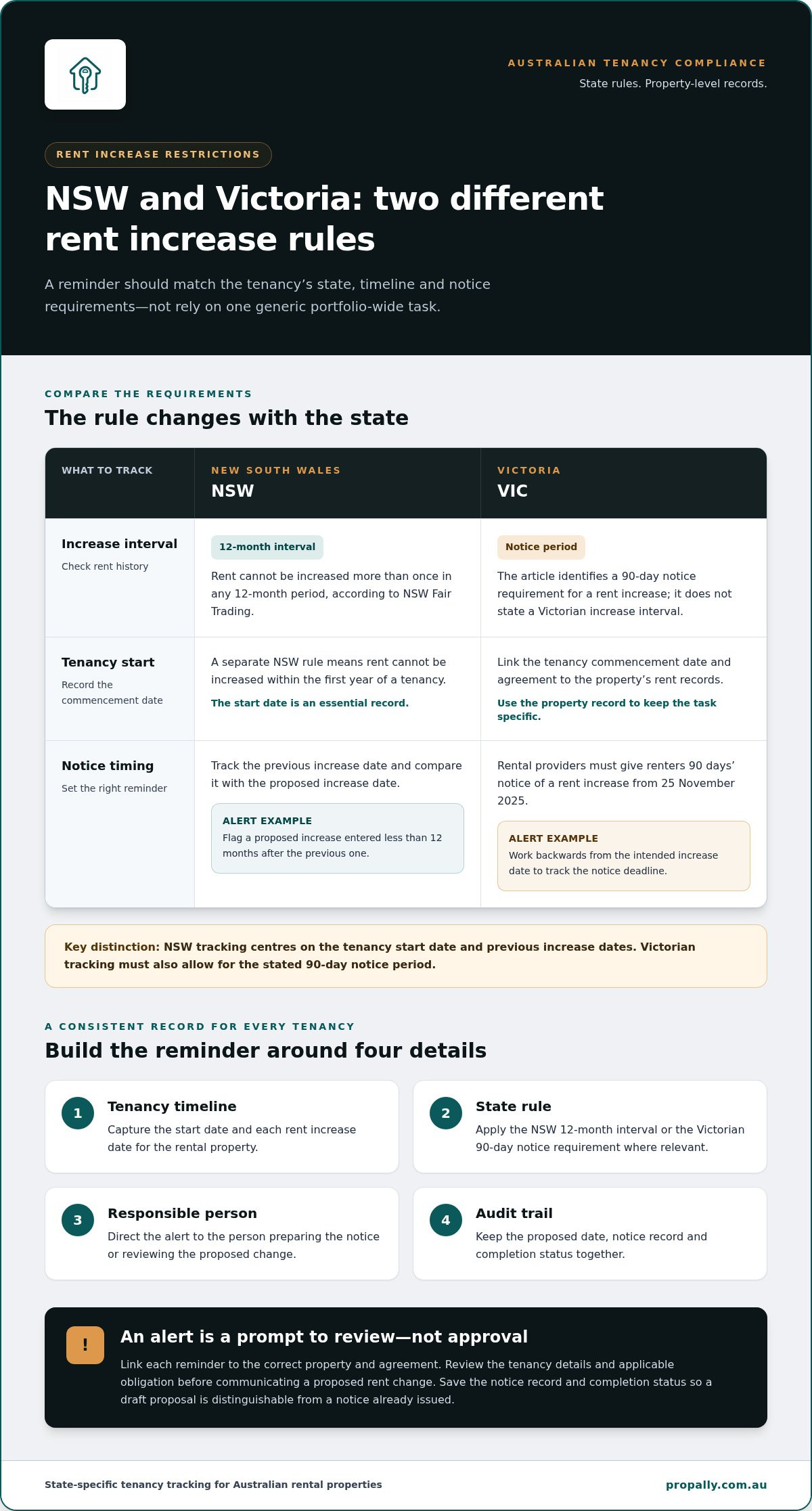
Rent increase controls vary across Australia, so a reminder must match the tenancy’s state and rental history. In NSW, rent cannot be increased more than once in any 12-month period, according to NSW Fair Trading. A separate NSW rule means rent cannot be increased within the first year of a tenancy. Together, these restrictions make the tenancy start date and previous increase dates essential records.
Victorian rental providers must give renters 90 days’ notice of a rent increase from 25 November 2025. That notice period makes timing a key part of the workflow. A reminder should identify the intended increase date, calculate backwards to the notice deadline, and flag the task early enough to prepare the required communication. It should also be linked to the correct rental property and agreement.
For a portfolio with properties in NSW and Victoria, use separate state rules rather than one generic rent-increase task. Record each tenancy’s commencement date, rent amount, previous increase date and relevant notice deadline, then link the alert to the property record. This helps prevent a NSW reminder being applied to a Victorian tenancy, or vice versa.
Automated alerts can support efficiency by prompting a review before a proposed increase is communicated. They can surface a date conflict, such as a NSW increase entered less than 12 months after the previous one. They can also flag a Victorian notice task that does not allow the required 90 days. The alert should prompt staff to review the tenancy details and applicable obligation, not treat a rent change as automatically approved.
- Record the tenancy timeline: capture the start date and each rent increase date for the rental property.
- Apply the state rule: use the NSW 12-month interval or Victorian 90-day notice requirement where relevant.
- Assign responsibility: direct the alert to the person preparing the notice or reviewing the proposed change.
- Keep an audit trail: save the proposed date, notice record and completion status together.
These records clarify responsibilities when a property changes hands or a team member takes over a tenancy. For example, a new manager can compare a proposed increase with the recorded NSW increase history before preparing a notice. In Victoria, the notice deadline can be tracked against the planned increase date. A clear record also distinguishes a draft proposal from a notice already issued.
Keep alerts specific. A useful notification names the property, state, relevant date and next action. It should also record the rule’s effective period, so the team can tell whether an older reminder still applies. These details make automated rent tracking more precise and keep decisions and communications visible to the people responsible.
Compliance management providers
Compliance tools organise reminders, records and assigned tasks, but coverage and integrations vary. Before choosing a workflow for your portfolio, compare how each tool handles Australian state rules, deadlines and property records.
Compliance provider features
Compliance management tools can help teams track obligations such as permit renewals, inspection deadlines and document submissions. Automated reminders make the next task visible, while tracking can show upcoming renewals and overdue items. These features matter because a missed handover or unrecorded inspection can leave staff unsure who must act and which evidence belongs with a rental property.
Assess how a tool turns an alert into a completed task. Can staff assign an owner, add a due date, attach a document and record completion? A clear workflow distinguishes an upcoming inspection from an overdue one. It also helps teams keep agreements, inspection records and correspondence together instead of searching separate inboxes and folders.
Compare the work a platform supports, not just its feature labels. Check whether alerts can be sorted by urgency, state and property, and whether managers can see unresolved tasks across their portfolio. An upcoming permit renewal, for example, should be easy to distinguish from an overdue document submission. These details help teams set priorities without treating every notification as equally urgent.
Comparing state coverage and integrations
State coverage describes the jurisdictions a tool accounts for; integrations show how it connects with existing records and workflows. This matters to investors with properties across state borders, because one generic checklist may not capture each location’s obligations. Check whether state-specific requirements are organised by property and linked to the relevant agreement or compliance record.
Ask how the platform presents a rule change: does it identify the affected state, task and effective period? Then compare its integrations with your current process, including where tenancy documents, inspection evidence and task ownership sit. A tool that fits your records may reduce duplicate entry. A disconnected workflow can leave a completed inspection invisible to the person monitoring deadlines.
Assess what a provider’s alerts do not decide. A notification can prompt a review, but it doesn’t establish whether conduct meets a legal requirement or resolve a compensation dispute. In Queensland, members of the public can anonymously report advertised rental properties that appear not to meet minimum housing standards. This illustrates why a recorded task and evidence trail matter alongside reminders.
- Map coverage: list each property’s state and compare it with the tool’s jurisdictional organisation.
- Test the workflow: follow one inspection task from alert through assignment and saved evidence.
- Review integrations: identify which existing records connect and where staff still need manual entry.
- Separate compliance from disputes: the Residential Tenancies Authority’s investigations focus on compliance, not recovering money or providing compensation.
For example, a property team can use an overdue-task view to find a missing inspection record, assign follow-up and retain the resulting document. Comparing tools against these practical steps shows whether a platform supports your record-keeping needs and daily work, rather than simply sending more notifications.
Limits of software guidance and legal advice
Automated alerts organise regulatory updates and tasks, but they don’t determine a landlord’s legal position. Landlords retain ultimate legal responsibility for compliance at their properties. An alert can flag a change or deadline; it cannot establish whether a particular action prevents a breach in a specific tenancy.
Consider a notice prepared after a rental rule changes. Software can help surface the update, but applying it may depend on the agreement, the property’s state and the circumstances behind the notice. A date reminder alone cannot resolve competing interpretations or determine whether a proposed step is legally valid. Those questions call for legal advice, not an automated prompt.
Keep the distinction clear in daily workflows. Use software to track a due date, assign a task and retain evidence. Treat legal interpretation as a separate decision. For example, a maintenance record can show when an inspection occurred, but assessing the legal effect of an incomplete inspection requires considering the applicable rule and facts.
- Use alerts for administration: record deadlines, assign responsibility and flag overdue tasks.
- Review the underlying source: identify the state, rule and effective period before changing a process.
- Escalate interpretation: seek legal advice when a notice, agreement or individual circumstance creates uncertainty.
- Preserve evidence: keep the relevant communication, document and completion record with the property file.
This distinction matters when an alert seems incomplete or conflicts with a staff member’s understanding. Record the question, preserve the notification and pause any action that depends on a disputed interpretation. A status marked “complete” confirms only that a workflow item was closed; it doesn’t prove the underlying conduct met every legal requirement.
A landlord managing homes in different states, for example, shouldn’t assume one state’s notice process applies across the portfolio. A platform can organise separate records, but the legal effect of a notice still depends on the jurisdiction and tenancy facts. Keeping the rule source and property details together gives an adviser a clearer basis for reviewing the issue.
Alerts can reduce missed administrative steps, but they can’t prevent every breach. They rely on accurate property details, current source material and staff action. Treat each notification as a prompt to review, not a guarantee of compliance or a substitute for advice. This keeps technology useful without giving automated guidance more authority than it has.
State- and territory-specific tenancy compliance
Australian landlords should monitor legislation affecting safety, rent, notices, bonds and tenancy documents. Set reminder schedules to match each property’s state and the event involved, rather than relying on one national calendar.
Monitoring tenancy law changes
Monitoring means tracking regulatory updates and recording their effect on relevant residential tenancies. It matters because a change in Victoria may not apply to a rental in Queensland. The Residential Tenancies Authority enforces compliance with Queensland's Residential Tenancies and Rooming Accommodation Act 2008. Keep each alert tied to its jurisdiction, effective date, affected property and required action.
For example, Victoria requires rental providers and agents to arrange annual smoke alarm safety checks for all rental agreements from 25 November 2025. From 13 October 2026, gas and electrical safety checks are required every 2 years; gas checks apply only where gas appliances, fixtures or fittings are present. Victorian minimum energy efficiency standards begin phased implementation on 1 March 2027. These dates belong on a Victoria-specific schedule.
Other jurisdictions have distinct records and triggers. NSW rental homes need at least one working smoke alarm on each level, tested annually and replaced before expiry. Western Australian rental homes require two RCDs on the switchboard before leasing, while smoke alarms must be less than 10 years old. Keep these checks separate from Victoria’s requirements to avoid applying one state’s checklist elsewhere.
State-specific compliance reminders
State-specific reminders connect a tenancy event with the relevant task and deadline. This matters for rent increases, renewals, inspections and notices, because triggers and rules can differ by jurisdiction. Set reminders using the agreement date, proposed action or inspection schedule, then assign them to the responsible person.
For rent, NSW increases can’t occur more than once in any 12-month period, according to NSW Fair Trading. Victorian providers must give renters 90 days’ notice of a rent increase. For notices to end a NSW tenancy, the required period depends on the reason and agreement type: examples include 90 days for some longer fixed-term or periodic tenancies, and 60 days for a fixed term of 6 months or less.
- Victoria: schedule annual smoke alarm checks and track the 2-year gas and electrical safety-check cycle where applicable.
- NSW: record rent increase dates, smoke alarm checks and the reason for any termination notice.
- Western Australia: link RCD and smoke alarm checks to the property record.
- Every jurisdiction: track renewal dates, inspection evidence and notices against the relevant agreement and local rules.
Organise property records and state-specific compliance tasks in one workflow. Organise state-specific compliance records alongside each rental property.
PropAlly: Starter Plan
PropAlly helps Australian property investors organise compliance records and property data in one dashboard. Its state-specific compliance checklists and bond authority workflows keep property-level tasks visible alongside cash flow, tax calculations and bond evidence.
The Starter Plan can help investors organise records for their rental properties. For portfolios that need broader oversight, the Business Plan is another option. The dashboard can automatically read statements from agents and inboxes, consolidating information across multiple properties and states. It supports compliance tracking, but doesn’t replace legal advice or determine how a law applies to a specific tenancy.
To explore how PropAlly can organise your Australian rental property records, visit PropAlly’s website.
Build a compliance workflow that keeps pace
Build compliance into how you onboard and oversee each Australian rental property. Assign a clear owner to every record, deadline and update. When a property joins your portfolio or responsibility changes hands, review its state, tenancy details and task history. This creates a repeatable process that can grow with your portfolio instead of relying on someone to remember an old email.
Use automated tenancy law compliance alerts in Australia as prompts for action, not substitutes for judgement. Track routine tasks in your property records and keep questions about legal interpretation separate for appropriate advice. This helps your team act on updates while preserving the context behind each decision.
PropAlly offers the Starter Plan, Pro Plan and Business Plan for Australian property investors organising rental property information. If you’re ready to bring compliance records into a more structured workflow, contact PropAlly about tenancy alerts. A clear process starts with one well-organised property record, then builds from there.
Frequently Asked Questions
Have notice periods changed?
Yes. Victoria’s rental rules changed on 25 November 2025: rental providers need a valid reason to issue a notice to vacate, including at the end of a fixed-term agreement. Victorian rental providers must also give 90 days’ notice for rent increases and certain notices to vacate. In NSW, notice periods depend on the agreement type and reason for ending the tenancy, so identify both before preparing a notice.
Does this compliance software replace legal advice?
No. Compliance software can organise reminders, property records and state-specific checklists, but it can’t determine how legislation applies to a dispute or unusual tenancy. A dashboard may show that a notice task is due, for example, but can’t decide whether the proposed notice is legally valid in your circumstances. Use software to manage administration, and seek legal advice when you need an interpretation or guidance on a specific matter.
What happens if I miss a compliance deadline?
The consequences depend on the requirement and what was missed. A delayed inspection record may need prompt follow-up, while a missed safety obligation could create a more serious compliance issue. Record the missed deadline, affected property and action taken, and preserve relevant documents and communications. If the delay may involve a breach or affect a tenant’s rights, seek legal advice about next steps rather than relying on an alert to resolve it.
Which states and territories are covered?
PropAlly’s state-specific compliance checklists cover Queensland, New South Wales, Victoria, South Australia, Western Australia, Tasmania, the Northern Territory and the Australian Capital Territory. If you invest across state borders, organise records by address and jurisdiction. This keeps each checklist with the right property instead of treating a national portfolio as if every tenancy followed identical rules.
What tenancy laws and compliance deadlines vary by Australian state and territory?
Requirements can differ for safety checks, notices, bonds and rental agreements. For example, Queensland rental homes require interconnected photoelectric smoke alarms in specified areas, while NSW rental homes need working smoke alarms on each level, tested annually. Victoria has separate gas and electrical safety-check requirements. Keep each property’s state, features and tenancy details with its task schedule so the checklist reflects that property.
Which automated tenancy compliance alert platforms operate in Australia?
PropAlly is a property-investor platform with state-specific compliance checklists and deadline tracking. Its dashboard helps organise compliance alongside rental property records. When comparing platforms, look at whether they support the jurisdictions and tasks in your portfolio and fit your workflow. Treat alerts as prompts for review, not as a complete directory of every Australian tenancy tool.
How do rental law alert services track and verify legislative changes?
Alert tools can organise obligations by jurisdiction, property and task, then flag deadlines for review. Verification still matters: before updating a tenancy process, compare the alert’s stated change and effective period with the relevant legislation or official state information. Keep the source and date with your internal record, giving staff context if they review an older checklist or saved notice later.
What are the penalties for missing tenancy compliance deadlines in Australia?
There isn’t one penalty for every missed deadline. The consequences depend on the obligation and the seriousness of any resulting breach. Identify the specific requirement, document the circumstances and seek legal advice if you need to assess a potential breach.