

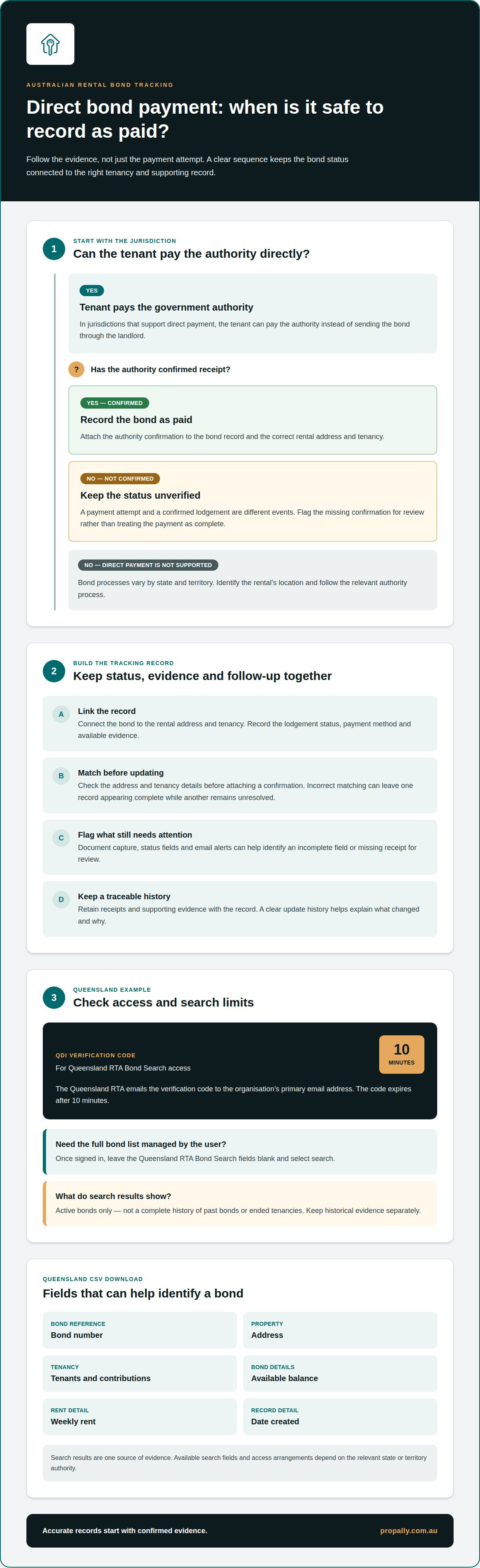
Can a tenant pay a rental bond straight to the government authority instead of sending it through the landlord? In Australian jurisdictions that support direct payment, yes: the tenant can pay the authority, and the landlord can record the bond as paid once the authority confirms receipt. Automated bond lodgement tracking in Australia can keep that status alongside the bond record and its supporting evidence.
A direct payment removes one hand-off, but it doesn’t remove the need to know whether the bond has been lodged, what information is visible and whether the records are complete. Clear tracking helps keep bond updates and follow-up actions organised.
This guide explains how automated tracking handles updates and alerts, search visibility, receipts and audit trails. It also covers how reporting requirements and potential penalties relate to the process, and what to know when a tenant pays the authority directly.
Key Takeaways
- In jurisdictions that support direct payment, tenants can pay the bond to the government authority; the landlord can record it as paid after receipt is confirmed.
- Queensland’s bond search shows active bonds, and its CSV download includes key details such as the bond number, tenant contributions and available balance.
- Accurate, timely reporting matters. The relevant requirements and consequences depend on the state or territory.
- Receipts and a clear record of updates can help keep bond evidence organised and make the history easier to follow.
- Lodgement deadlines differ across Australia, so identify the rules that apply to the rental’s state or territory.
Automated tracking updates and alerts
Professional providers use property-management or compliance software to organise bond records, documents and follow-up tasks. These tools may include document capture, status fields and email alerts. The useful feature is a clear record of what has happened, what evidence supports it and what still needs attention.
Automation usually starts with a bond record linked to a rental address and tenancy. Record the lodgement status, payment method and available evidence. The workflow can flag an incomplete field or missing receipt for review, rather than treating an unverified payment as complete.
When a tenant pays an authority directly, record the bond as paid only after the authority confirms receipt. A payment attempt and a confirmed lodgement are different events. A tracking system should retain both the status and the evidence behind each update.
Queensland provides a specific example of why updates need a clear sequence. RTA Bond Search users must verify their identity through Queensland Digital Identity (QDI). The Queensland RTA emails the verification code to the organisation’s primary email address, and the code expires after 10 minutes.
That short expiry makes timely access important for an organisation checking bond information. Once signed in, leaving the Queensland RTA Bond Search fields blank and selecting search displays the full bond list managed by the user. The result supports a status review, but does not replace confirmation of new payment evidence.
Organisations unable to use RTA Web Services can request a list of bonds they manage through the Queensland RTA Administrative Access Scheme. Use the list as a reference when reconciling records, and note discrepancies for follow-up. Recording the source and date of each review helps explain later changes.
What software tools do property managers use for automated bond lodgement tracking in Australia? Tracking platforms bring bond details, supporting documents and follow-up tasks into one organised workflow. The exact setup depends on the property manager’s systems and the authority process for the rental’s state or territory.
How is rental bond lodgement tracking automated in Australia? Structure each record, capture payment or authority evidence, update its status and route incomplete items for review. An alert is most useful when it identifies a specific next action, such as matching an authority confirmation to the correct tenancy.
Privacy needs attention at each step. Bond records can contain tenant names, addresses and payment information, so restrict access to people who need it and use authorised accounts. For Queensland searches, QDI verification and delivery to the organisation’s primary email are part of the access process.
Incorrect matching is another practical risk. A confirmation attached to the wrong rental can leave one record appearing complete and another unresolved. Match the address and tenancy details before updating a bond, then retain the confirmation with that record.
Bond information available in search results
Online bond searches show selected records, not necessarily a complete tenancy history. Queensland’s search service provides a clear example of the information available to an authorised user.
Online tracking through bond authorities
The Queensland RTA offers a Bond Search Web Service. Its results include active bonds only, so they show current bond records rather than a complete record of past bonds. When reviewing an address with previous tenancies, remember that a search result shows managed bond information, not the full rental history.
The Queensland RTA CSV download includes the bond number, address, tenants and their contributions, available bond balance, weekly rent and date created. These fields help connect a bond record with a property and its tenants. Use the address and bond number to identify the relevant record, then compare the displayed details with the tenancy information on file.
Which Australian rental bond authorities offer online bond tracking? The Queensland RTA offers the Bond Search Web Service, including a CSV download of managed bond information. Online access and available records depend on the relevant jurisdiction’s bond authority.
Search visibility has limits. Queensland’s results contain active bonds only, so they do not show a complete timeline of ended tenancies. When reviewing records across several properties, keep historical evidence separately so old receipts and bond references remain findable after a bond is no longer active.
State and territory lodgement approaches
Rental bonds are handled through government processes that vary by state and territory. A national property portfolio may therefore involve different authority records and search arrangements. Start by identifying the rental’s location: a Queensland bond, for example, belongs in the Queensland RTA process.
For tracking, associate each property with the correct authority record and bond status. Queensland’s CSV fields offer an example of a structured record: the bond number, property address, tenant contributions and available balance can support reconciliation. Do not assume every jurisdiction’s search results include the same fields.
For a multi-state portfolio, group jurisdiction-specific records by rental location. A Queensland search result and a record from another state may show different fields or status details. Consistent internal labels, such as property address and tenancy reference, help organise the records without confusing one authority’s data with another’s.
Search results are one source of evidence, not a substitute for the authority’s full record or supporting documents. Use visible bond details to identify a mismatch, then keep the relevant receipt or correspondence with the property file. This makes it easier to review a tenant contribution, balance or address that needs attention.
Late or incorrect reporting penalties
Late or inaccurate bond reporting can leave a tenancy record unresolved. The relevant deadline and consequences depend on the state or territory and the circumstances of the lodgement.
Bond lodgement deadlines
Each state and territory has its own rental bond process, so one deadline does not apply across Australia. The relevant authority, lodgement method and tenancy details determine which process applies. A tracking workflow should identify the property’s jurisdiction first, then record the due date and required action.
For example, do not treat a record marked “submitted” as approved or complete unless the authority’s process supports that status. A portal receipt or authority confirmation can show that a lodgement step occurred. Keeping the recorded status distinct from its evidence helps identify items that still need follow-up.
Responding to an unlodged bond
If a landlord or agent has not lodged a bond, tenants can request a written update and retain payment evidence. If the issue remains unresolved, contact the relevant state or territory bond authority for guidance. In Queensland, tenants can refer to their rental bond acknowledgement or contact the RTA for assistance.
Keep the tenancy address, payment record and messages together. These details help explain what was paid, when it was paid and who received it. If the authority confirms the bond is not recorded, the information gives the tenant a clear basis for asking the landlord or agent to resolve the discrepancy.
There is no single national penalty amount. Consequences depend on the jurisdiction’s rules and the type of reporting failure, such as a late lodgement or incorrect tenancy details. A wrong address can make a record harder to match, while missing payment confirmation can leave its status unclear.
Automation can surface these gaps, but it cannot turn an incomplete record into proof of lodgement. A useful workflow distinguishes key stages, such as payment made, evidence received, submission to the authority and confirmation recorded. Staff can then review exceptions instead of assuming every submitted item has been accepted.
For a property manager handling rentals across jurisdictions, assign each bond to the correct state or territory process. Record the lodgement date, the portal or channel used, and any reference or receipt generated. If a correction is needed, retain the original entry and document the change, rather than overwriting the record without an explanation.
When reviewing a potential delay, focus on the outstanding action: confirmation, corrected details or communication with the authority. This makes the next step clear and creates a traceable account of how the matter was handled. The applicable deadline and any penalty depend on the relevant jurisdiction’s requirements.
Official receipts and audit trails
A receipt and an internal tracking entry serve different purposes. An authority receipt records a lodgement or payment event; the property file shows how staff handled that evidence. Link both to the correct tenancy so the record is easier to follow when a tenant, landlord or agent asks about the bond.
When a tenant pays the bond directly, the authority’s confirmation is key evidence of receipt. The landlord can then update the internal record to show the payment as confirmed. An entry that says only “paid” does not show who received the money or what evidence supports that status.
A practical audit trail records each meaningful change rather than replacing the original status without explanation. For example, it might show that payment evidence was received, a reference matched to a property, and the status updated after confirmation. Dates and staff actions make the sequence clear.
Document management matters too. Store the receipt or acknowledgement with the relevant bond record, using a consistent property identifier such as the rental address. If an attachment is replaced because it was incomplete or unreadable, note the correction. This distinguishes the first document from the version used for the final update.
- Identify the record: connect the document to the rental address and tenancy.
- Record the event: note whether evidence shows payment, submission or authority confirmation.
- Keep the source: retain the receipt, acknowledgement or relevant correspondence.
- Explain changes: record why a status or document was updated.
These steps help staff answer specific questions. If a tenant asks whether payment was received, the record can show the evidence and subsequent status change. If an agent needs to investigate a mismatch, the sequence can reveal whether the issue arose during document capture, matching or follow-up.
Queensland offers a useful example of keeping official and internal information distinct. Tenants seeking Queensland bond details can refer to their rental bond acknowledgement or contact the RTA for assistance. An internal file can keep that acknowledgement with related correspondence, clearly identifying it as supporting evidence rather than a substitute for the authority’s record.
Access controls are another part of a reliable audit trail. Limit editing rights to staff responsible for bond administration and retain a record of changes. For example, a staff member may correct a tenancy reference, while a reviewer checks that the attached document relates to the same property.
For Australian property managers, the goal is traceability, not a larger pile of files. An organised record connects the bond, its official evidence and the actions taken. That makes each update easier to explain and helps prevent a receipt for one rental being mistaken for evidence for another.
What are the legal deadlines for lodging a rental bond in each Australian state and territory?
Australia has no single rental bond lodgement deadline that applies in every jurisdiction. The timeframe depends on the state or territory and its bond process, so do not copy a deadline for one rental across a national portfolio.
For New South Wales, Victoria, Queensland, Western Australia, South Australia, Tasmania, the Australian Capital Territory and the Northern Territory, identify the relevant jurisdiction before recording a due date. This keeps each tenancy aligned with the applicable authority process instead of relying on one national setting.
A reliable deadline record links the required lodgement action with its trigger and supporting evidence. For example, staff can record when the bond was received, when lodgement was submitted and the authority’s response. These events help distinguish a pending task from a completed lodgement.
The key operational risk is treating a reminder as proof of compliance. An alert can prompt action, but it does not establish that the bond was lodged or accepted. The property file should distinguish the due date, submission status and any authority confirmation.
- Jurisdiction: record the state or territory where the rental is located.
- Deadline: enter the timeframe that applies to that jurisdiction and process.
- Event: capture when the relevant lodgement action occurred.
- Evidence: retain the submission record or authority response against the tenancy.
For a portfolio spanning Queensland and New South Wales, each property needs its own jurisdiction-linked deadline and status. The same internal workflow can organise both, but should not assume their legal timeframes are identical. A change in tenancy or lodgement circumstances should prompt a record review.
As a deadline approaches, the tracking workflow should show the property, outstanding action and responsible staff member. If submission has occurred, retain its date and reference. If confirmation is pending, show that distinction rather than marking the matter complete.
Use the relevant authority’s current requirements to establish the timeframe for each state or territory. The tracker supports consistent administration by storing that deadline with the property record and prompting follow-up. It organises the evidence but does not replace the legal requirement.
PropAlly
PropAlly helps Australian property investors organise bond evidence and compliance records across their rental properties. Its dashboard brings property cash flow, tax, compliance and bond evidence into one view. It also automatically reads statements from agents and inboxes to consolidate information across properties and states.
PropAlly provides bond evidence records and state-specific compliance reminders. These are record-keeping tools, not confirmation from a bond authority. This guide does not establish a direct integration that lodges bonds, retrieves authority balances or automatically confirms lodgement; verify status with the relevant authority or managing agent.
For a clearer way to track rental property records, explore PropAlly’s plans and choose the one that fits your portfolio.
Make your next bond update easier to manage
Make bond administration part of a consistent property-record workflow. Decide how to record a new bond, assign responsibility for follow-up and distinguish an outstanding task from a completed record. Clear internal processes make automated bond lodgement tracking in Australia more useful across a changing rental portfolio.
PropAlly brings bond evidence and compliance information together with other rental property records, helping investors keep portfolio administration organised. If you’re ready to bring more structure to your property records, contact PropAlly about bond tracking.
Start with your portfolio’s current needs, then build a process that can keep pace as it grows. A clear record is a practical foundation for more confident property administration.
Frequently Asked Questions
What is bond lodgement tracking in Australia?
Bond lodgement tracking records a rental bond’s progress from payment to its authority record. For investors, automated bond lodgement tracking in Australia can connect tenancy details, payment evidence and the bond’s recorded status. When a tenant moves to a different rental, for example, a clear record helps distinguish the current bond from an earlier one at another address.
How can property investors have a professional check whether their bond has been lodged with the relevant authority?
A professional can compare tenancy details with the relevant authority’s records and the investor’s documents. Automated bond lodgement tracking in Australia helps organise that review by linking a rental address with its supporting evidence. For a Queensland rental, provide the address, tenant names and any bond reference or receipt to help identify the relevant record.
What information should property investors provide to a professional to track or confirm a rental bond lodgement?
Provide the rental address, tenancy details, tenant names, payment date and any receipt, acknowledgement or authority reference. Share documents containing personal information through a secure channel. If the property has had multiple tenancies, include the relevant tenancy dates or agreement so the professional can distinguish the current bond from earlier records. This helps avoid matching evidence to the wrong rental period.
What are the costs of rental bond tracking and property management software in Australia?
Costs vary according to software functions, the number of properties tracked and whether document processing or reporting tools are included. Bond tracking may be part of broader property portfolio software rather than a standalone service. Compare the subscription structure with the records you need to manage, such as evidence across properties and compliance tasks. Record-tracking software is distinct from property management services.
What penalties apply for failing to lodge a rental bond on time in Australia?
There is no single penalty amount that applies across Australia. The relevant rules and consequences depend on the state or territory, the circumstances and the nature of the failure. A tenant concerned about an unlodged bond can contact the relevant bond authority and keep payment records and written communications together. These documents help explain the situation and support follow-up about the bond’s status.
Official source and access note
Queensland access note, checked 17 November 2026: the RTA Bond Search Web Service is for joint lessors and eligible organisations, not individual private landlords or tenants. Private landlords and tenants should use their Acknowledgement of rental bond and contact the RTA if they need help. The Queensland example is not a national access rule.
Queensland RTA: Online Bond Search. General information only; check the authority for the property's jurisdiction.