

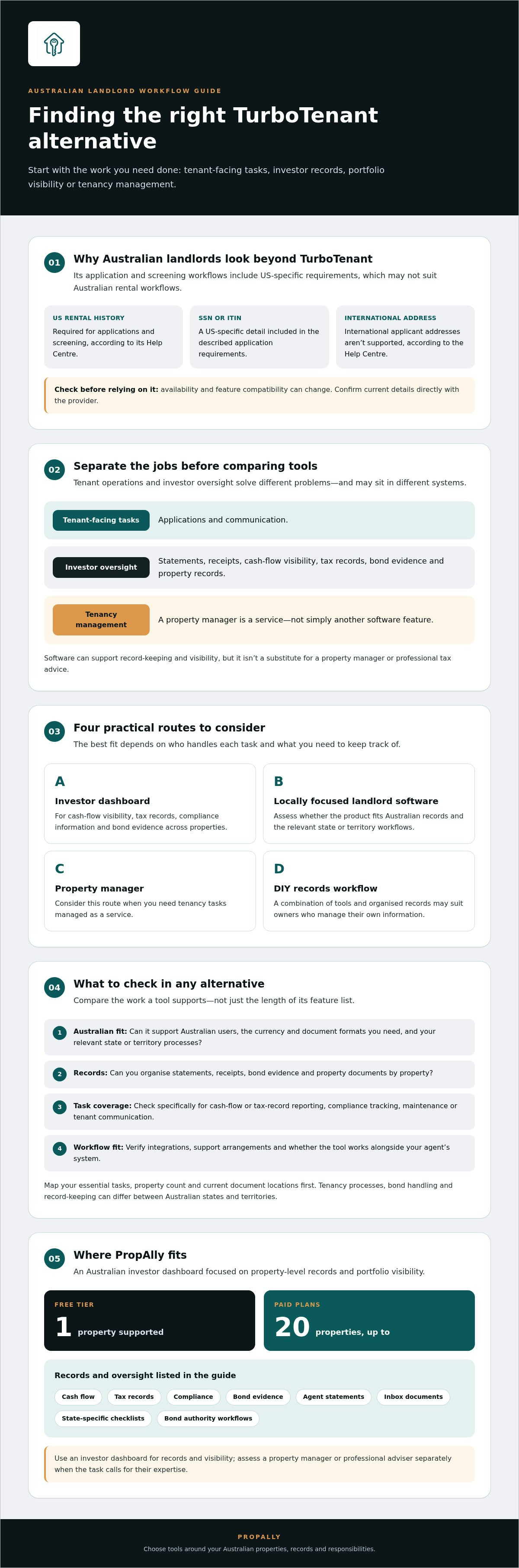
TurboTenant may not suit Australian landlords: its application and screening workflows require US-specific details, including a US rental history and an SSN or ITIN, and don’t support an international applicant address, according to its Help Centre. So the search for turbo tenant alternatives for australian landlords is really a search for a workflow built around Australian rentals.
The right fit depends on who handles each task. A self-managing investor may need a reliable way to organise statements, receipts, bond evidence and property records. An owner whose properties are managed by an agent may mainly want clearer portfolio visibility. Software can support these jobs, but it isn’t a substitute for a property manager or professional tax advice.
This guide compares practical options by use case, from investor-focused record-keeping tools to systems used by agencies. It looks at Australian relevance, document organisation, compliance support and portfolio visibility, then explains where PropAlly may fit for landlords tracking cash flow, tax records and bond evidence across properties. Use the criteria below to shortlist a tool, or a combination of tools, that matches your portfolio and the work you actually manage.
Key Takeaways
- Use the comparison of turbo tenant alternatives for australian landlords to shortlist options by Australian relevance, portfolio scale and the records you need to track.
- Separate tenant-facing tasks from investor record-keeping, cash-flow visibility and compliance tracking before comparing tools.
- Choose between an investor dashboard, locally focused landlord software, a property manager or a DIY records workflow based on who handles each task.
- Map your essential tasks, property count and current document locations before deciding which features are worth prioritising.
- See how PropAlly’s investor dashboard can bring cash-flow, tax records, compliance information and bond evidence into a property-level view.
Why Australian landlords are looking beyond TurboTenant
An alternative doesn’t have to be a like-for-like app. For an Australian landlord, turbo tenant alternatives for australian landlords can mean a different product or a combination of tools and services that better fits the work involved, from tenant communication to keeping property records organised.
Local fit matters. Tenancy processes, bond handling and record-keeping can differ between Australian states and territories. A tool that looks comprehensive on paper may not support the locations, documents or workflows in your portfolio. An investor dashboard is also not necessarily a tenant-facing service or a full-service property manager. The broader field of property management includes both operational services and the systems used to support them, so compare like with like.
Check TurboTenant’s Australian suitability against current provider information. Its Help Centre information, published on 6 March 2025, describes US-specific requirements for applications and screening, including a US rental history and an SSN or ITIN, and says international applicant addresses aren’t supported. These details may create barriers for Australian users, but availability and feature compatibility can change. Confirm them directly before relying on the platform.
What should Australian landlords check before switching?
Start with practical compatibility, not the feature count. Ask each provider whether it supports Australian users, the currency and document formats you need, and any integrations your workflow requires. Check that its processes suit the state or territory where each property is located, and that you can organise records by property across your portfolio.
Next, list the tasks the tool actually handles: statements and receipts, cash-flow or tax-record reporting, bond evidence, compliance tracking, maintenance or tenant communication. Don’t assume a product covers every task just because it describes itself as all-in-one.
When does an alternative make more sense than one platform?
Consider another product or workflow if records are scattered across agent statements, email, spreadsheets and folders, or if property information is difficult to review in one place. You may need a dedicated record-keeping tool alongside an agent’s tenant-management system, rather than a wholesale switch.
An Australian landlord software alternative is a product or workflow that better fits an owner’s Australian property records, portfolio and management responsibilities. Start by identifying the gap. If it’s document organisation or portfolio visibility, software may help. If you need someone to manage tenancy tasks, that’s a property-management service. Questions requiring professional or tax advice call for the relevant adviser, not an app.
Compare TurboTenant alternatives using Australian landlord criteria
Compare the work each option supports, not just the length of its feature list. Separate tenant-facing tasks, such as applications and communication, from investor oversight, such as organising statements, tracking cash flow and reviewing tax records. They solve different problems and may sit in different systems.
Jurisdiction fit matters: software should reflect the Australian records and state or territory workflows relevant to your properties, rather than assuming a US process will transfer unchanged. The Real Estate Institute of Australia provides national real estate sector context, but check each provider’s current product details for specific functionality.
| Option | Australian availability and portfolio scale | Records and task focus | Integrations and support |
|---|---|---|---|
| TurboTenant | Its Help Centre describes US-specific application requirements, including a US rental history and an SSN or ITIN. These requirements may limit its suitability for Australian workflows. Confirm current details with the provider. | US-focused tenant workflows; Australian record fit needs verification. | Australian integrations and support arrangements: verify directly. |
| PropAlly | Australian investor dashboard. Free tier supports one property; paid plans cover portfolios of up to twenty properties. | Tracks cash flow, tax, compliance and bond evidence. Can read agent statements and inbox documents; state-specific checklists and bond authority workflows are offered. | Confirm current integrations, document-processing limits and support details with the provider. |
| Other landlord software | Australian availability and portfolio limits vary; check with each provider. | Confirm which records and tenant-facing tasks are included. | Check supported integrations, document formats and support arrangements. |
| Agency system or DIY records | Scale and access depend on the agency’s system or your chosen workflow. | Agency systems may support tenancy operations; DIY records depend on how you organise and review documents. | Ask an agent what owner access is available, or confirm how your own records are backed up and retrieved. |
“Not confirmed” means the information wasn’t verified here, not that a feature is absent. Ask providers to demonstrate how statements, receipts, bond evidence and property documents are stored, searched and reported. Check how you can review records by property and across the portfolio. State-specific checklists can help organise tasks, but don’t treat them as a guarantee of compliance.
How should landlords compare automation and portfolio visibility?
Check which inboxes and document formats a tool can read, what needs manual review and whether processing limits apply. Then test whether cash flow is visible by property as well as across the portfolio. For a practical checklist, see this Australian property data-entry automation guide. If consolidated investor records are your priority, explore PropAlly’s investor dashboard as one option.
Four practical TurboTenant alternatives for Australian landlords
There’s no single best replacement for every owner. These four options address different jobs, from tracking an investment portfolio to handing tenancy tasks to a professional. Treat them as categories, not a ranked list. The right fit depends on what you manage yourself and what you want to see in one place.
1. Australian investor dashboards
Best fit: Landlords who want a central view of property records and portfolio information, whether or not an agent manages the tenancy. Trade-off: An investor dashboard isn’t a tenant-management service. Check which documents it accepts, how information is organised by property and whether reporting supports your review needs.
PropAlly fits this category. It provides an Australian property-investor dashboard for tracking cash flow, tax, compliance and bond evidence. It can read agent statements and inbox documents, and offers state-specific checklists and bond authority workflows. Its ATO-aligned tax calculations are designed for the Australian market, but the platform doesn’t provide tax advice or guarantee compliance.
2. Locally focused landlord software
Best fit: Owners looking for software with workflows designed for Australian rentals, potentially including tenant-facing tasks. Trade-off: Local focus alone doesn’t confirm that a product suits your state, documents or portfolio. Verify its current Australian availability, supported features, integrations and support directly. Check whether it handles the day-to-day tenancy tasks you need or focuses mainly on landlord records.
3. A property manager
Best fit: Landlords who want professional assistance with agreed tenancy and property-management tasks, rather than another app to operate themselves. Trade-off: This is a service model, not a like-for-like software alternative. Clarify the scope of service, how your agent communicates updates and what owner records or reporting you can access. You may still want a separate system for your own investment records and portfolio oversight.
4. DIY records with spreadsheets and folders
Best fit: Owners with a straightforward workflow who prefer to organise records themselves. Trade-off: You’ll need to create and maintain the structure manually. Decide how to label files by property, record transactions, store receipts and bond evidence, and retrieve documents later. Check that your process remains workable as your records or portfolio grow.
These options show why turbo tenant alternatives for australian landlords aren’t limited to competing apps. Start with the task you need to solve, then confirm the product or service actually covers it.
Match a TurboTenant alternative to your portfolio and workflow
Choose by fit, not feature count. A tool may automate one task neatly but still leave a gap in how you handle documents, review records or communicate with tenants. Use this five-step shortlist to test whether an option suits your properties and the work you actually do.
A five-step shortlist process for landlords
- 1. List the work. Note recurring tasks, such as reviewing agent statements, filing receipts, tracking bond evidence or managing tenant communication.
- 2. Map your portfolio. Record the number of properties, the states or territories they’re in, and where key documents currently sit, such as email, agent portals, spreadsheets or folders.
- 3. Set your must-haves. Confirm Australian access, data handling, integrations and plan limits directly with each provider. Treat automation and tenant-facing functions as optional unless they solve a real need.
- 4. Test a typical workflow. Use a representative agent statement, receipt and property record. Check how each is added, organised, reviewed and retrieved. Ask about document-reading support, processing limits and any manual steps.
- 5. Review the result. Can you find the right record and understand the property information without extra workarounds? Choose the workflow that fits, not the product with the longest feature list.
For an Australian-specific reference point, compare your checklist with this Australian investment property compliance checklist. For organising rental records, see the ATO rental property records guide. These resources can help you identify what to track, but they aren’t a substitute for qualified advice on your circumstances.
How to reduce switching friction
Before changing systems, inventory existing records and decide what must stay accessible during the transition. Ask shortlisted providers how imports work, what export formats are available and what happens to your data if you close an account. Don’t assume documents or history will transfer automatically.
Keep authoritative source documents accessible, even if a new tool creates summaries or extracts information from them. For tax or legal questions, seek advice from a suitably qualified professional.
If a central view of property records and portfolio information is a priority, explore PropAlly’s investor dashboard as one option to assess against your shortlist.
Where PropAlly fits among TurboTenant alternatives
PropAlly is an Australian property-investor dashboard for owners who want a clearer view of investment records and portfolio information. It tracks cash flow, tax, compliance and bond evidence across rental properties. Its role is investor oversight, not day-to-day tenancy management.
A key part of that workflow is document organisation. PropAlly can read agent statements and inbox documents, bringing information from different sources into a property-level view. It also offers state-specific checklists and bond authority workflows. These features can help organise records, but they don’t guarantee compliance or replace advice tailored to your circumstances.
Who may find PropAlly a relevant alternative?
It may suit landlords who want a central place to review property data, particularly when records arrive through different agents or email accounts. Investors with properties across multiple states may also value having property-level records and state-specific tools in one dashboard, while checking that the workflow covers their actual needs.
The Free Plan supports one property, and paid plans cover portfolios of up to twenty properties. Optional email document processing add-ons are available. Before choosing a plan or add-on, check the current inclusions and any document-processing limits directly with PropAlly. Don’t assume a particular feature is included at every plan level.
What to check before choosing PropAlly
Compare the dashboard’s scope with the work you need done. If your priority is cash-flow visibility, tax-record organisation, compliance tracking or bond evidence, assess how the dashboard supports those tasks. If you need someone to manage tenant communication or other tenancy operations, an investor dashboard isn’t a substitute for a property manager. ATO-aligned tax calculations don’t make PropAlly a tax adviser, and the software doesn’t provide financial or tax advice.
As you compare turbo tenant alternatives for australian landlords, look beyond whether a tool appears comprehensive. Check how it handles your documents, portfolio structure and state-related record-keeping. Confirm current plan features before relying on them, and retain source documents for your own records.
If a dedicated investor view matches your requirements, explore PropAlly’s property investor dashboard and assess its current features against your shortlist.
Choose a workflow that keeps your property records in view
The right choice isn’t necessarily a single all-in-one platform. Match your tools and services to the work you handle, then check Australian availability, state-specific workflows and document support before switching. That’s the practical approach to turbo tenant alternatives for australian landlords.
Keep the distinction clear: tenant management, investor record-keeping and professional advice are different needs. A dashboard may help organise portfolio information, but it doesn’t replace a property manager or a qualified tax or financial adviser.
For landlords seeking a central view of property cash flow, tax, compliance and bond evidence, PropAlly offers an Australian-focused investor dashboard. It can read agent statements and inbox documents, with state-specific checklists and bond authority workflows to support record organisation. Check current plan inclusions and document-processing limits to confirm the fit for your portfolio.
Explore PropAlly’s Australian property investor dashboard to assess whether it suits the way you manage your records. With a clear workflow and the right tools, you can make property administration easier to oversee.
Frequently Asked Questions
Is TurboTenant available to Australian landlords?
TurboTenant’s Australian suitability appears limited: its Help Centre information, published on 6 March 2025, says applications and screening require US-specific details, including a US rental history and an SSN or ITIN, and don’t support an international applicant address. As availability and features can change, confirm the current position with TurboTenant before signing up or moving records. Australian landlords should also check whether its workflows support their local documents and needs.
What are the best TurboTenant alternatives for Australian landlords?
There’s no single best option for every portfolio. The right turbo tenant alternatives for australian landlords depend on whether you need tenant-facing tools, investor record-keeping or hands-on management. Consider an Australian investor dashboard for cash flow and property records, locally focused landlord software for relevant tenancy workflows, a property manager for an agreed service, or a DIY system of spreadsheets and folders. Check each option’s Australian availability and current capabilities.
Can Australian landlords use US property-management software?
Sometimes, but don’t assume a US platform will support Australian users or workflows. Confirm account eligibility, currency, document formats, integrations and support directly with the provider. Then check how it handles Australian rental records, bond evidence and relevant state or territory processes. A tool might still suit a specific task, but gaps in local compatibility could mean you need a separate system or manual steps. Verify the details before relying on it.
Which features should Australian landlords compare in an alternative?
Compare features against the work you need to manage. Check whether the software organises agent statements, receipts, bond evidence and property documents, and whether reports help you review records by property or across your portfolio. If automation matters, verify supported inboxes, document formats and processing limits. Assess tenant applications and communication separately from investor functions such as cash-flow visibility, tax-record tracking and compliance checklists.
Does landlord software replace a property manager or tax adviser?
No. Landlord software can support record organisation, portfolio visibility or selected tenancy tasks, depending on the product. It doesn’t automatically provide the service of a property manager or the professional advice of a tax adviser. For example, PropAlly is an investor dashboard, not a property manager or tax adviser. Check who will handle tenant interactions and seek qualified advice for tax or legal questions about your circumstances.
How can I switch from TurboTenant without losing rental records?
Before changing systems, make an inventory of records and identify what must remain accessible, including statements, receipts, bond evidence and property documents. Ask the current and new providers about export formats, import options, account closure and continued access to records. Save authoritative source documents separately rather than assuming everything will transfer. Test a sample statement and receipt in the new workflow, then check that you can retrieve and review them correctly.