

The best RentHQ alternative may not be another property-management platform. For Australian investors, the real test is whether a tool brings rental income, agent statements, tax records and property documents into one clear view. Judge renthq alternatives for australian investors by the work they support, not just the number of features on a pricing page.
If you’re juggling an agent-managed property alongside one you manage yourself, records can end up scattered across inboxes, spreadsheets and accounting software. State and territory bond processes add another layer of administration. The right platform should fit how you oversee your portfolio and keep investor record-keeping distinct from the operational needs of a property manager.
This comparison looks at spreadsheets, general accounting tools, agency-focused platforms and investor-focused property hubs. It covers the workflows that matter for Australian portfolios, including agent statement tracking, tax record organisation and state-specific compliance. Use the comparisons and practical tests to identify an option that suits your properties and processes. Software can help organise records and support tax calculations, but it isn’t a substitute for financial or tax advice.
Key Takeaways
- Compare tools by property count, cash-flow visibility, document handling and reporting, not feature count alone.
- Spreadsheets, accounting software, agency platforms and investor hubs serve different workflows, each with its own setup and record-keeping trade-offs.
- Use your portfolio needs and day-to-day administration to narrow down renthq alternatives for australian investors.
- Before switching, map the properties, accounts and records you need to carry across, including statements, receipts and bond evidence.
- Consider whether an investor-focused dashboard such as PropAlly suits your workflow, while keeping software record support separate from professional tax advice.
Why Australian investors look beyond RentHQ for portfolio administration
“Alternative” doesn’t have to mean a like-for-like replacement. For an Australian investor, it can be any tool or process that helps track property income and expenses, keep supporting records together or review portfolio performance. Compare what each option actually helps you do, rather than whether it reproduces every feature of RentHQ.
Property administration has two distinct sides. A property manager may handle operational tasks such as communicating with tenants and coordinating a tenancy. The owner still needs a clear view of rental income, expenses, agent statements, receipts and compliance records across their investments. The Australian property market overview provides broader context for the diverse ownership and investment landscape, but day-to-day record-keeping depends on each investor’s properties and arrangements.
What investors mean by a RentHQ alternative
Start by identifying the gap you want to close. Do you want to replace your current system, add a portfolio tracker alongside an agent’s tools or simplify your process with a spreadsheet and consistent filing? Each can be a valid alternative if it supports the administration you need. An agency system may coordinate property operations, while an investor’s records focus on cash flow, supporting documents and an overview across properties. Don’t assume every option does both jobs.
RentHQ alternatives for australian investors can include more than dedicated property software. Your choice depends on what you need to organise, how you review information and whether you prefer a manual or more consolidated workflow. Base any comparison with RentHQ on its current product information, rather than assumptions about its features or intended use.
When a different tool may fit better
Look for friction in your existing process. You might enter the same expense in multiple places, search different inboxes for agent statements or struggle to see rental cash flow across properties without combining figures yourself. A growing portfolio, a change in how properties are managed or a mix of self-managed and agent-managed arrangements can also make an existing process harder to maintain.
An agent’s involvement doesn’t remove the owner’s need to keep clear records. Statements and other documents may still need to be filed and reviewed as part of your financial administration. The question is whether your current setup gives you a dependable, understandable record, not whether it automates every task.
There’s no universal tipping point. If your needs are straightforward, a well-maintained spreadsheet and orderly document folders may be enough. With a more complex portfolio, a dedicated system that brings records together may save effort. Identify the recurring task that takes the most time, then assess whether another approach would reduce that friction. A new platform only helps if it fits the way you oversee properties and maintain records.
How to compare RentHQ alternatives for Australian investor workflows
Compare each option against the records you actually use, then test how it handles current Australian requirements. For example, from 13 October 2026, Victoria’s mandatory gas and electrical safety checks every two years apply to all rental properties. Investors with Victorian properties may need a reliable way to organise related evidence and review dates alongside records for the rest of their portfolio. The Reserve Bank of Australia analysis of housing investment offers broader economic context. For choosing a tool, focus on the practical administration it supports.
Compare the records and reporting you actually use
Treat rental income, expenses, agent statements and supporting documents as separate requirements. A platform may organise one well but leave you entering another manually. Check whether you can review reports by property and understand the portfolio as a whole. Also check whether you can export records in a useful format for your files or reporting process.
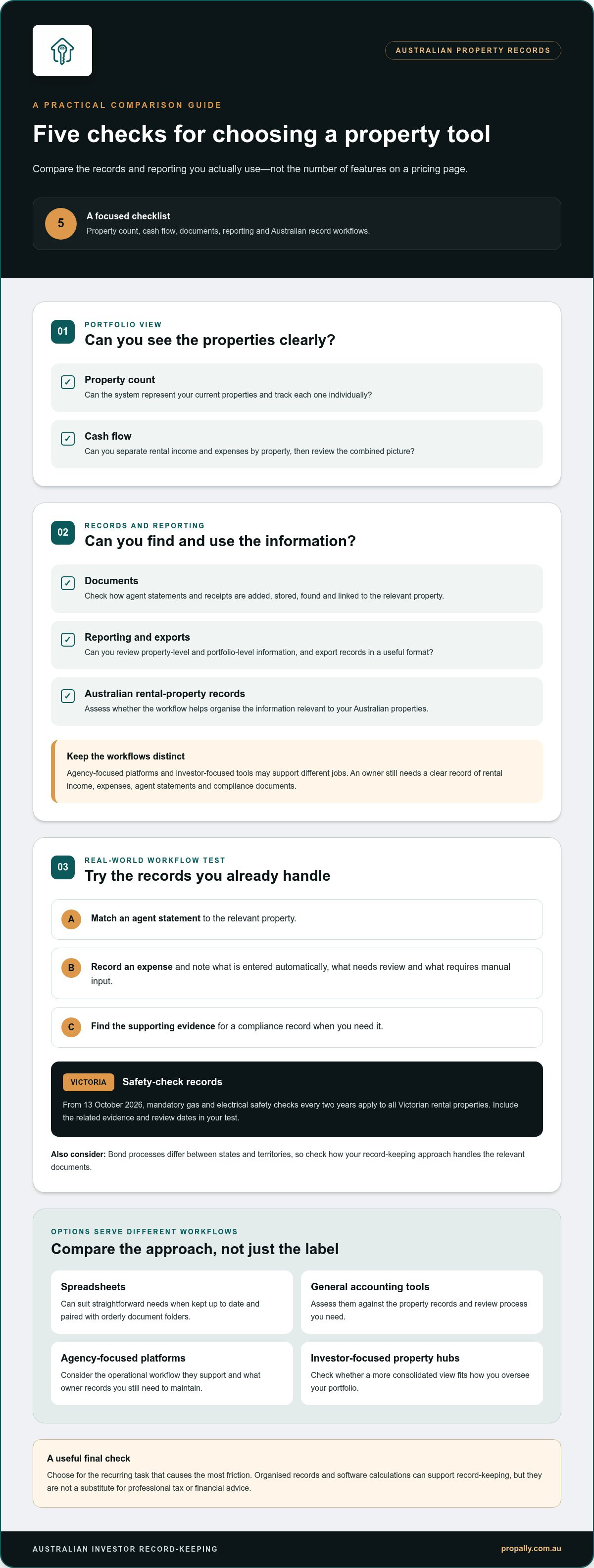
Property count: Can the system represent your current properties and let you track them individually?
Cash flow: Can you separate rental income and expenses by property, then review the combined picture?
Documents: How are statements and receipts added, stored, found and linked to the relevant property?
Reporting: Can you review property-level and portfolio-level information, and export what you need?
Australian records: Does the workflow help organise information relevant to your Australian rental-property records?
Test the process with a real example. Match an agent statement to the relevant property, then check how an expense is recorded. For a Victorian property, include a safety-check record and see whether you can find its supporting evidence when needed. Note what the system enters automatically, what you need to review and what requires manual input. Check current product information before relying on a specific platform capability. Organised records and software calculations can support record-keeping, but they aren’t professional tax or financial advice.
Check Australian compliance and document workflows
Bond administration can differ between states and territories, so assess whether a tool helps you keep bond evidence organised for the relevant property and process. Consider which documents you can store, how easily you can retrieve them and whether the workflow shows which property they relate to. A generic document folder may not account for every state-specific process or compliance record.
For document handling, trace one item from arrival to review, such as an agent statement or receipt. Does the workflow reduce repeat entry, or just move the same manual task elsewhere? Check how you correct information and retrieve the original document if needed. These small tests show whether a platform supports your routine or adds another place to maintain.
Use this framework to compare renthq alternatives for australian investors against your records and reporting needs. If an investor-focused dashboard is on your shortlist, explore PropAlly’s Starter Plan as an option for organising property administration.
RentHQ alternatives compared: spreadsheets, general tools and investor platforms
No single tool category suits every Australian property investor. A spreadsheet offers control, general accounting software supports broader financial records, agency platforms focus on property operations, and investor hubs centre on the owner’s portfolio view. You can also combine tools, using an agent’s system for tenancy operations and a separate method to organise your own records.
The trade-off is usually between flexibility, purpose and upkeep. You can shape a spreadsheet around your workflow, but you’re responsible for maintaining its structure and entering information consistently. General accounting software can organise transactions, but you may need to build a property-by-property system around it. Dedicated platforms have a defined purpose, so compare the tasks they support rather than assuming every product covers the same ground.
Use RentHQ’s current product information as your baseline. Don’t infer its intended audience, capabilities or fit from its name or from another platform’s feature list. Apply the same rule to named competitors: verify specific features and limits before relying on them.
Compare categories by the work they do
| Tool category | Audience and records | Reporting and compliance questions | Manual effort and possible fit |
|---|---|---|---|
| Spreadsheet | Investors wanting a custom register for income, expenses and documents. | Can you separate each property and produce a clear portfolio view? Where will state-specific records and bond evidence be stored? | You control the layout, but need to maintain formulas, enter information and organise supporting files. It may suit simple workflows and investors comfortable managing their own system. |
| General accounting tool | Investors who want property activity organised within a broader accounting workflow. | Can you distinguish properties and retrieve statements and receipts alongside relevant transactions? What reporting can you produce at property and portfolio level? | Setup may involve creating a consistent structure. Property-specific organisation can remain your responsibility. |
| Property-management platform | Primarily serves operational workflows for agencies and property managers. | Does the system address the owner’s portfolio records, or mainly the agency’s day-to-day processes? How are compliance documents handled? | Its workflow may not match an investor seeking owner-level oversight. Assess its purpose before comparing it with investor tools. |
| Investor-focused portfolio hub | Owners seeking a consolidated view of property records and portfolio administration. | Can you review property and portfolio information, organise documents and manage relevant Australian compliance and bond records? | Consider what is automated, what requires review and what still needs manual entry. It may suit investors seeking a dedicated owner-side workflow. |
| RentHQ as a baseline | Use its current product information to establish the tasks it supports. | Compare verified details against the same records, reporting and compliance questions. | Don’t assume capabilities or limits. Assess the current workflow before deciding whether to replace or complement it. |
Use the table to shortlist, not to declare a universal winner. If you prefer control and have a straightforward set of records, a manual method may be enough. If you need broader accounting organisation, a general tool may fit. Investors seeking a central owner-side view may prefer a dedicated hub, while an agency platform may be more relevant to operational management than portfolio tracking.
For renthq alternatives for australian investors, the practical question is which combination keeps your records consistent and retrievable without creating duplicate work. You don’t have to force every task into one system. A complementary setup can work if you know which record is authoritative and where to find it.
How to shortlist and switch from RentHQ without losing control of records
A controlled change starts before you move a single record. Map your current tasks, test likely options against familiar documents, then plan how you’ll preserve and check your information. Treat the change as a records project, not a rushed transfer that could leave gaps.
- Inventory your workflow. List every property and where its rental income, expenses, agent statements, receipts and bond evidence currently sit. Note the accounts or folders you use, any repeated entry and the information you gather for tax-time preparation.
- Rank your criteria. Decide what matters most: property-level records, portfolio reporting, document handling, Australian compliance workflows or data export. Include ownership arrangements or state differences where they affect how you organise or retrieve information.
- Test real records. Use representative examples, such as an agent statement, receipt and bond document, to see how a shortlisted tool handles entry, organisation, review and reporting. Check current product documentation for export and access options.
- Plan the transition. Keep source documents accessible, decide which records will move and set a point to compare transferred information against the originals. Don’t assume data will transfer seamlessly or that every detail will be included.
Map your current portfolio workflow
Make the inventory practical. For each property, note the source of rental income information, how expenses are recorded, where statements arrive and how receipts are filed. Mark any repeated steps, such as copying a figure from an agent statement into another record. This shows which tasks a new system needs to simplify and which records must remain easy to retrieve.
For properties in different states or with different ownership arrangements, note the distinction if it changes your administration. You may need to keep separate documents or track information differently. Capture your actual workflow rather than creating extra categories you won’t use.
Test and transition with care
Before committing, work through a small set of familiar records. Check whether each document can be associated with the right property, whether entered information is easy to review and whether reports make sense against the source material. Compare the ongoing effort of entering and checking records, not just the features listed on a product page. Keep originals available during the change.
After a transfer or manual re-entry, compare key entries with statements and receipts. Check that each property is represented, documents are accessible and totals reflect the records you intended to move. Note anything that didn’t transfer so it remains part of your existing filing process. This check gives you a clearer basis for deciding when the new workflow is ready to use.
For investors comparing renthq alternatives for australian investors, the best shortlist is the one tested against real records and recurring tasks. If an investor-focused dashboard suits your workflow, explore PropAlly’s investor dashboard to organise rental cash flow, documents, compliance and bond evidence.
Where PropAlly fits among RentHQ alternatives for Australian investors
After comparing tool categories against your records, consider PropAlly as an investor-focused option. Its dashboard helps Australian property owners track rental cash flow, tax, compliance and bond evidence across their properties. That owner-side focus suits investors who want a clearer portfolio view alongside existing property-management arrangements, rather than a system centred on agency operations.
PropAlly workflows relevant to the comparison
PropAlly brings property information together to track rental cash flow and tax-related records. Its automated document reading can process agent statements and inbox documents, consolidating information that might otherwise need to be entered from separate sources. Review the extracted information and keep the underlying documents organised as source records.
For Australian portfolios, PropAlly provides state-specific compliance checklists and bond authority workflows. These help investors organise administrative tasks and bond evidence with state differences in view. Assess how those workflows fit the properties you own and the records you need to maintain. A dashboard need not replace every tool or professional support you already use.
PropAlly provides ATO-aligned tax calculations to support record organisation. These calculations are a software function, not financial or tax advice. Review your information and make decisions appropriate to your circumstances.
Match the plan to your portfolio needs
The Free Plan covers one property. Paid plans support portfolios of up to twenty properties. Consider the platform in relation to your portfolio size and the records and workflows you need. Optional email document-processing add-ons are available for investors who want email documents included in their administrative workflow.
Think about the kinds of documents you handle and how often you need to bring them into your property records. If agent statements and relevant inbox documents are a regular part of your process, automated reading may be useful. It doesn’t remove the need to review records, retain source documents or seek professional advice where needed.
For investors weighing renthq alternatives for australian investors, PropAlly is most relevant when the priority is owner-side oversight: cash flow, tax records, compliance and bond evidence in a property-investor dashboard. It can complement an agent’s operational systems rather than replace them. Compare the workflows against your portfolio, then choose the setup that keeps administration clear and manageable.
Start organising your property portfolio with PropAlly.
Make your next property admin step a manageable one
Your next platform doesn’t need to solve every portfolio challenge at once. Pick one recurring task that slows you down, such as sorting statements or locating supporting documents. Define what a clearer process would look like, then use that as a practical measure of whether a new system earns a place in your routine.
That keeps the choice of renthq alternatives for australian investors grounded in how you manage property records, rather than the promise of a long feature list. As your portfolio or arrangements change, revisit the process and adjust your tools. Clear ownership of records and a consistent routine make the work easier to oversee.
Ready to put that approach into practice? Explore PropAlly and organise your Australian property portfolio. Start with the workflow you want to bring under control, then build from there.
Frequently Asked Questions
Is RentHQ suitable for Australian property investors?
It may suit investors whose administration needs match its current tools and pricing structure. As of October 2026, RentHQ’s published pricing uses a A$6 monthly base fee plus A$0.40 per property per month. That cost structure alone doesn’t establish whether it fits your workflow. Consider how you handle Australian rental records, review portfolio information and keep state-specific documents, then compare those tasks with RentHQ’s current product information.
What should I compare when choosing a RentHQ alternative in Australia?
Compare how each option handles the records you rely on, not just its feature list. Check whether you can review rental income and expenses by property, retrieve statements and receipts easily, and produce useful portfolio reports. For renthq alternatives for australian investors, also consider support for Australian compliance and bond administration, what requires manual review, and whether you can retain or export your records.
Can I use a property management platform and an investor portfolio tracker together?
Yes, they can serve different roles. A property manager’s system may support tenancy operations, while an investor tracker can help you monitor owner-side records across properties, including those managed by different agents. In a hybrid arrangement, decide which system is the source for each record. For example, keep operational updates with the agent and use your own organised records to review income and expenses across the portfolio.
How do I move rental records when switching from RentHQ?
First, preserve your existing records and source documents, including statements, receipts and bond evidence. Check RentHQ’s current documentation for available data access or export options, then establish what you can transfer before changing your routine. After importing or re-entering information, compare selected entries against original statements and receipts. Keep a list of anything missing or altered, and retain the old records until you’re confident the new set is complete and usable.
Do Australian property investors need separate bond records for different states?
Keep bond documents clearly associated with the relevant property and state, because bond authority processes can differ across Australia. That doesn’t necessarily mean you need a separate storage system for each state. A consistent filing structure can distinguish properties and retain the applicable evidence. For current requirements and process details, use the relevant state or territory bond authority’s official information, rather than assuming one national process applies everywhere.
Can property software provide tax advice or guarantee ATO compliance?
No. Property software can help organise records or perform calculations, but that isn’t the same as professional tax advice or a guarantee that your tax reporting is correct. Check entries against source documents and keep records that support the information you report. For decisions about your circumstances, rely on qualified professional advice and current Australian Taxation Office guidance. Treat software as an administration aid, not a substitute for judgement or advice.
Is a spreadsheet enough to track multiple investment properties?
A spreadsheet can be enough if you can maintain it consistently and retrieve supporting records when needed. Give each property a clear identifier, use consistent categories for income and expenses, and keep source documents in an orderly filing system. As your portfolio or reporting needs become more complex, manual updates can be harder to review and keep consistent. The practical test is whether you can reliably trace each figure back to its supporting record.