
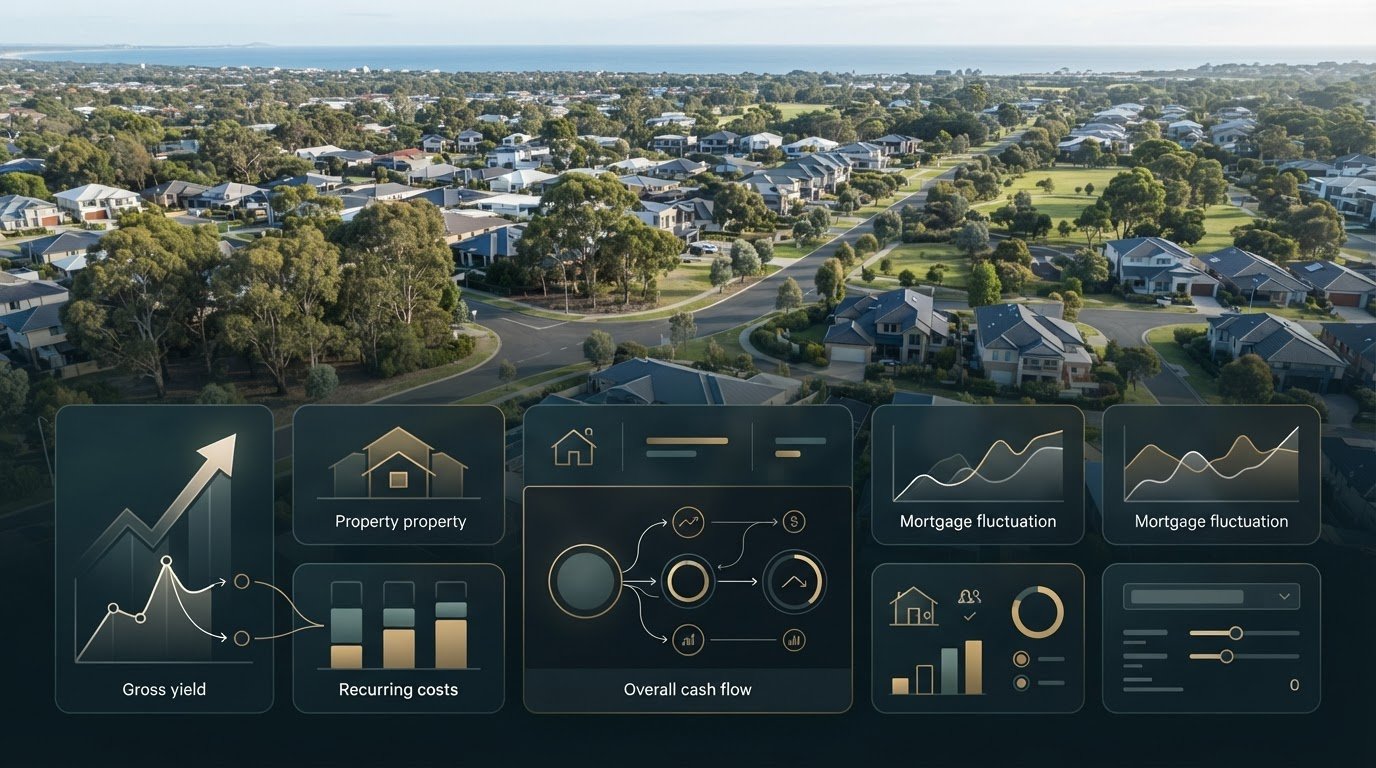
A 5% headline yield looks impressive on paper, until recurring holding costs quietly erode your net cash flow. Relying on an entry-level rental yield calculator Australia investors use often delivers a false sense of security. Static spreadsheets and basic online calculators capture purchase prices and weekly rent, but they ignore the ongoing operational friction of shifting interest rates, strata levies, landlord insurance premiums, and council rates.
Watching paper projections drift away from your actual bank balance is a frustrating reality for many landlords. You already know that sound financial oversight shouldn't require hours of manual data entry across fragmented agent statements. This guide provides the tools to master both gross and net rental yield calculations with total precision, using standard Australian formulas to evaluate true investment performance. We will examine every recurring outgoing, clarify the critical gap between headline marketing yields and genuine take-home returns, and demonstrate how continuous tracking keeps your entire portfolio under control.
Key Takeaways
- Master the mathematical distinction between headline gross yield and true net cash flow to protect your bottom line from unexpected holding costs.
- Account for essential property outgoings, including council rates, strata levies, and insurance premiums, using standardised national formulas.
- Recognise why an entry-level rental yield calculator Australia investors frequently rely on fails to reflect shifting mortgage rates and vacancy fluctuations.
- Establish continuous portfolio oversight by replacing static, error-prone spreadsheets with automated statement extraction and real-time performance tracking.
Understanding Rental Yield in Australia: Gross vs Net Calculations
Rental yield measures the annual income generated by an asset relative to its value, expressed as a clean percentage. In property investment, it acts as a primary barometer for income productivity. Yet, evaluating properties solely through headline figures creates dangerous blind spots. A typical rental yield calculator Australia buyers encounter during preliminary research defaults to gross yield, hiding the structural holding costs that define actual performance.
Capital values often move independently of lease agreements. When market values surge while weekly rents remain steady, yields contract mathematically. Conversely, softening property values can make yields look deceptively strong on paper. Understanding the core financial mechanics detailed in this real estate investing overview clarifies why distinguishing top-line revenue from net operating performance is critical for preserving portfolio equity.
The Mechanics of Gross Rental Yield
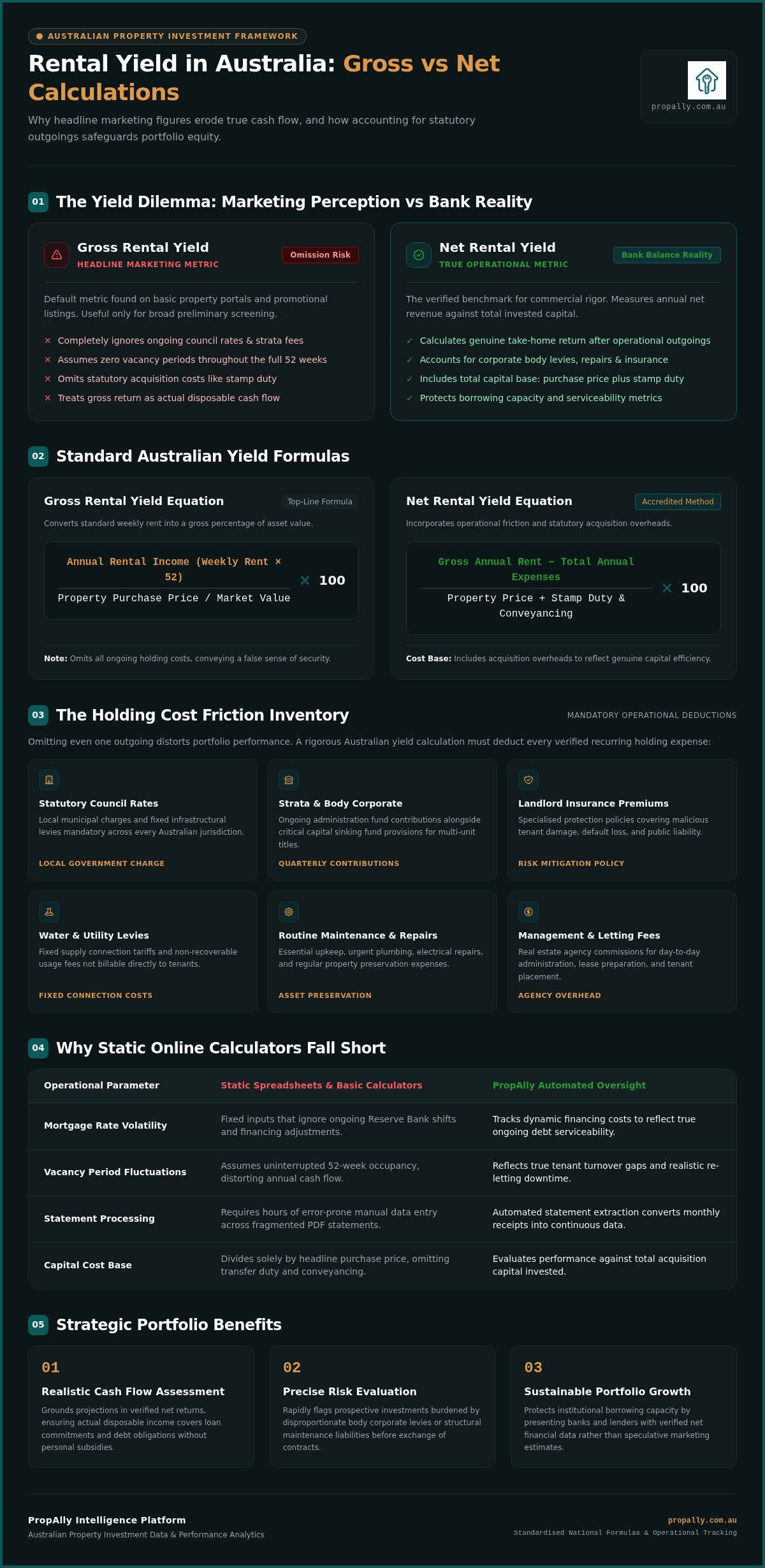
Gross rental yield offers rapid initial utility. The calculation multiplies weekly rent by 52 weeks, divides that total by the property purchase price or current market value, and multiplies the result by 100. Investors rely on this metric to screen prospective acquisitions rapidly across broad markets.
Its strength is simplicity. Its limitation is omission. Gross yield completely ignores ongoing operating charges, including council rates, strata levies, routine repairs, letting fees, and vacancy gaps. Treating gross return as disposable cash flow quickly leads to capital shortfalls.
The Critical Role of Net Rental Yield
Net rental yield provides true operational visibility. It divides net operating income (gross annual rent minus all operational outgoings) by the total capital invested, including statutory purchase costs like transfer duty.
- Realistic cash flow assessment: Reflects actual disposable income after mandatory property expenses.
- Precise risk evaluation: Identifies properties burdened by disproportionately high ongoing maintenance or corporate body charges.
- Sustainable portfolio expansion: Protects borrowing capacity by ensuring serviceability calculations reflect verified net returns rather than marketing estimates.
Relying on net yield grounds your investment strategy in verifiable data. It transforms optimistic assumptions into disciplined, repeatable financial oversight.
Step-by-Step Rental Yield Calculation: Formulas and Practical Framework
Precision calculation requires moving beyond high-level estimates to process verifiable balance sheet entries. Calculating yield correctly means converting weekly rental payments into annual figures and structuring every incoming dollar alongside its operational cost. Rather than depending on a basic rental yield calculator Australia property listings provide, investors must standardise their mathematical workflow using verified national formulas.
Accurate reporting begins with precise income classification. Consult the official ATO Guide to Rental Income to ensure every assessable payment, including utility recoveries and forfeited tenant bonds, is captured correctly in your gross operating baseline.
The Standard Yield Formulas Explained
Both calculations rely on standard percentage models, but their operational inputs differ significantly:
- Gross Rental Yield:
(Annual Rental Income / Property Value) × 100 - Net Rental Yield:
[(Annual Rental Income - Total Annual Expenses) / Total Acquisition Base] × 100
To establish annual rent, multiply the weekly rate by 52. The critical variable in the net calculation is the total cost base. Seasoned investors divide net operating income by the purchase price plus initial acquisition overheads, such as conveyancing and stamp duty, to reflect true capital efficiency.
Comprehensive Inventory of Deductible Operational Expenses
Deductions must account for all recurring overheads that impact performance. Omitting a single cost category skews performance metrics and damages forward planning. A rigorous calculation tracks:
- Statutory Council Rates: Local municipal charges and fixed infrastructural levies.
- Water and Utility Levies: Fixed supply connection fees and non-recoverable usage costs.
- Strata and Body Corporate Fees: Ongoing administration fund contributions and capital sinking fund allowances for multi-dwelling titles.
- Professional Management Charges: Monthly agency percentages (typically 5% to 12% nationally) alongside standard tenant re-letting fees.
- Landlord Insurance Premiums: Comprehensive policies protecting against malicious tenant damage, loss of rent, and liability.
- Maintenance and Compliance: Routine plumbing, electrical checks, and mandatory annual smoke alarm certifications.
Collating these fragmented figures across multiple paper invoices is tedious. Investors seeking systematic control can leverage automated platforms like PropAlly to extract statement outgoings directly into a unified dashboard, keeping portfolio yield calculations mathematically sound.
Key Factors That Impact Australian Rental Yields Over Time
Yield isn't static. It fluctuates as market dynamics, borrowing terms, and tenancy stability evolve. When investors use a standard rental yield calculator Australia platforms host online, they evaluate a snapshot frozen in time. In real-world conditions, macro and microeconomic factors continuously shift your bottom line.
Interest rate movements hit operating returns immediately. When the Reserve Bank of Australia adjusts the official cash rate, variable mortgage repayments re-align. With average investor loan rates hovering around 6.4%, increased interest expenses quickly compress net margins, pushing properties with modest headline yields into negative cash flow territory. Reviewing the Australian Taxation Office guide to rental expenses helps confirm how deductible interest and recurring outgoings interact to affect post-tax returns.
Vacancy Rates and Cash Flow Volatility
Vacancy erodes net yield faster than almost any other operating cost. While national rental vacancy rates sit at historically low levels between 1.1% and 1.3%, an unexpected tenant transition still disrupts financial continuity. Just two weeks of lost rent slashes an asset's annual gross revenue by nearly 4%.
- Proactive renewal schedules: Open lease discussions 90 days before agreement expiry to eliminate gap weeks.
- Strategic rent reviews: Adjust weekly pricing inline with broader wage and CPI indices rather than pushing speculative hikes that trigger unnecessary tenant turnover.
- Maintenance response times: Resolving essential repairs promptly increases long-term tenant retention.
Capital Growth vs Rental Yield: The Strategic Trade-off
Australian property markets operate on an inverse relationship between capital appreciation and income yield. Assets situated in premium inner-ring locations frequently trade at higher price-to-rent multiples. They generate tighter gross yields (often below 3.5%), but offer strong historical equity gains.
Conversely, regional properties and higher-density units often return gross yields above 5.5% or 6.0%, yet they may deliver slower capital growth. Balanced portfolios rarely bet on one extreme. High-yielding assets fund the ongoing cash requirements of capital-growth properties, keeping your collective borrowing capacity intact across shifting credit cycles.
Why a Static Rental Yield Calculator Falls Short for Active Investors
Pre-purchase metrics quickly expire. While running numbers through a standard rental yield calculator Australia platforms provide works for initial screening, static math cannot manage active operations. Property ownership is dynamic. Rents adjust, insurance rates climb, and unexpected capital repairs alter your balance sheet overnight. Relying on an initial snapshot leaves you unprepared when actual outgoings diverge from your initial underwriting.
Spreadsheet administration introduces severe operational friction. Manual tracking across fragmented monthly statements inevitably leads to formula breakages, missing expense entries, and version control errors. Rather than wrestling with manual files, forward-thinking investors transition to a centralised property portfolio performance tracker to govern their assets with absolute administrative clarity.
The Limitations of One-Off Point-in-Time Estimates
Purchase-day yield assumptions degrade the moment settlement completes. When an air conditioning unit fails or an emergency roof leak requires immediate attention, your projected quarterly cash flow contracts instantly. A single unexpected repair can wipe out an entire quarter's surplus.
Annual holding costs don't stay fixed either. Council valuations adjust upward, strata committees issue special administration levies, and landlord insurance premiums change at annual renewal. Measuring portfolio health strictly against baseline acquisition yields obscures whether an asset is genuinely generating positive net cash flow today.
Eliminating the Administrative Burden of Manual Spreadsheets
Maintaining separate spreadsheets for multiple properties creates an unsustainable administrative bottleneck. Entering lines manually from differing agent statements wastes hours and introduces human errors that corrupt yield reporting. Investors need systematic processes that eliminate manual friction.
- Automated ingestion: Learn how to automate rental property data entry to extract rental income and line-item disbursements directly from monthly agency PDF statements.
- Standardised categorisation: Map outgoing expenses into uniform operational ledgers that align directly with national reporting standards.
- Tax-ready audit trails: Maintain a verifiable record of all receipts and invoices to simplify end-of-year reconciliations.
Take charge of your portfolio metrics today. Create your account and get started with PropAlly to replace outdated spreadsheets with dynamic cash flow tracking.
Moving from Manual Calculations to Centralised Portfolio Control with PropAlly
Managing an expanding property portfolio with single-use calculators and disparate balance sheets restricts long-term visibility. A standard rental yield calculator Australia investors access online provides initial clarity at purchase, but it cannot deliver ongoing operational intelligence. Sustainable wealth generation demands moving from static snapshots to active financial oversight. PropAlly bridges this operational divide, translating fragmented monthly documentation into continuous performance metrics.
Investors managing growing holdings can deploy structured solutions such as the PropAlly Starter Plan to establish comprehensive oversight from day one. Centralising multiple assets into a unified dashboard transforms disconnected property statements into a disciplined system of accountability.
Automated Financial Ingestion and Live Cash Flow Monitoring
Disparate agency statements represent a major administrative friction point for landlords with properties managed by different real estate agencies nationwide. PropAlly eliminates manual data entry by extracting line-item entries directly from agency statements.
- Automated Statement Extraction: Ingest PDF statements instantly, capturing exact management fees, repair disbursements, and rental distributions.
- Dynamic Net Yield Tracking: Monitor real-time net returns that adjust automatically as actual holding costs and maintenance debits register.
- Historical Trend Analysis: Track performance shifts over rolling quarters to inform capital deployment and evaluate borrowing terms.
Tax Compliance and Audit-Ready Record Organisation
True net yield is ultimately defended at tax time. Overlooking deductible property outgoings inflates taxable income, quietly draining investment capital. Operating within a dedicated ato rental property records app structure ensures that all ongoing expenses, from council rates to smoke alarm checks, align directly with national tax categorisation standards.
Eliminating spreadsheets protects your bottom line against calculation decay and administrative clutter. Real-time categorisation maintains an audit-ready financial trail, ensuring every deductible expense is preserved. By integrating active yield calculations with reliable portfolio administration, you maintain absolute control over every asset you own.
Take Strategic Control of Your Portfolio Returns Today
A static rental yield calculator Australia investors use during acquisition is only an initial baseline. Sustained investment success requires looking beyond top-line gross numbers to measure real holding costs, shifting interest rates, and ongoing maintenance. When you track outgoings systematically, net cash flow transforms from an educated guess into a predictable, measurable asset.
Built specifically for Australian property investors managing single or multiple holdings, PropAlly replaces manual admin with total portfolio visibility. Automated data extraction captures income and disbursements directly from agent statements nationwide, feeding a consolidated dashboard that delivers real-time net yield and ATO-aligned expense tracking. Stop losing hours to broken spreadsheets and fragmented paperwork. Take command of your property cash flow with PropAlly and manage your wealth with complete clarity and confidence.
Frequently Asked Questions
What is considered a good rental yield for residential property in Australia?
A competitive gross rental yield in Australia typically sits between 5% and 6%, though expectations vary across property types. With investor interest rates around 6.4%, yields below 4% generally create negative gearing scenarios where outgoings exceed rental revenue. For units, gross returns often run higher than detached houses. Ultimately, a strong yield depends on your balance sheet strategy, balancing immediate surplus cash flow against long-term capital appreciation potential.
How do you calculate gross rental yield using weekly rent?
To calculate gross yield, multiply your weekly rental rate by 52 to establish annual earnings, divide that figure by the total property value or acquisition cost, then multiply by 100. For example, generating A$650 per week on an A$750,000 asset yields 4.5% gross. Using a dedicated rental yield calculator Australia property investors utilise streamlines this initial formula, giving you a quick benchmark before factoring in deductible operational outgoings.
What is the main difference between gross rental yield and net rental yield?
The primary difference lies in operational deductions. Gross rental yield evaluates top-line rental income against property value, ignoring holding costs entirely. Net rental yield subtracts all ongoing operating expenses, including management fees, council rates, insurance, and routine maintenance, before dividing the resulting net operating income by the total acquisition cost base. Across Australian residential properties, the gap between gross and net yield typically spans 1.0 to 1.8 percentage points.
What common expenses should be deducted when calculating net rental yield?
Calculating net yield requires deducting all non-capital running expenses incurred during property ownership. Key deductions include local council rates, water supply levies, strata or corporate body administration fees, landlord insurance premiums, routine maintenance invoices, and agency property management fees. Investors should also factor in statutory compliance safety checks and an annual allowance for vacancy periods to ensure the resulting net percentage accurately reflects actual take-home investment returns.
Can rental yield change after an investment property is purchased?
Yes, rental yield changes constantly throughout your holding period. Because yield measures annual income against current asset valuation, any change in market rent or capital value alters the metric. Rents may increase during annual reviews, lifting gross returns. Conversely, unexpected holding costs, escalating strata levies, special levies, or shifting mortgage repayments directly compress net yield. This volatility makes dynamic portfolio tracking essential rather than relying on purchase-day calculations.
Why do high-yield properties sometimes deliver lower capital growth?
High-yield assets frequently trade in markets where tenant demand outpaces buyer capital growth pressure. In these locations, lower land values keep purchase prices accessible relative to achievable weekly rents, producing attractive yield percentages. However, long-term capital growth is predominantly driven by underlying land value appreciation in high-demand, supply-constrained areas. Properties positioned for significant capital appreciation usually demand higher purchase prices, which mathematically compresses their immediate rental yield.
How does an automated property management platform improve yield tracking over a spreadsheet?
Manual spreadsheets depend on tedious manual data entry that quickly breaks when receipts, rate notices, and agent statements accumulate. An automated property management platform ingests agency statements directly, categorises operational outgoings automatically, and calculates live net yields across multiple assets. Instead of relying on a static rental yield calculator Australia buyers run once, software connects ongoing income directly to ATO-aligned expense records, giving investors continuous financial visibility without administrative disorder.