

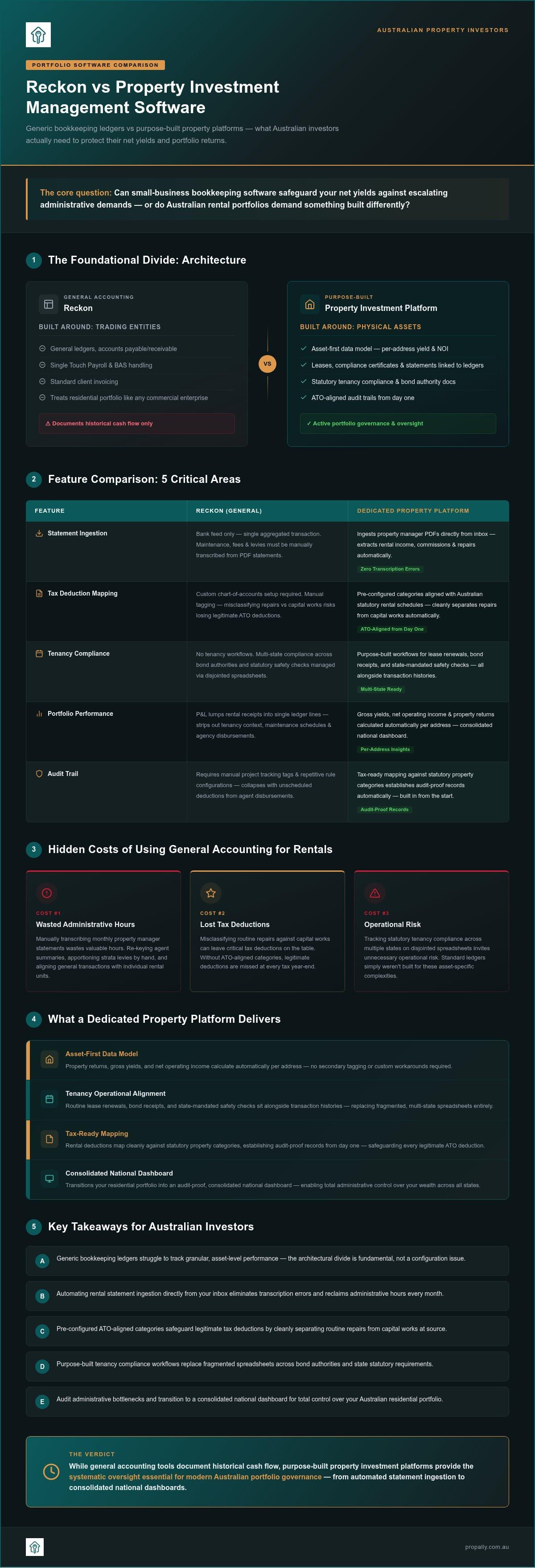
General accounting tools record historical transactions; specialised property platforms drive active portfolio governance. When evaluating reckon vs property investment management software for your Australian rentals, the core question isn't just about balancing numbers. It's about whether small-business bookkeeping software can actually safeguard your net yields against escalating administrative demands.
Manually transcribing monthly property manager statements wastes valuable hours. Worse, misclassifying routine repairs against capital works can leave critical tax deductions on the table, while tracking statutory tenancy compliance across multiple states on disjointed spreadsheets invites unnecessary operational risk. Standard ledgers simply weren't built for these asset-specific complexities.
Discover how general accounting software compares against specialised property investment platforms to protect your portfolio returns. We examine statement automation, ATO-aligned audit trails, and portfolio consolidation so you can establish total administrative control over your wealth.
Key Takeaways
- Weighing reckon vs property investment management software reveals why generic bookkeeping ledgers struggle to track granular, asset-level performance.
- Automate rental statement ingestion directly from your inbox to eliminate transcription errors and reclaim administrative hours every month.
- Safeguard legitimate tax deductions using pre-configured categories aligned with Australian statutory rental schedules to cleanly separate repairs from capital works.
- Replace fragmented spreadsheets with purpose-built workflows designed for statutory tenancy compliance and state bond authority documentation.
- Audit administrative bottlenecks to transition your residential portfolio into an audit-proof, consolidated national dashboard.
Evaluating Reckon vs Property Investment Management Software for Portfolios
Managing Australian real estate requires financial precision, but standard business ledgers were never constructed around rental mechanics. In any rigorous comparison of reckon vs property investment management software, the foundational divide lies in software architecture. Small business accounting platforms track trading entities, whereas purpose-built property software structures every workflow directly around physical real estate assets.
When you consult a broader comparison of general accounting software, the standard capability set is clear: general ledgers, accounts payable, accounts receivable, and merchant reconciliation. These metrics suit companies selling billable hours or physical stock. However, a generic profit-and-loss report lumps rental receipts into single ledger lines, stripping out the operational context of tenancy agreements, routine maintenance schedules, and agency disbursements.
Bridging this gap manually demands constant spreadsheet reconciliation. Property investors find themselves re-keying monthly agent summaries, apportioning strata levies by hand, and attempting to align general transactions with individual rental units. To see how specialized systems replace this administrative friction with end-to-end automation, review our guide on property management tools for investors.
The Core Purpose of General Accounting Platforms
Reckon delivers dependable small-business utility. It handles Single Touch Payroll, Business Activity Statements (BAS), and standard client invoicing with ease. Yet it treats a residential portfolio like any ordinary commercial enterprise. Tracking individual properties requires custom chart-of-accounts setups, manual project tracking tags, and repetitive rule configurations that collapse the moment an agent deducts an unscheduled council rate payment from your net disbursement.
The Architecture of Dedicated Property Investment Platforms
Dedicated property software reverses this static hierarchy. Everything starts with the asset. The software links leases, compliance certificates, and property manager statements directly to financial ledgers.
- Asset-first data models: Property returns, gross yields, and net operating income calculate automatically per address without secondary tagging.
- Tenancy operational alignment: Routine lease renewals, bond receipts, and state-mandated safety checks sit alongside transaction histories.
- Tax-ready mapping: Rental deductions map cleanly against statutory property categories, establishing audit-proof records from day one.
Evaluating reckon vs property investment management software ultimately comes down to administrative control. While general accounting tools document historical cash flow, purpose-built platforms provide the systematic oversight essential for modern portfolio governance.
Feature Comparison: Small Business Bookkeeping vs Dedicated Property Systems
Side-by-side software assessments often focus solely on invoice matching. Yet pitting reckon vs property investment management software exposes critical functional divides across automation, risk management, and regulatory compliance. Small business accounting platforms monitor basic bank flows. Purpose-built property engines automate the operational life cycle of physical property portfolios.
Statement Ingestion and Document Automation
Reckon relies heavily on live bank feeds. When your managing agent deposits net rent, Reckon flags a single aggregated transaction. It cannot see the maintenance callouts, letting fees, or strata levies deducted before disbursement. You must manually open each PDF statement and transcribe these deductions line by line. Specialized systems ingest property manager PDF statements directly from your email inbox. The platform extracts rental income, management commissions, and sundry repairs automatically, eliminating transcription errors entirely. Learn the mechanics in our guide on how to automate rental property data entry.
National Tenancy Compliance and Governance
General accounting packages provide zero framework for tracking statutory tenancy deadlines. If an electrical safety inspection expires, Reckon remains silent. Dedicated property software integrates built-in compliance registers that track state bond authority lodgements, routine inspection cycles, and mandatory safety certifications across all states. You can systematically audit your portfolio obligations using our comprehensive investment property compliance checklist.
- Bond authority tracking: Centralise verification numbers and lodgement receipts across diverse state bodies in one interface.
- Safety certifications: Schedule recurring alerts for mandatory smoke alarm checks and gas safety certificates.
- Lease governance: Retain clear document trails for fixed-term lease expirations, rent review schedules, and condition reports.
Tax Categorisation and ATO Alignment
Tax preparation reveals another stark contrast in the reckon vs property investment management software showdown. In Reckon, investors must manually engineer custom accounts to separate immediately deductible repairs from depreciable capital works. Misclassifications create substantial audit exposure under the Australian Taxation Office rental property guide. In contrast, dedicated property technology features pre-configured tax categories that mirror the statutory rental schedules on your annual return, keeping borrowing expenses and capital allowances completely separate.
If you want to replace manual transcription with automated statement reading and state compliance tracking, explore how PropAlly brings effortless order to multi-property management.
The True Cost of Adapting General Accounting Tools for Rental Portfolios
A common argument among investors is that an active subscription to a general ledger is good enough for a few rental properties. On paper, it looks economical. In practice, forcing a small-business platform to do the job of a specialist engine introduces heavy manual labour. When weighing reckon vs property investment management software, the true cost isn't the software subscription; it's the unbilled hours spent retrofitting accounts that were never structured for residential assets.
Professional industry standards, including those promoted by the Property Investment Association of Australia, highlight that robust governance protects long-term portfolio yields. Relying on makeshift spreadsheets and disconnected software workarounds erodes that protection. It wastes personal time and inflates professional advisory costs at tax time.
Manual Entry Overhead and Data Reconciliation Gaps
Bank feeds tell only half the truth. When a property manager disburses funds, your bank account registers a single net figure. It leaves behind the gross rent, letting fees, smoke alarm testing charges, and repair bills deducted at the source.
Reconciling these items manually requires downloading PDF statements, calculating gross rental figures, and typing individual expense lines into custom accounts. Transcribing these numbers every month invites simple human error. Typographical mistakes compound across financial quarters, obscuring true cash performance and distorting yield metrics.
- Net deposit blindness: Bank feeds miss hidden deductions taken by managing agents before funds hit your account.
- Manual transcription drift: Retyping numbers across dozens of monthly statements creates balance discrepancies.
- Custom account maintenance: Building individual sub-accounts for every property asset consumes significant administrative time.
Audit Vulnerability and Tax Preparation Inefficiencies
General accounting tools are built around standard business charts of accounts. They lack automated prompts to align your deductions with statutory tax return categories. Misclassifying an initial capital repair as an immediately deductible routine expense triggers audit red flags. When the Australian Taxation Office requests substantiation, general software rarely maintains the linked digital paper trail required to verify claims instantly.
Accountants spend hours untangling misallocated repairs, chasing missing PDF invoices, and re-sorting receipts to compile statutory schedules. This administrative mess directly inflates annual tax preparation invoices. Building a clean, audit-proof system requires specialised tools; discover proven record-keeping strategies in our breakdown of the ATO rental property records app.
Resolving the debate around reckon vs property investment management software comes down to accountability. Makeshift ledgers leave you exposed to administrative friction and tax risk, while dedicated software builds an airtight, repeatable workflow.
How Australian Investors Should Evaluate Dedicated Property Management Software
Selecting the right technological foundation requires looking beyond basic bookkeeping features. When assessing reckon vs property investment management software, Australian property investors need a systematic framework that prioritises administrative automation, compliance governance, and portfolio scalability. Evaluating platforms through a structured, multi-step audit ensures you adopt an engine engineered for long-term wealth protection.
- Audit data intake bottlenecks: Quantify the hours spent handling email attachments, paper invoices, and monthly property manager statements.
- Verify automated extraction: Confirm the platform uses direct inbox ingestion to parse PDF disbursements into granular financial items automatically.
- Review state compliance registers: Ensure the software tracks regional tenancy rules, mandatory safety certificates, and state bond authorities.
- Check national tax alignment: Check that expense categories map directly to official Australian rental tax schedule items.
- Evaluate portfolio scalability: Ensure the software handles growth smoothly across multiple properties without requiring complex ledger rebuilds.
Automation Capabilities and Inbox Processing
Modern property technology should eliminate manual transcription entirely. Rather than relying on you to download and key in monthly agency disbursements, advanced systems ingest statements straight from your email inbox. The software reads the underlying PDF, identifying water consumption charges, letting fees, routine maintenance invoices, and management fees. Crucially, each original source document remains permanently attached to the corresponding financial record, creating a verifiable audit trail.
Portfolio Performance and Cash Flow Visibility
Generic accounting tools obscure asset-level returns behind entity-wide profit-and-loss summaries. Dedicated platforms provide dedicated dashboards that calculate gross yields, operating margins, and true net rental cash flows in real time. They track cash flow variances during vacancy phases and highlight shifting return metrics as financing costs change. To dive deeper into these core metrics, consult our complete property portfolio performance tracker guide.
Making the right choice in the reckon vs property investment management software decision means selecting a platform that actively reduces administrative stress. To replace manual workarounds with an automated, purpose-built portfolio hub, get started with PropAlly today.
Achieving Total Portfolio Control with Purpose-Built Property Technology
Replacing generic bookkeeping workarounds with specialised architecture transforms property administration from an ongoing chore into a streamlined, automated operational routine. In the debate between reckon vs property investment management software, the turning point arrives when manual workarounds begin eroding your personal time. Migrating to purpose-built technology delivers immediate operational relief, replacing disconnected ledgers with absolute clarity across your entire portfolio.
A centralised system removes the friction of hunting through scattered email threads and desktop folders. Tenancy compliance certificates, state bond authority records, and monthly property manager statements converge into one permanent repository. Every financial figure links directly to its underlying document, providing the transparent governance required for confident long-term investing.
Eliminating Administrative Chaos Through Specialised Architecture
Small-business tools force you to act as an unpaid bookkeeper, manually adapting rigid charts of accounts to match tenancy realities. Specialised software eliminates this administrative drag entirely.
- Single national dashboard: Review gross yields, operating expenses, and net cash flow across your complete portfolio in real time.
- Tax-aligned reporting: Present your accountant with structured figures mapped directly to Australian statutory rental schedules, eliminating billable clean-up hours.
- Secure document hub: Store digital statements, condition reports, and safety certificates securely in dedicated cloud infrastructure.
Your tax adviser receives reconciled, audit-ready data rather than unorganised receipts, turning annual lodgements into a frictionless verification process.
Selecting the Right Operational Plan for Your Portfolio
Modern property platforms scale alongside your real estate ambitions, providing the flexibility needed as holdings expand. You can establish baseline oversight on a Free Plan, then step up into automated data extraction as statement volume increases.
Private landlords managing growing residential holdings require deeper automation. Upgrading to tiered options like the Pro Plan or Business Plan introduces sophisticated multi-property monitoring. Investors seeking effortless inbox processing can activate an Email Basic Add-on or Email Unlimited Add-on to digest statements automatically without lifting a finger.
For investors ready to move past manual spreadsheets and generic accounts, discover the tailored features of the PropAlly Starter Plan. Settle the reckon vs property investment management software choice definitively by securing total administrative control. Join the PropAlly platform today to establish an audit-proof foundation for your investments.
Upgrade from Static Bookkeeping to Intelligent Portfolio Governance
Your residential investments require infrastructure built specifically for real estate, not generic trading businesses. Resolving the choice between reckon vs property investment management software comes down to operational capability. Standard business ledgers track historical bank entries, but purpose-built platforms actively safeguard your net rental yields and administrative sanity.
PropAlly establishes total administrative control for Australian property investors. Automated statement ingestion directly from your email inbox eliminates manual spreadsheet reconciliations, while pre-configured, ATO-aligned tax categories ensure every repair and capital allowance is classified correctly from day one. Instead of juggling fragmented files, you maintain continuous visibility over multi-state tenancy compliance, bond receipts, and true asset performance in one consolidated dashboard.
Free yourself from manual transcription errors and messy end-of-year tax preparation. Take command of your portfolio with PropAlly and establish an audit-proof, stress-free foundation for your property wealth today.
Frequently Asked Questions
Can I use Reckon to track my Australian investment properties?
Yes, you can track rental income and expenses in Reckon, but it requires significant manual setup. Reckon is engineered for trading businesses rather than residential real estate. You'll need to manually configure your chart of accounts, set up sub-classes for individual properties, and transcribe monthly agent statements line by line. It lacks automated document parsing and native tenancy compliance registers.
How does dedicated property investment software differ from standard accounting platforms?
Dedicated property software structures every workflow directly around physical real estate assets rather than generic business ledgers. When comparing reckon vs property investment management software, the distinction lies in asset governance. Dedicated platforms automate statement ingestion, track statutory tenancy compliance across states, and map expenses directly to Australian tax return categories, whereas standard ledgers only record raw debits and credits.
Can property investment software automatically extract data from my property manager's statements?
Yes, modern property platforms can ingest and process PDF statements directly from your email inbox. Systems like PropAlly read incoming managing agent statements, extracting rental disbursements, management commissions, letting fees, and maintenance charges automatically. This eliminates manual data entry, prevents transcription mistakes, and permanently links original PDF receipts to digital transaction records for effortless record-keeping.
How do purpose-built platforms help ensure compliance with the Australian Taxation Office?
Purpose-built platforms categorise income and expenses using pre-configured categories that match official statutory rental schedules. Standard accounting systems leave tax mapping to manual entry, risking costly misclassifications between immediately deductible repairs and depreciable capital works. Dedicated software isolates capital allowances, tracks borrowing expenses, and maintains linked digital receipts, ensuring your records remain fully verifiable during tax reviews.
Do I still need an accountant if I use dedicated property management software?
Yes, dedicated software does not replace licensed professionals or provide financial and tax advice. Instead, the platform organises, tracks, and consolidates your portfolio's administrative records so that your tax professional receives clean, audit-ready data. By eliminating shoeboxes of loose receipts and messy spreadsheets, the software reduces billable reconciliation hours during annual tax preparation.
Can property management software handle tenancy compliance across different Australian states?
Yes, specialised property software provides compliance tracking tailored to specific state legislation. Australian tenancy regulations differ across jurisdictions. Purpose-built platforms track mandatory safety checks, such as annual smoke alarm testing and routine electrical safety checks, while logging official bond authority lodgements. This unified tracking prevents missed renewal deadlines and protects landlords against statutory compliance breaches nationally.
Is general bookkeeping software cheaper than dedicated property investment software?
Entry-level bookkeeping subscriptions might appear cheaper upfront, but they carry heavy hidden labour costs. In the choice between reckon vs property investment management software, the hours spent manually retyping statements and untangling spreadsheets quickly erase nominal savings. Dedicated platforms offer tiered options, ranging from a Free Plan to a Starter Plan, delivering automated extraction that reclaims personal time.