
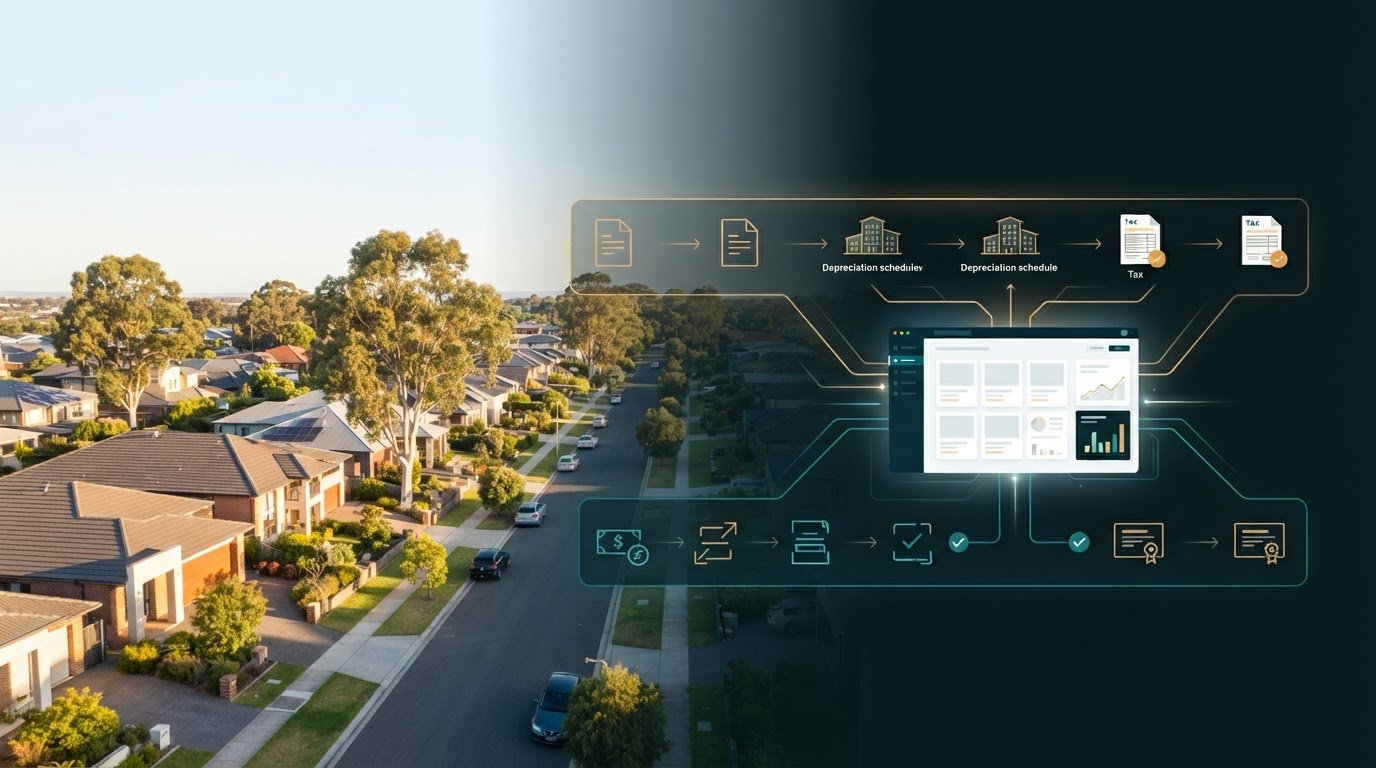
The better landlord software isn’t necessarily the platform with the longest feature list. In this propkt vs propally landlord software comparison, the key question is which tool fits the way you manage Australian rental records, tax preparation and state-based tasks, especially when information is spread across properties or agents.
That’s a familiar challenge for investors. Product descriptions can be hard to translate into everyday workflows, and a feature that sounds useful may not solve the admin you face each month. Propkt focuses on landlord workflows including tenancy documents, depreciation calculations and tax-package exports. PropAlly centres on consolidated portfolio administration, with tools for cash flow, document processing, compliance tracking and bond evidence.
This comparison looks beyond feature counts. It explains where the platforms differ, what their Australian-focused workflows are designed to support, and how portfolio limits and plans may suit different needs. Use it to weigh your priorities and keep software calculations and records distinct from professional tax advice or legal guidance.
Key Takeaways
- Use the propkt vs propally landlord software comparison to assess workflow fit, not just feature counts. Distinguish investor record-keeping tools from agency operations platforms.
- Compare matched tasks such as cash-flow tracking, property records, document capture and multi-property oversight.
- Australian-focused tax, bond and compliance workflows can support administration, but they don’t guarantee legal or tax outcomes.
- Match plan limits and document-processing needs to your portfolio. PropAlly’s Free Plan covers one property, while paid plans support up to twenty.
- Use your portfolio size, document volume and Australian record-keeping priorities to narrow down which platform best fits your day-to-day needs.
Propkt vs PropAlly: What kind of landlord software are you comparing?
Which platform helps you keep rental-property records organised, rather than run a tenancy day to day? That distinction matters in a propkt vs propally landlord software comparison. Landlord software covers different tools and tasks, so compare what each product does in practice, including its intended users, features and plan limits.
This comparison focuses on investor administration: portfolio records, document handling, tax organisation, compliance workflows and plan fit. That differs from software built primarily for real-estate agency operations, such as managing tenancy tasks across an agency’s rent roll. A broader property management system may serve different users and workflows, so the label alone doesn’t tell you whether a product matches an owner’s needs.
Who is each platform designed to help?
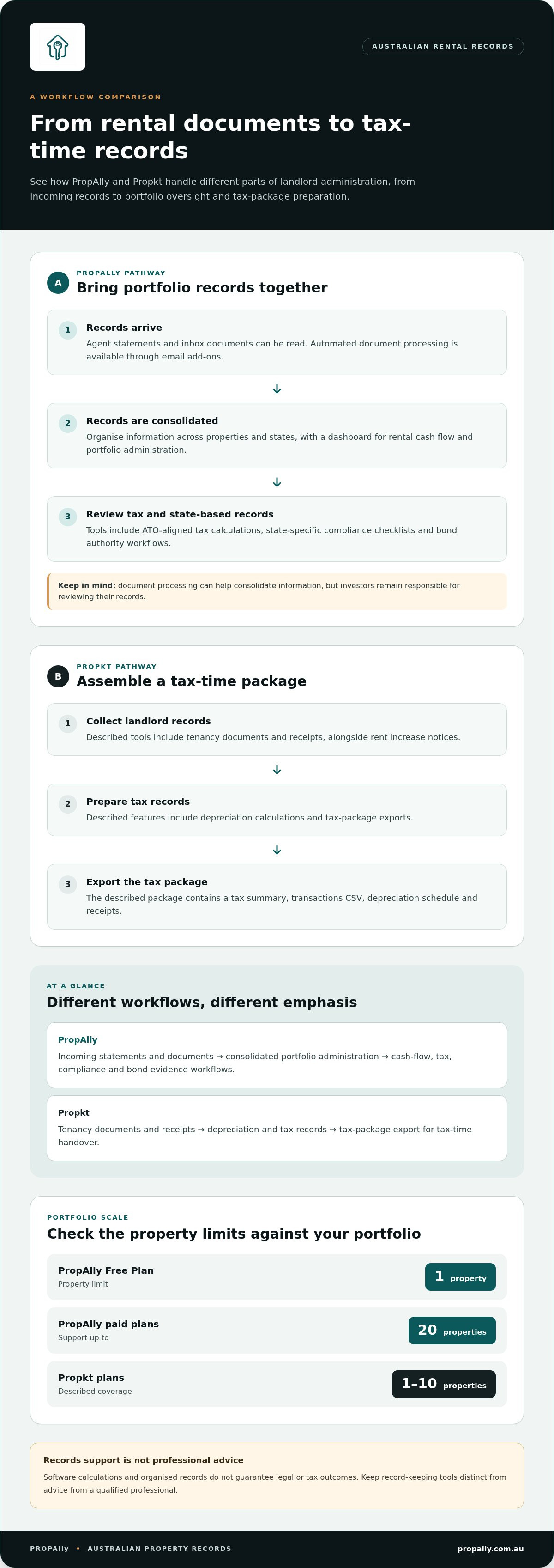
PropAlly is an Australian property-investor dashboard for tracking rental cash flow, tax, compliance and bond evidence. It can consolidate information across properties and states, read agent statements and inbox documents, and support state-specific compliance and bond authority workflows.
Propkt’s described tools include tenancy documents, rent increase notices, depreciation calculations and tax-package exports. These features relate to landlord administration and tax-time organisation. Investors comparing the platforms should separate record-keeping tasks from day-to-day tenancy management, which can involve handling tenant requests and coordinating property matters. Those are related, but not interchangeable, responsibilities.
What does “landlord software” mean here?
Investor-focused landlord software helps Australian property owners organise rental records, documents and portfolio administration. It doesn’t, by itself, manage a tenancy or provide professional advice. PropAlly supports investor administration. It doesn’t provide property management services or financial and tax advice. Its ATO-aligned tax calculations are software tools for organising records, not a substitute for advice from a qualified professional.
The table summarises the workflows described for each platform, so you can see which tasks to compare against your own portfolio.
| Criteria | Propkt | PropAlly | What to compare |
|---|---|---|---|
| Intended user | Landlords organising tenancy documents and tax records. | Australian property investors managing portfolio administration. | Choose the workflow that matches your role as an owner or investor. |
| Records and documents | Described features include tenancy documents, receipts and tax-package exports. | Can read agent statements and inbox documents, and consolidate information across properties and states. | Compare document capture, organisation and export tasks. |
| Tax and compliance | Described features include depreciation calculations and tax-package exports. | Includes ATO-aligned tax calculations, state-specific compliance checklists and bond authority workflows. | Distinguish record-keeping support from tax or legal advice. |
| Plan fit | Described plans cover one property and up to ten. | Free Plan covers one property; paid plans support up to twenty. | Match the property limit and included workflows to your portfolio. |
Compare Propkt and PropAlly’s core landlord workflows
Compare the work each platform helps you complete, not just the number of features on a product page. In this propkt vs propally landlord software comparison, useful checks include how rental documents enter the system, whether information is organised by property, and how easily you can review cash flow across a portfolio. The differences become clearer when you compare these tasks side by side.
How do the platforms handle rental documents and agent statements?
PropAlly can read agent statements and inbox documents, helping bring property information together rather than leaving every record scattered across emails and files. Automated document processing is available through email add-ons. This can help investors consolidate information across properties, while still leaving them responsible for reviewing their records.
Propkt’s described tax-package export contains a tax summary, transactions CSV, depreciation schedule and receipts. That supports the collection of records for tax-time handover, but it is a different workflow from reading incoming statements and populating records. When comparing the platforms, consider whether you mainly need to assemble and export tax records or process documents as they arrive.
How do dashboards support portfolio and cash-flow oversight?
PropAlly is designed to track rental-property cash flow and consolidate information across properties and states. That can help an investor bring agent statements and property records into a broader portfolio view. Propkt’s described tax-package export focuses on assembling tax records, so compare that task separately from a dashboard for ongoing cash-flow and multi-property oversight.
For tax records, software can help organise information, but it doesn’t determine your obligations. Use the ATO rental property guide as the authoritative reference for rental income and expenses. A dashboard is most useful when it makes the records you need easier to review and maintain.
- Document workflow: PropAlly can read agent statements and inbox documents. Propkt’s described export bundles tax records and receipts.
- Portfolio view: PropAlly’s product details include cash-flow tracking and consolidation across properties and states.
- Reporting: Propkt’s described tax-package export includes a summary and transaction file. Compare that with the portfolio view and records you need to review regularly.
If consolidated investor records are your priority, explore the PropAlly property-investor dashboard as one option for managing that workflow.
Compare Australian tax, bond and compliance record workflows
Tax records, bond evidence and state-based tasks are useful comparison points when the software’s role is clear. Software can help organise information and support consistent record-keeping, but it can’t guarantee a legal outcome or replace professional tax advice. In this propkt vs propally landlord software comparison, look at how each platform supports those administrative tasks and keep the limits of software calculations in mind.
How does each platform organise tax records for Australian investors?
PropAlly calculates tax using ATO-aligned logic and brings tax records into its investor dashboard. This describes software support for organising information and calculations, not ATO approval, a guaranteed return outcome or tax advice. Investors can refer to the ATO guide to rental property records for official information on rental income, expenses and record-keeping.
Propkt’s described features include depreciation calculations and a tax-package export with a tax summary, transactions CSV, depreciation schedule and receipts. Compare how these functions fit your tax-record workflow, and remember that software tools don’t replace advice about your circumstances.
Can the software help track bonds and state-based tasks?
PropAlly includes state-specific compliance checklists and bond authority workflows. These can help organise tasks and bond-related records across a portfolio, including properties in different states. A checklist supports administration; it doesn’t establish that a landlord has met every applicable obligation or determine the outcome of a bond matter. Check requirements with the relevant authority for the property’s jurisdiction.
For a broader view of the records and tasks landlords may need to organise, use an Australian investment property compliance checklist alongside the relevant state or territory authority’s guidance. Keep the source and date of important records in your own notes, especially when requirements or software features change.
- Tax: PropAlly’s ATO-aligned calculations support record organisation, not tax advice or a guaranteed result. Propkt’s described tax tools include depreciation calculations and a tax-package export.
- Bonds and compliance: PropAlly provides bond authority workflows and state-specific checklists.
- Decision point: Compare how each product organises records and tasks, not whether it promises a legal or tax outcome.
Compare plan fit, portfolio scale and document processing
Plan fit depends on more than the property cap. Consider how many properties you need to track, how often records arrive, and whether manual entry is manageable. In a propkt vs propally landlord software comparison, match each plan’s limits and features to your actual portfolio and document workload. No single structure suits every Australian investor.
Which plan structure suits a single property or a growing portfolio?
PropAlly offers a Free Plan for one property, while its paid plans support portfolios of up to twenty properties. That gives a single-property owner a way to start with a smaller portfolio, while investors with multiple properties can consider a paid tier based on their records and workflow needs. The Starter Plan is one option to assess against your requirements.
Propkt’s described plan structure includes a Solo Plan for one property and a Pro Plan for up to ten. Compare property limits, included workflows and any document allowances, rather than relying on plan names alone. A plan that fits today should also suit the records you expect to manage as your portfolio changes.
How should landlords assess automated document processing?
PropAlly offers optional email document-processing add-ons. Plan information gives monthly processing volumes from 500 documents on Pro to 2,000 on Business. These figures can help investors estimate capacity, but the right fit depends on how many agent statements and other property documents arrive, and how much manual entry they want to reduce. Avoid treating a document allowance as a promise of time or cost savings.
Propkt’s described tax-package export supports assembling tax records. When comparing document workflows, distinguish that from automated incoming-document capture and extraction. Consider which records you currently enter manually and whether you need a system to organise documents as they arrive.
Use this quick assessment before choosing:
- Count properties: Compare your current portfolio and likely near-term needs with each platform’s property limits.
- Estimate documents: Review a typical month of statements and inbox records, then compare that volume with documented processing allowances.
- Check workflow fit: Decide whether you need automated document handling or simply a place to organise records and reports.
For a closer look at how a plan fits your records workflow, explore PropAlly’s portfolio and document tools.
Which landlord software should you choose: Propkt or PropAlly?
The right choice is the one that fits your portfolio and the administration you want to bring under control. In this propkt vs propally landlord software comparison, use a simple sequence: count properties, identify recurring record-keeping tasks, estimate incoming document volume, then compare those needs with each product’s features and plan limits. Don’t treat a longer feature list as proof of a better fit.
A practical checklist for making the final comparison
Start with the records you handle regularly: agent statements, rental income and expenses, tax documents, bond evidence and state-based tasks. Mark which ones currently require manual entry or are spread across separate files. Then compare each platform against those priorities.
- Portfolio size: PropAlly’s Free Plan covers one property, and paid plans support up to twenty. Propkt’s described plans cover one property and up to ten.
- Core workflow: Decide whether you need consolidated cash-flow, tax, compliance and bond records, or a more specific function such as assembling a tax package.
- Document volume: Estimate how many statements and other documents arrive in a typical month. Compare that with each product’s documented processing limits and note what requires manual handling.
- Must-haves: Separate essential workflows from useful extras. Check that the features you rely on are included in the plan you’re considering.
When might PropAlly’s investor dashboard be the better fit?
PropAlly may suit investors who want a consolidated view of rental cash flow, tax records, compliance tasks and bond evidence across properties and states. Its ability to read agent statements and inbox documents is relevant if gathering and entering those records takes up too much administrative time. Optional email document add-ons support higher processing volumes, so compare your expected workload with the available plan details.
Propkt may suit an investor whose priorities align with its described workflows, such as its tax-package export and property limits. That isn’t enough, on its own, to establish an overall winner. Match the functions you’ll use repeatedly against the records you need to maintain, then choose accordingly.
If PropAlly’s investor-dashboard approach matches your needs, explore PropAlly’s Starter Plan and compare its inclusions with your must-have workflows.
Choose the workflow that brings your records together
The practical takeaway from this propkt vs propally landlord software comparison is to choose by workflow fit, not feature count. Start with your portfolio size, the records you manage regularly and the amount of document handling you want to reduce. Compare each platform’s features and plan limits against those needs.
PropAlly is designed as an investor dashboard for cash flow, tax records, compliance tasks and bond evidence. Its document tools can read agent statements and inbox documents, while Australian-focused features include state-specific compliance checklists and bond authority workflows. These tools support administration and record organisation; they don’t replace professional tax advice or determine legal outcomes.
If bringing those investor workflows into one dashboard suits your priorities, explore PropAlly’s Starter Plan and review its inclusions against the tasks you want to manage. Choose a workflow that makes your property records easier to organise and oversee.
Frequently Asked Questions
Is PropAlly or Propkt better for Australian landlords?
Neither is automatically better; choose the platform whose workflows match your portfolio. Propkt’s described tools include Australian tenancy documents, rent increase notices, depreciation calculations and a tax-package export. PropAlly focuses on investor administration, with cash-flow, tax, compliance and bond records in a dashboard, plus agent-statement and inbox document reading. This propkt vs propally landlord software comparison is most useful when you compare the tasks you need to manage, not just feature counts.
What is the difference between landlord software and property management software?
Landlord software for investors helps owners organise property records, documents, cash flow and compliance tasks. Property-management software generally supports operational tenancy and agency workflows, such as handling tenant requests or managing a rent roll. The categories can overlap, so assess what each product actually does. PropAlly is an investor administration dashboard; it doesn’t provide property management services, financial advice or tax advice.
Can PropAlly read rental statements automatically?
Yes. PropAlly can automatically read statements from agents and documents sent to inboxes, helping consolidate property information across multiple properties and states. Automated email document processing is also available through optional add-ons. The software’s ability to read a statement doesn’t remove the need to review your records for accuracy.
Does PropAlly support Australian rental property tax records?
Yes. PropAlly helps investors organise rental-property tax information and uses ATO-aligned logic for tax calculations. These are software tools for record-keeping and calculation, not tax advice, an ATO-approved outcome or a guarantee of compliance. Keep supporting documents and use official Australian Taxation Office guidance or a qualified tax professional for advice about your circumstances.
Can landlord software track rental bonds across Australian states?
Some landlord software can help organise bond evidence or related workflows, but capabilities vary by product. PropAlly provides bond authority workflows and tracks bond evidence, alongside state-specific compliance checklists. Treat these as administrative support, not a guarantee of meeting legal requirements or resolving a bond dispute. Check the relevant state or territory authority for current requirements that apply to your property.
How should I compare landlord software plans for my portfolio?
Start with your property count, then list the records and recurring tasks you want to manage, such as agent statements, tax documents, bond evidence and compliance reminders. Compare those needs with plan limits and document-processing allowances. PropAlly’s Free Plan covers one property, while paid plans support up to twenty. Also consider how many documents arrive each month and which tasks still require manual entry.