

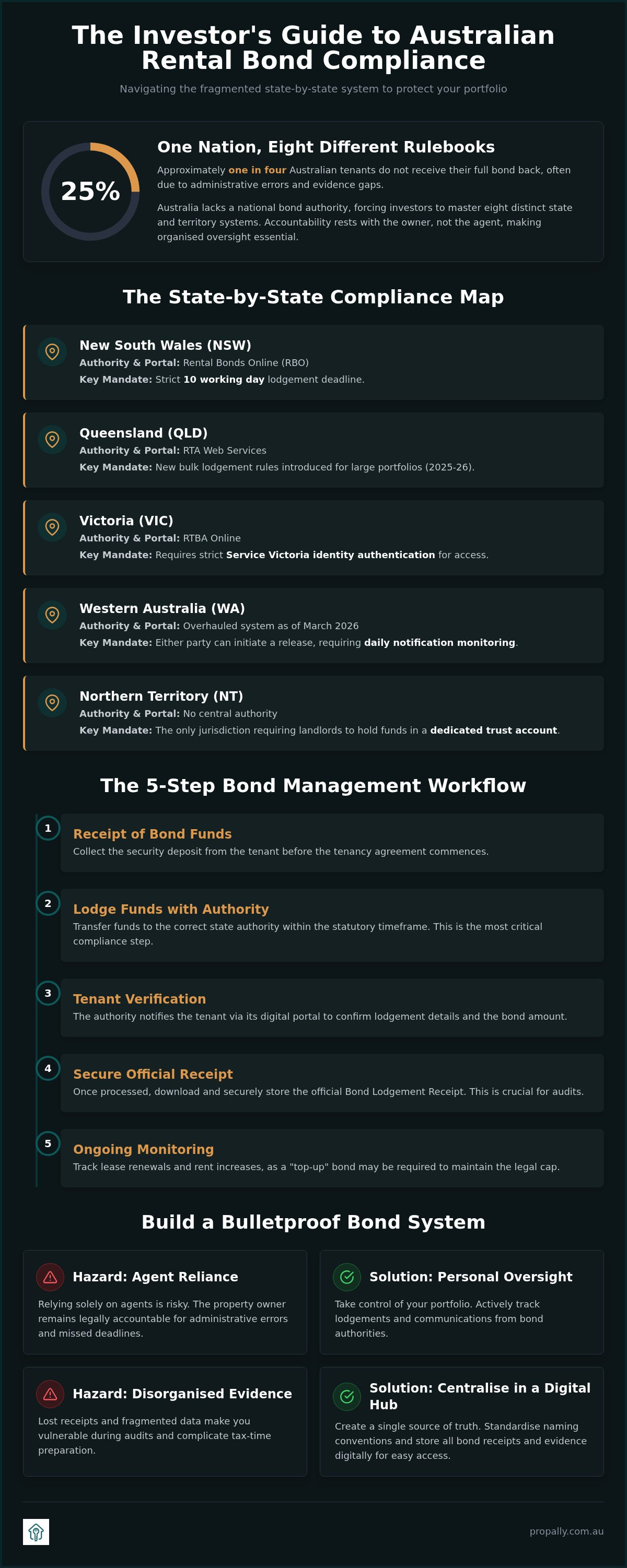
Approximately 25 per cent of Australian tenants do not receive their full bond back, often due to evidentiary gaps that catch investors off guard. As of late 2026, the rental bond authority workflow Australia requires has become more fragmented than ever. Managing a multi-state portfolio now means juggling eight distinct sets of regulations, from Victoria’s new evidence mandates to the Northern Territory’s unique trust-based system. It is a compliance minefield that rewards the organised and penalises the distracted.
You likely feel the weight of this administrative chaos. Manually entering data from agent statements is tedious. Losing a single receipt before tax time is stressful. You want control over your investments, not a mountain of paperwork. The fear of non-compliance fines is real, especially when state rules shift without warning. We understand the pressure of maintaining oversight while trying to scale your property assets.
This guide promises to simplify the complexity. You will learn to navigate state-specific lodgement rules and build a bulletproof tracking system for your entire portfolio. We provide a clear breakdown of the national landscape and show you how to establish a centralised digital hub for all bond evidence. Let’s replace the manual oversight with systematic clarity.
Key Takeaways
- Understand that Australia operates without a national oversight body, requiring investors to navigate eight distinct state-specific regulators.
- Master the rental bond authority workflow Australia requires to ensure every lodgement meets strict statutory deadlines and avoids heavy non-compliance fines.
- Shift from high-risk agent reliance to personal oversight, as property owners remain legally accountable for bond administrative errors in 2026.
- Centralise your bond receipts and evidence within a digital hub to safeguard your portfolio against audits and streamline tax-time preparation.
- Standardise your naming conventions and documentation to maintain unwavering control over your property data across various jurisdictions.
The Fragmented Landscape of Australian Rental Bond Authorities
Australia does not have a single, unified regulator for residential tenancies. Instead, the rental bond authority workflow Australia operates under is a patchwork of state-governed statutory bodies. Each jurisdiction follows its own legislative framework. This creates a complex environment for investors with properties across state lines. Relying solely on a property agent to manage these details is a risky strategy. Legally, the accountability for compliance often rests with the property owner. If an agent misses a lodgement deadline or fails to provide the correct evidence, you are the one facing potential fines or lost claims.
These authorities serve as independent custodians. Their primary function is to hold a security deposit in trust, ensuring the funds are protected for both the tenant and the landlord. By removing the money from the direct control of either party, the system aims to reduce disputes and provide a regulated pathway for refunds. However, the administrative burden of interacting with multiple systems can quickly become overwhelming without a centralised strategy.
Identifying Your State Authority and System
Success starts with knowing which portal to use. In New South Wales, Rental Bonds Online (RBO) is the standard for digital lodgement. It's fast and integrated. Queensland investors use RTA Web Services; be aware that as of 2025 and 2026, new bulk lodgement rules have been introduced to streamline data for larger portfolios. In Victoria, the RTBA Online system now requires strict Service Victoria authentication. You can't simply log in; you must verify your identity through a centralised government portal first. Western Australia recently overhauled its system in March 2026, allowing either party to initiate a release, which places more pressure on owners to monitor their notifications daily.
The Cross-Border Compliance Challenge
Managing properties in multiple states introduces significant friction. Lodgement deadlines vary wildly. For instance, New South Wales landlords must lodge bonds within 10 working days. In contrast, the Northern Territory remains the only jurisdiction without a central bond authority, requiring landlords to hold funds in a dedicated trust account. Missing these windows by even 24 hours can trigger compliance audits and financial penalties. You also face varying caps on bond amounts. In Queensland and Victoria, the maximum bond is strictly capped at four weeks' rent for most standard tenancies as of late 2026. Managing these differing rules requires a high level of administrative precision. The burden of tracking multiple logins, different receipt formats, and varying dispute resolution windows often leads to manual data entry errors that can haunt you at tax time.
The Standard Rental Bond Workflow: A Step-by-Step Breakdown
A disciplined rental bond authority workflow australia wide follows a linear, five-step logic. This process ensures compliance and protects your financial interests. Skipping a step or delaying action creates unnecessary liability for your portfolio. Each stage requires precise documentation to maintain administrative clarity.
- Step 1: Receipt of bond funds. Collect the bond from the tenant before the tenancy begins. This may include a Homes Victoria bond loan in specific Victorian tenancies.
- Step 2: Lodgement. Transfer the funds to the state-specific authority within the legal timeframe. This is the most critical compliance gate in the entire process.
- Step 3: Tenant Verification. The tenant receives a notification through the authority's digital portal to approve the lodgement details and confirm the amount.
- Step 4: Securing the Receipt. Once the authority processes the payment, download the official Bond Lodgement Receipt. This document is your primary shield during audits.
- Step 5: Ongoing Monitoring. Track lease renewals and rent increases. Higher rent often requires a "top-up" bond to maintain the maximum four-week cap.
The Critical 10-Day Lodgement Window
The first fortnight of a tenancy is a high-risk period for administrative slips. In jurisdictions like New South Wales, the deadline is strict and unforgiving. The lodgement period is the statutory time a landlord has to transfer funds to the authority. Failing to meet this window can result in immediate fines and complicates future claims. Authorities view late lodgement as a serious breach of the Residential Tenancies Act. By organising your bond evidence through a centralised dashboard, you can ensure these deadlines never pass unnoticed.
Digital vs. Paper Workflows in 2026
Paper forms are effectively obsolete in 2026. Most Australian states have transitioned to fully digital environments to increase transparency and speed. For example, Queensland's rental bond process now relies heavily on RTA Web Services for all interactions. Digital receipts have replaced the traditional "yellow copy" paper trail, providing a more secure and searchable record. If you use a property manager, ensure they utilize "Bulk Bond Lodgement" services correctly. This reduces the risk of manual data entry errors. A digital-first approach ensures that your bond data is integrated, monitored, and ready for tax-time reporting without the chaos of physical folder management.
Compliance Hazards: Why Bond Management Fails
Many investors operate under the "Agent Reliance" myth. They assume a property manager handles every compliance detail perfectly without the need for oversight. Legally, the property owner is often the primary responsible party. If an agent fails to lodge a bond or misses a statutory deadline, the financial penalties and legal repercussions fall on you. Relying on third-party verbal assurances is a dangerous strategy in a high-stakes regulatory environment.
Legislative shifts in 2025 and 2026 have significantly increased penalties for administrative errors. These are no longer minor slaps on the wrist. They now include substantial fines and the potential loss of your right to claim against the bond for property damages. A flawed rental bond authority workflow australia wide can leave your investment unprotected. Precision in record-keeping is your only reliable defence.
Bond increases are a frequently forgotten workflow. When you raise the rent, you are typically entitled to increase the bond to maintain the four-week maximum security deposit. Many investors neglect this step, leaving their asset under-insured against potential tenant damage. Every rent review should trigger a corresponding bond review to ensure your security levels remain optimal and compliant with state caps.
The ATO also takes a keen interest in these records during tax reviews. Bond receipts serve as vital evidence to verify the start and end dates of tenancies. They provide a clear, third-party audit trail that substantiates your reported rental income and deductible expenses. Without these records, proving the legitimacy of your claims during a federal audit becomes significantly more difficult.
Hot Topic: The 2026 Rental Law Crackdown
National trends now lean toward aggressive enforcement of bond lodgement timelines. Several states have introduced "Rental Commissioners" to monitor landlord and agent performance with greater scrutiny. These officials have the power to audit your records at any time. Missing a single receipt can complicate a property portfolio tax summary, leaving you vulnerable during a compliance check. Maintaining administrative clarity is a core requirement for portfolio survival.
Managing Bond Claims and Disputes
The refund process at the end of a tenancy is where most workflows break down. You generally have two paths: mutual agreement or a tribunal hearing. In 2026, many states allow tenants to initiate the refund process themselves. This shifts the burden to you to dispute the claim within a tight 14-day window. If you miss this notification, the bond may be released to the tenant automatically.
Having a digital evidence trail of the original lodgement is vital for successful claims. Common reasons for deductions include cleaning issues, which accounted for over 56 per cent of disputes in Queensland in 2024. To succeed in a claim, you need the original bond receipt, the entry condition report, and current invoices. Structured data is the only way to replace the potential chaos of a dispute with the calm of a documented victory.
How to Organise Your Portfolio’s Bond Evidence
Scattered emails and bulging physical folders are the enemies of administrative clarity. To master the rental bond authority workflow australia demands, you must centralise your receipts into a single, accessible environment. Digital clutter leads to missed deadlines and lost claims. By moving your bond evidence into a structured hub, you replace manual chaos with systematic control. This approach ensures that your data is always integrated, monitored, and ready for immediate action.
Standardise your naming conventions immediately to eliminate search friction. Use a "State-Address-BondNumber" format for every digital file. For example, a Victorian property file should be named VIC-45SmithSt-RTBA987654. This simple logic allows for rapid retrieval during a high-pressure audit or a bond dispute. Quarterly audits of your portfolio are essential. You must ensure every active lease has a verified, matching bond number recorded in your system. This proactive monitoring identifies administrative gaps before they escalate into legal liabilities. Integrate these steps into your investment property compliance checklist to maintain a robust oversight framework across your entire asset base.
Building a Digital Compliance Hub
A single source of truth is the foundation of a resilient portfolio. Linking each bond receipt to its specific tenancy agreement ensures you are always ATO-ready. This connection is vital when the tax office requests substantiation for rental income periods or vacancy dates. Handling tenant changes also requires precision. When one tenant vacates but others remain, you must document the bond transfer or partial refund process to keep your records accurate. Clear documentation prevents future disputes over security deposit contributions and ensures you remain in total control of the funds held in trust.
State-by-State Compliance Checklists
Different authorities require different data points for effective tracking. For NSW Fair Trading, you must track your Rental Bonds Online (RBO) reference number and the associated email verification date. In Victoria, monitor the RTBA transaction ID and the Service Victoria identity verification status. Queensland investors must maintain records of RTA lodgement numbers and any bulk upload IDs for multi-unit dwellings. Set automated alerts for bond top-ups. After a rent increase, you are often required to lodge additional funds to maintain the maximum security level. Utilising property management tools for investors allows you to automate these reminders and maintain unwavering control over your compliance obligations.
Take command of your portfolio data today. Start organising your bond evidence with PropAlly to ensure total compliance across every state.
PropAlly: Your Central Hub for National Bond Compliance
PropAlly provides the definitive central hub for managing the rental bond authority workflow australia demands. It replaces manual oversight with automated, systematic organisation. The dashboard consolidates cash flow, tax calculations, and bond evidence in one secure centre. This approach provides unwavering control over complex data across your entire portfolio. You no longer need to navigate different state portals to find a single receipt. Everything is integrated, monitored, and accessible.
The Starter Plan allows investors to take command of their property data for free. It is the essential first step for those beginning to organise their portfolio. By integrating state-specific compliance tracking, it ensures your records align with the specific requirements of the Australian market. This is not just a storage tool. It is a strategic partner that understands the nuances of local legal frameworks. You gain the certainty of a specialist who understands the specific pressures of property investment.
The platform acts as a diligent overseer for your assets. It projects a clear image of your portfolio's health in real time. Bond evidence is tracked as a shield against potential audits. Tax time becomes a simple exercise in data retrieval rather than a desperate search for lost documents. Every feature is designed to reduce administrative stress and empower your decision-making.
Automated Evidence Extraction
PropAlly utilises advanced technology to read agent statements directly from your inbox. It identifies bond transactions and extracts relevant data without manual intervention. This process eliminates the risk of human error and ensures your records are always up to date. You can automate rental property data entry for your entire portfolio with ease. Structured data replaces scattered emails. Compliance becomes a byproduct of your existing workflow. Every statement read is a step toward a bulletproof audit trail. The system recognises the difference between a bond lodgement and a bond top-up automatically.
The Advantage for Multi-State Investors
Managing properties in Queensland, Victoria, and New South Wales requires a strategic partner. PropAlly allows you to view these jurisdictions side-by-side without switching systems or logins. You gain real-time visibility into outstanding compliance tasks across state lines. The platform highlights missing bond receipts or pending lodgements before they become legal issues. It is the robust foundation upon which meticulous digital architects build their success. Replace the potential chaos of manual tracking with the calm of a centralised, expert guide. Your portfolio remains organised, monitored, and proactive. You maintain unwavering control over every security deposit held in trust across the country.
Secure Your Portfolio's Future with Administrative Clarity
Mastering the rental bond authority workflow australia demands in 2026 is no longer optional. It's a core requirement for portfolio survival. You've seen how fragmented state regulations and stricter evidentiary rules have increased the risk for multi-state investors. Relying on agent statements alone is a compliance trap that leaves you vulnerable. Success requires a transition from manual chaos to systematic, digital oversight. By centralising your bond evidence and standardising your records, you protect your assets from unnecessary fines and lost claims.
PropAlly is specifically designed for the Australian market to provide the administrative clarity you need to scale with confidence. Automated document reading saves hours of manual entry by extracting data directly from your statements. This ensures your record-keeping remains ATO-aligned and audit-ready at all times. It's time to replace the stress of paperwork with the calm of automated organisation and unwavering control.
Start organising your bond evidence with PropAlly for free. Take command of your compliance today and build a robust foundation for your property success. You have the expertise and the tools to stay in control.
Frequently Asked Questions
What is the rental bond authority workflow in Australia?
It is the statutory process of receiving, lodging, and verifying tenant security deposits through state-governed bodies. Australia has no national regulator. Instead, investors navigate eight distinct systems like the RTA or RTBA. This workflow ensures funds are held in trust to protect both parties. A disciplined approach involves immediate lodgement, tenant confirmation, and secure receipt storage. This provides the necessary substantiation for future claims and tax-time reporting.
How long do I have to lodge a bond with the authority?
Lodgement deadlines vary by jurisdiction and typically range from 10 to 14 days. For instance, New South Wales landlords must lodge with Fair Trading within 10 working days. In Queensland, the timeframe is also 10 days, while Tasmania requires action within 3 working days of receiving keys. Missing these windows is a compliance breach. It can lead to heavy fines or the inability to make future claims against the bond.
Can I lodge a rental bond online for any Australian state?
Most Australian states now offer digital lodgement portals, though the Northern Territory remains a notable exception. Systems like Rental Bonds Online in NSW and RTA Web Services in Queensland have replaced traditional paper forms. These portals require digital identity verification, such as Service Victoria for Victorian properties. While online lodgement is the standard in 2026, the specific digital requirements and authentication methods differ significantly across various state borders.
What happens if I forget to lodge a rental bond?
Failing to lodge a bond within the statutory timeframe is a serious legal offence that carries financial penalties. You lose the protection of the authority if a dispute arises. Tenants can report non-lodgement to state regulators, which often triggers a broader compliance audit of your portfolio. In some jurisdictions, you may also be barred from issuing certain termination notices if the bond isn't correctly lodged and processed by the authority.
Do I need to track bond receipts if my agent manages the property?
Yes, because the legal responsibility for compliance ultimately rests with the property owner. Relying solely on an agent is a high-risk strategy. If they make an administrative error, you face the legal consequences. Maintaining your own digital hub for bond receipts ensures you have a permanent audit trail. This oversight allows you to verify that your agent is meeting their obligations and protects your position during tax time or disputes.
How do I handle a bond increase after a rent review?
When rent increases, you should calculate the additional bond required to maintain the maximum allowed amount. This is usually capped at four weeks' rent. You must then lodge this top-up amount with the relevant state authority using their specific increase forms or digital tools. Failing to update the bond leaves your asset under-insured. It's essential to record the new total and secure a revised receipt for your centralised compliance records.
Is there a national database for rental bonds in Australia?
No, there is currently no national database for rental bonds in Australia. Each state and territory operates its own independent registry and statutory body. This fragmented landscape is why a centralised rental bond authority workflow australia wide is so difficult to manage manually. Investors must interact with multiple separate government portals. Each has unique logins and receipt formats, making a third-party consolidation tool essential for effective multi-state portfolio management.
How does PropAlly help with bond authority compliance?
PropAlly provides a centralised digital hub that simplifies the rental bond authority workflow australia requires. The platform automatically reads agent statements to extract bond transaction data, reducing manual entry and human error. It features state-specific compliance checklists and ATO-aligned record keeping to ensure your portfolio is always audit-ready. By consolidating data from different states into one dashboard, PropAlly gives you unwavering control over your national property assets and administrative tasks.