

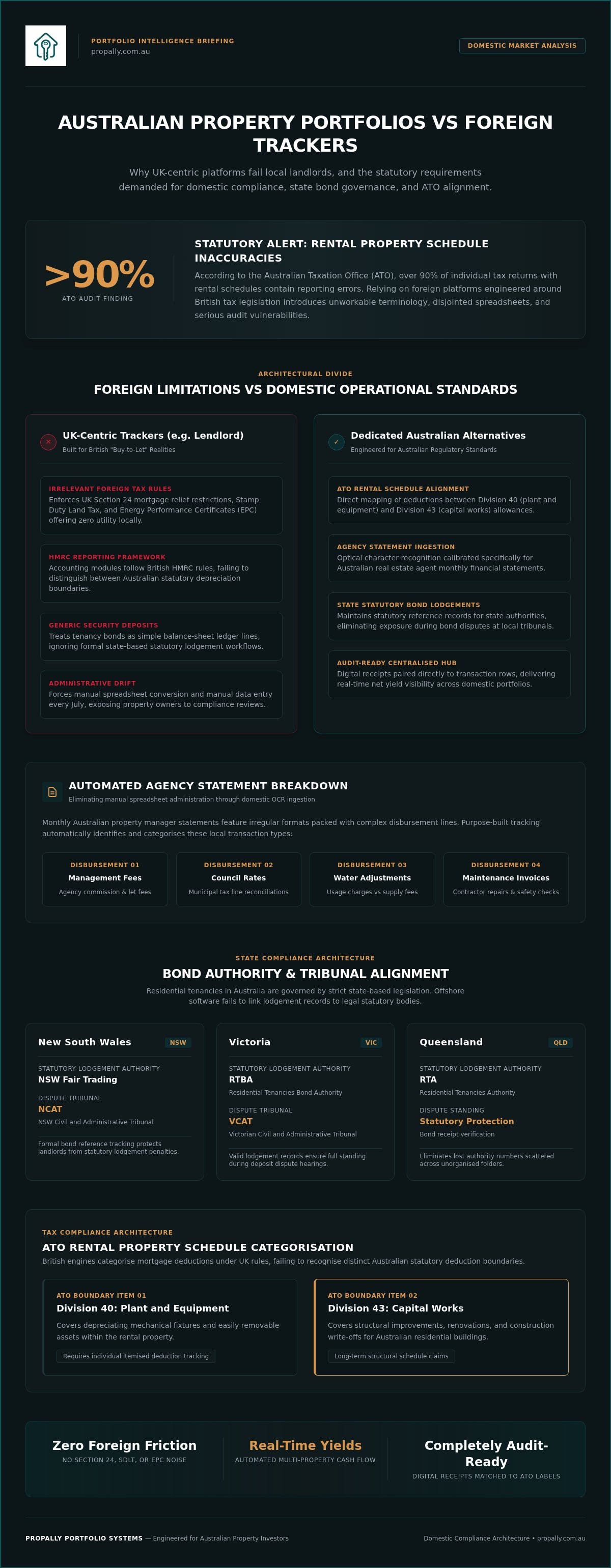
More than 90% of individual tax returns with rental property schedules contain reporting errors according to the ATO, yet many landlords still attempt to track their portfolios using software built for the British market. If you are searching for viable lendlord alternatives for australian property investors, you have likely run headfirst into irrelevant foreign features. UK Section 24 mortgage relief calculations, Energy Performance Certificates, and HMRC filing rules offer zero utility when you need to reconcile local real estate agent statements and manage Australian statutory requirements.
You shouldn't have to battle disjointed spreadsheets or re-enter data by hand just to monitor net rental yields and prepare for annual tax returns. In this guide, you will discover why offshore platforms fall short and compare the best Australian property tracking alternatives engineered specifically for domestic tax rules and tenancy laws. We review the leading local platforms that automate statement reading, monitor rental bond compliance across all states, and keep your portfolio completely audit-ready.
Key Takeaways
- Discover why UK-centric architectures fail local landlords by forcing irrelevant HMRC terminology and unworkable foreign tax rules onto Australian portfolios.
- Learn how to evaluate dedicated lendlord alternatives for australian property investors based on automated statement ingestion and domestic regulatory alignment.
- Identify key software features that extract data directly from real estate agent statements to eliminate manual spreadsheet administration.
- Understand how tracking state-specific compliance workflows and rental bond lodgements protects you from statutory penalties and tenancy tribunal disputes.
- Explore how a centralised domestic hub simplifies tax preparation to keep your multi-property cash flow clear, structured, and audit-ready.
Why Australian Property Investors Outgrow UK-Centric Platforms Like Lendlord
Lendlord was developed specifically for the British buy-to-let market. It excels at managing portfolio metrics governed by the UK tax system, but that structural focus creates immediate friction for portfolios here. When Aussie landlords import their assets into British trackers, they encounter foreign terms like Section 24 mortgage restrictions, stamp duty land tax, and Energy Performance Certificate requirements. These concepts have no legal or operational bearing in Australia. Adopting offshore systems forces investors to manually convert British metrics into local figures, creating administrative drag and increasing the risk of costly accounting mistakes.
Australian portfolios demand infrastructure built for domestic realities. Using offshore property management software exposes investors to reporting gaps, because foreign engines cannot map transactions to Australian Taxation Office reporting standards. That operational divide is precisely why searching for dedicated lendlord alternatives for australian property investors has become essential for growing portfolios.
The Problem with Foreign Tax Engines and Terminology
Offshore accounting modules follow rules set by HM Revenue and Customs, which diverge sharply from Australian tax law. British software categorises mortgage costs and relief under UK rules, ignoring the specific framework of the ATO rental property schedule. Local investors must divide asset deductions between Division 40 plant and equipment and Division 43 capital works. A UK platform cannot recognise these statutory boundaries. The result? Hours spent recategorising expenses into spreadsheets every July, exposing you to compliance reviews.
Missing Australian Rental Bond Authority Workflows
Residential tenancies across Australia are governed by strict state-based legislation that overseas software completely ignores. Every state enforces statutory lodgement deadlines through dedicated government bodies:
- Statutory lodgement records: Bond receipts must link directly to the relevant state authority, whether you deal with NSW Fair Trading, the RTBA, or the RTA.
- Dispute exposure: Missing formal lodgement records or misplacing authority references compromises your standing during bond refund disputes at state tribunals like NCAT or VCAT.
- Administrative drift: Overseas platforms lack workflows to track state bond numbers, leaving documentation scattered across random computer folders.
Offshore platforms treat bonds as simple security deposits in generic ledger lines. This operational void leaves Australian investors vulnerable to statutory penalties. Choosing dedicated lendlord alternatives for australian property investors ensures every bond receipt, lease date, and compliance deadline aligns with local statutory standards from day one.
Essential Selection Criteria for Australian Property Management Software
Selecting the right platform requires looking past generic global dashboards. Australian investors face distinct operational hurdles, from reconciling disparate monthly agency statements to navigating state-based tenancy laws. The most effective lendlord alternatives for australian property investors eliminate administrative drag while providing audit-level visibility across net yields, cash flow, and asset growth. Your chosen tool should act as an automated command centre rather than an empty digital ledger.
Automated Document Ingestion for Agency Statements
Manual spreadsheet entry is slow and prone to transcription errors. Monthly agency statements feature irregular formats packed with management fees, council rate disbursements, water usage adjustments, and maintenance invoices. Software must feature optical character recognition tailored to domestic real estate templates. Implementing an automated rental property data entry workflow pulls financial data directly from your email inbox, categorising income and deductions without manual input.
ATO-Aligned Tax and Audit Trail Governance
Tax preparation shouldn't mean a frantic annual search through desktop folders and emails. Modern software must align directly with official ATO residential rental property guidelines, categorising line items straight into standard tax schedule labels. Attaching verifiable digital receipts to each transaction protects your claims if selected for an audit. Adopting a specialised ato rental property records app gives you and your accountant structured, tax-ready financial packages at the end of the financial year.
State-by-State Legislative Compliance Checklists
Statutory landlord obligations differ across Australian states and territories. Missing mandatory deadlines exposes you to severe financial penalties and legal liability. Essential software tracking must cover:
- Smoke alarm certification: Annual testing records and mandatory hardware upgrades.
- Electrical and gas checks: Strict multi-year safety inspection records.
- Statutory limits: Legislative rent increase timelines restricted to 12-month intervals.
Tracking these milestones against a verified investment property compliance checklist prevents costly disputes before state tenancy tribunals. To maintain total administrative oversight across your portfolio, consider testing PropAlly to combine automated statement ingestion with structured compliance tracking in a single platform.
Comparing the Leading Software Alternatives for Australian Landlords
Tracking property wealth across multiple titles requires specialised infrastructure. Many Aussie landlords start out using generic spreadsheets or small-business ledgers. Soon, they run into walls. Spreadsheets require endless manual updates and break easily. Meanwhile, assessing genuine lendlord alternatives for australian property investors reveals distinct differences between British platforms, general accounting software, and specialised Australian portfolio tools. Making the right choice hinges on whether a platform handles everyday operational realities or merely logs ledger numbers.
To evaluate these solutions effectively, look at how each category manages critical workflows:
- Offshore portfolio trackers (e.g., Lendlord): Strong on British finance metrics, but fail to support local tax categories, state bond lodgements, or Australian agency layouts.
- Generic accounting platforms: Reliable for basic double-entry bookkeeping and bank feeds, but entirely blind to tenancy agreements, lease renewal dates, and routine inspection histories.
- Dedicated Australian portfolio engines (e.g., PropAlly): Built specifically to ingest local real estate agent statements, monitor statutory safety obligations across states, and format data directly for annual ATO returns.
Offshore Trackers vs Dedicated Australian Platforms
Offshore software introduces quiet administrative drag. Every time a UK-centric platform prompts you for British tax terminology, you lose momentum. You must calculate currency variances, adjust for different financial calendar years, and manually redistribute figures across Australian tax schedules. Dedicated local platforms remove that friction. They deliver pre-configured reporting aligned with Australian property investment considerations, ensuring cash-flow models reflect local council levies, land tax thresholds, and strata fees accurately.
Accounting Software vs Specialist Property Portfolio Dashboards
Standard small-business accounting tools track inflows and outflows well. However, they treat rental properties like retail storefronts. They record that rent arrived, but cannot alert you that a fixed-term tenancy expires in 30 days. They log a maintenance invoice, but cannot store the accompanying compliance certificate or track the bond board lodgement receipt. A purpose-built dashboard centralises both financial records and operational documents. This dual visibility bridges the gap between your bookkeeping records and mandatory landlord obligations.
For investors scaling beyond one or two holdings, using a platform built for the local market pays immediate dividends. Exploring viable lendlord alternatives for australian property investors lets you automate document intake, track net yield in real time, and protect portfolio equity with total confidence.
Overcoming the Compliance Void in Offshore Property Trackers
State-level residential tenancy reforms have transformed landlord governance across Australia. Statutory bodies now enforce strict safety guidelines, defined rent increase notice periods, and mandatory bond dispute workflows. Foreign portfolio engines like Lendlord provide zero visibility over these domestic obligations. They track high-level finance, but leave you completely exposed to state tribunal penalties. Choosing verified lendlord alternatives for australian property investors bridges this compliance void by pairing financial tracking with systematic legislative oversight.
A unified domestic system replaces administrative chaos with a dependable audit shield, giving you clarity across several key compliance layers:
- Routine safety verification: Storing gas, electrical, and smoke alarm certificates with automated expiry reminders.
- Statutory notice periods: Logging written notices and rent revision schedules that adhere to state tenancy legislation.
- Defensible substantiation: Archiving digital receipts and tax-deductible invoices against Australian Taxation Office reporting standards.
Managing Smoke Alarm and Electrical Safety Records
State tenancy laws require scheduled inspection cycles for vital services. Smoke alarms demand regular functional testing, while electrical and gas installations require certified safety checks by licensed trades. Overlooking these recurring milestones carries heavy consequences. If a household emergency occurs and your safety records are missing, insurers can legally deny property damage and liability claims. Structured Australian compliance dashboards eliminate this risk by tracking certificate validities and alerting you well before compliance windows expire.
Defensible Record Keeping for Australian Taxation Audits
Individual rental schedules remain under heavy regulatory scrutiny, with incorrect deduction claims contributing over $1.26 billion annually to the net tax gap. The ATO enforces a strict five-year record retention rule for all deductible property expenses. Unorganised email inboxes and faded paper receipts leave you vulnerable to deduction clawbacks, interest penalties, and formal amendment notices. Linking digital receipts directly to property line items establishes a tamper-proof audit trail that your accountant can instantly verify.
Offshore platforms were never engineered to safeguard Australian landlords against local legislative exposure. Secure your portfolio against costly tribunal disputes and tax penalties by choosing PropAlly to manage Australian property compliance today.
Migrating to PropAlly: Purpose-Built Control for Australian Investors
PropAlly provides the definitive central hub tailored specifically to Australian property portfolios. It resolves the operational gaps left by foreign platforms, giving you total visibility over rental income, deductible expenses, and compliance deadlines. When evaluating viable lendlord alternatives for australian property investors, PropAlly stands out by eliminating manual friction and mapping every transaction directly to domestic tax schedules.
Seamless Ingestion with Automated Email Document Add-ons
Transcribing numbers from property manager PDFs by hand wastes hours and invites human error. PropAlly eliminates this friction by reading and parsing monthly real estate agency statements automatically. By activating the Email Basic Add-on or Email Unlimited Add-on, your agency statements flow directly from your inbox into your portfolio dashboard. Management fees, council disbursements, water usage, and maintenance charges are extracted and categorised without manual typing.
Selecting the Right Plan for Your Property Portfolio
Every portfolio requires infrastructure that matches its current scale and growth trajectory. PropAlly provides clear tiers engineered for Australian investors:
- Free Plan: The dedicated entry point for tracking a single investment property with structured financial records.
- Starter Plan: Built for investors expanding their holdings. Review how the Starter Plan delivers comprehensive oversight for emerging portfolios.
- Pro Plan: Configured for serious multi-property investors requiring substantial monthly document extraction capacity and deep yield analytics.
- Business Plan: The ultimate hub for extensive portfolios holding up to twenty properties, providing maximum document processing allowances.
You don't need to struggle with foreign tax concepts, fragile spreadsheets, or fragmented compliance folders any longer. Transitioning to dedicated lendlord alternatives for australian property investors establishes administrative clarity and keeps your portfolio fully protected. Consolidate your records, streamline your tax prep, and take control with PropAlly today.
Streamline Your Property Oversight with Purpose-Built Infrastructure
Running an Australian portfolio with overseas software is an unnecessary operational gamble. You shouldn't have to wrestle with foreign tax settings, manual spreadsheet reconciliation, or scattered compliance receipts. When assessing genuine lendlord alternatives for australian property investors, choose a platform engineered from the ground up for our domestic landscape.
PropAlly delivers administrative clarity and complete control. Built exclusively for the Australian property regulatory and taxation framework, the platform features automated statement extraction supporting major Australian real estate agency formats. From tracking state-based rental bond records to generating audit-ready ATO expense schedules, every feature protects your time and your yield. Flexible tiers start with a dedicated Free Plan and scale through to comprehensive business solutions as your asset base expands.
Take command of your Australian portfolio with PropAlly and enjoy automated, stress-free property tracking today.
Frequently Asked Questions
Can I use Lendlord for tracking investment properties in Australia?
While you can technically set up Australian assets in Lendlord, the platform is fundamentally ill-suited to domestic portfolios. It is architected for the UK buy-to-let ecosystem, relying on HMRC reporting standards, Section 24 mortgage restrictions, and British energy ratings. It cannot process Australian agency statements, map to ATO tax forms, or track state tenancy compliance. Investors searching for lendlord alternatives for australian property investors gain far greater accuracy and legal protection using local platforms.
Why do Australian property investors require software with ATO-aligned categories?
Australian property investors need ATO-aligned categories to ensure deductions withstand tax office audits and streamline annual tax returns. The ATO enforces strict classification rules between deductible immediate repairs and long-term capital improvements across Division 40 and Division 43. Software mapped directly to standard rental schedule labels prevents costly misallocations. It ensures every expense is substantiable with linked receipts, eliminating stress and administrative friction when collaborating with your tax accountant each July.
How does automated statement reading work for Australian real estate agent receipts?
Automated statement reading uses optical character recognition to extract line items directly from your property manager's monthly PDF summaries. When connected via email add-ons, the software scans incoming statements from major Australian real estate agency systems. It identifies gross rent, management commissions, maintenance outlays, and municipal charges, sorting each item into correct ledger categories. You don't have to re-type numbers or manage manual spreadsheets, turning a tedious multi-hour monthly task into an automated background process.
What makes Australian property compliance tracking different from UK landlord software?
Australian compliance is governed by state-based residential tenancy acts that enforce specific statutory timelines for safety checks and bond lodgements. UK software focuses on British obligations like gas safety records, Section 21 notices, and council licensing. In contrast, Australian landlords must track state-specific smoke alarm certifications, electrical safety inspections, and strict 12-month rent increase limits. Local lendlord alternatives for australian property investors ensure every statutory deadline aligns with the relevant state tribunal standards.
Does PropAlly offer a free tier for property investors starting out?
Yes, PropAlly provides a dedicated Free Plan designed specifically for investors managing a single rental property. This entry-level tier gives you complete access to portfolio tracking tools, ATO-aligned expense organisation, and basic compliance oversight without any initial financial commitment. As your asset base expands, you can easily upgrade to scalable options like the Starter Plan, Pro Plan, or Business Plan, adding advanced document ingestion and capacity for up to twenty properties.
Can Australian property accountants access reports generated by PropAlly?
Yes, PropAlly generates clean, audit-ready financial summaries structured specifically for Australian property accountants and tax agents. Instead of handing over messy shoeboxes of paper invoices or unlinked spreadsheets, you can export comprehensive financial packages. These reports group your income, deductible operating expenses, and capital works claims directly into standard tax schedule classifications. This systematic clarity saves your accountant billable hours and ensures full substantiation if your return is reviewed.
How does PropAlly help track rental bond authority lodgements across different states?
PropAlly features built-in compliance workflows that track rental bond lodgements across every Australian state and territory authority. The dashboard records unique lodgement numbers, transfer receipts, and key dates tied directly to individual leases and tenants. Centralising this documentation ensures you never misplace state authority reference numbers. If a tenancy dispute arises at a state tribunal, you have immediate digital evidence proving statutory lodgement compliance and defending your claim against the bond.