
Your "reliable" Excel spreadsheet is no longer a tool; it's a liability that could trigger an ATO audit or cost you thousands in missed deductions. Most Australian investors started with a simple grid to track rental income, but as the RBA cash rate sits at 4.35% and compliance gets tighter, manual entry just doesn't cut it. You're likely tired of hunting for PDF statements in a cluttered inbox or worrying if your bond lodgements are actually up to date across different states. In an era of rapid economic shifts and complex state-specific regulations, sticking to old-school methods isn't just inefficient; it's a genuine risk to your wealth.
This article explores the definitive investment property spreadsheet alternative that replaces administrative chaos with a centralised, automated dashboard. You'll discover how to gain total control over your portfolio while making tax time a breeze with audit-proof records. We'll break down why manual data is failing in 2026 and how automated statement reading can transform your property management from a chore into a streamlined, professional operation.
Key Takeaways
- Identify why manual data entry in Excel has become a liability for Australian portfolios, increasing the risk of ATO audit triggers and costly formula errors.
- Discover the benefits of an investment property spreadsheet alternative that uses automated statement reading to eliminate manual oversight and inbox clutter.
- Learn how to transition from static, siloed records to a centralised digital hub that provides a real-time, consolidated view of your cash flow and equity.
- Master state-specific compliance and bond lodgements with built-in workflows designed for the unique requirements of every Australian jurisdiction.
The Spreadsheet Trap: Why Manual Property Tracking Fails in 2026
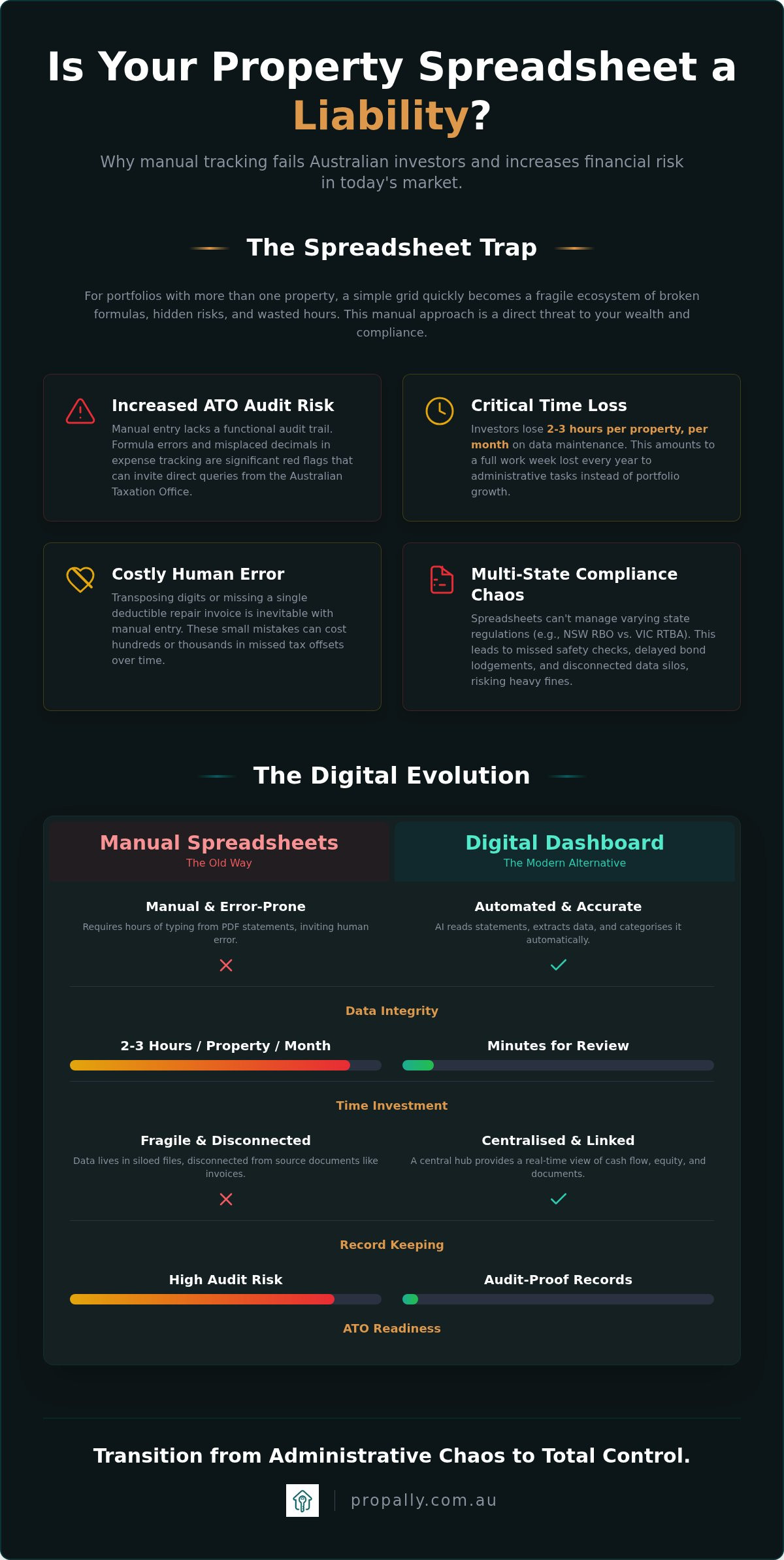
The "Spreadsheet Trap" is a quiet transition. It happens the moment your DIY tracking sheet stops being a cost-saver and starts becoming a liability. For most Australian investors, this occurs when the portfolio grows beyond a single asset. You start with a simple grid. You end up with a fragile ecosystem of linked cells, hidden tabs, and broken macros. With the RBA cash rate currently at 4.35%, precision in your interest expense tracking is non-negotiable. A single misplaced decimal point in a negative gearing formula doesn't just skew your numbers; it invites a direct query from the ATO.
Excel lacks a functional audit trail. It cannot prove when a record was created or who modified a transaction. This transparency gap is a significant risk during tax season. While a traditional Property management system was once reserved for large agencies, modern digital hubs now provide the same level of administrative clarity for individual investors. If you're still spending your "Admin Sunday" manually reconciling bank feeds against PDF statements, you're operating with a tool built for the 1990s, not the high-stakes property market of 2026.
The Hidden Cost of Manual Data Entry
Manual entry is a productivity killer. Investors typically lose two to three hours per property, per month, just on basic data maintenance. That's a full work week lost every year to administrative friction. Beyond the time-cost, human error is inevitable. Transposing digits or missing a single deductible repair invoice can cost you hundreds in tax offsets. A professional investment property spreadsheet alternative eliminates this risk by automating the flow of data, ensuring every cent is accounted for without the manual grind.
Compliance Risks in a Multi-State Portfolio
Managing a portfolio across state lines adds a layer of complexity that a flat spreadsheet cannot handle. Each jurisdiction has its own rules. You might be dealing with the Rental Bonds Online (RBO) system in NSW while simultaneously managing the Residential Tenancies Bond Authority (RTBA) in Victoria. Keeping track of these varying workflows in a cell on a screen is a recipe for oversight.
- Missing Safety Checks: Spreadsheets don't send alerts for mandatory smoke alarm or gas safety inspections.
- Bond Lodgement Lags: Manual tracking often leads to delays in bond transfers, risking heavy fines.
- Data Silos: Your records are disconnected from the actual documents, making it impossible to find a specific compliance certificate when you need it most.
Relying on Excel means you're always one broken formula away from a compliance failure. It's time to trade the chaos of manual oversight for the calm of a systematic digital architect.
The Evolution of Property Tracking: Automation and AI Statement Reading
The era of the static ledger is ending. Modern investors are adopting an investment property spreadsheet alternative that leverages Optical Character Recognition (OCR) and machine learning. This isn't just about digitising paper; it's about shifting the investor's role from a data entry clerk to a strategic overseer. Instead of manually typing figures from a monthly statement, the technology extracts data with surgical precision. It identifies rental income, management fees, and maintenance costs, then maps them directly to specific ATO tax labels. This systematic approach ensures your records are always audit-ready without the manual grind.
By moving away from manual entry, you eliminate the friction of administrative oversight. The software functions as a diligent digital architect, organising complex financial data into a structured format. This transition allows you to focus on portfolio growth rather than the minutiae of bookkeeping. It replaces the stress of missing a deduction with the confidence of knowing every transaction is captured and categorised correctly from the moment it occurs.
How Automated Statement Reading Works
The journey begins in your inbox. When your property manager sends a monthly statement, the system captures the PDF automatically. It doesn't just store the file; it reads it. By using specialised document processing add-ons, the platform identifies key data points like the statement period, gross rent, and individual expense items. This "Set and Forget" model means your dashboard updates while you sleep. You remain the diligent overseer, performing a quick final review rather than spending hours sorting through paper trails. You can learn more about how to automate rental property data entry for your Australian portfolio to see this in action.
Real-Time Cash Flow Visibility
Waiting until July to understand your portfolio's performance is a tactical error. In the 2026 market, where interest rates and holding costs are dynamic, real-time visibility is essential. A live dashboard provides an immediate snapshot of your net position as soon as an invoice is cleared or rent is paid. This allows for proactive decision-making regarding repairs, renovations, or further acquisitions. It's a far cry from the siloed, stagnant nature of a traditional Excel file.
By integrating your financial data into a professional hub, you replace the potential chaos of manual oversight with unwavering administrative clarity. For those ready to upgrade their workflow, the PropAlly Free Plan offers a robust starting point for single-property investors to test this investment property spreadsheet alternative. It's time to stop being a data entry clerk and start being a portfolio manager.
Manual Spreadsheet vs. Digital Dashboard: A Comparative Analysis
Spreadsheets are static archives of the past. A professional digital hub is a dynamic engine for future growth. When you rely on Excel, your data remains siloed, often scattered across multiple files or tabs that don't communicate with each other. This lack of integration becomes a major bottleneck for investors managing a multi-state portfolio. A centralised dashboard provides a consolidated view, allowing you to monitor equity and cash flow across NSW, Victoria, and Queensland simultaneously. It replaces the potential chaos of manual oversight with the calm of a systematic, organised structure.
The transition to an investment property spreadsheet alternative also transforms your relationship with your accountant. Instead of handing over a messy CSV file or a shoe box of receipts at the end of the financial year, you can provide direct dashboard access. This professional approach ensures your tax agent has immediate, high-quality data. It eliminates the back-and-forth emails and reduces the time spent on manual reconciliations, which often results in lower accounting fees and more accurate tax returns.
Audit-Proofing Your Portfolio for the ATO
A cell in a spreadsheet is not evidence. During a formal ATO audit, the burden of proof rests entirely on the investor to provide source documents for every claim. Digital hubs solve this by linking digital receipts and property manager statements directly to specific expense records. This creates a perfect, permanent audit trail that is far more robust than a standalone Excel file. For a deeper look at meeting these requirements, see our ATO Rental Property Records App: The 2026 Investor’s Guide to Compliance. Having your documents organised and accessible provides the administrative clarity needed to face any query with confidence.
Scaling Beyond One Property
The complexity of property management doesn't grow linearly; it follows an exponential curve. Managing one property in a spreadsheet is a weekend hobby. Managing three properties across different time zones and jurisdictions is a part-time job. You're suddenly juggling varying lease expiries, insurance renewals, and state-specific safety regulations.
- Automated Reminders: Never miss a smoke alarm check or a land tax payment deadline.
- Jurisdictional Control: Track bond lodgements according to the specific rules of each state authority.
- Strategic Oversight: View your total debt-to-equity ratio across your entire Australian portfolio in one click.
For those moving from a single asset to a growing portfolio, the Starter Plan serves as a logical bridge. It provides the professional infrastructure required to scale without the administrative breakdown that typically plagues spreadsheet-bound investors. Choosing an investment property spreadsheet alternative isn't just about better software; it's about building a foundation for steadfast reliability and long-term success.
Transitioning Your Records to a Professional Digital Hub
Switching to an investment property spreadsheet alternative is a structured process that replaces manual friction with administrative clarity. The transition begins with a rigorous consolidation of your existing records. Identify the "data gaps" where your current Excel file lacks critical compliance details, such as smoke alarm expiry dates or water efficiency certificates. This initial audit ensures your new digital hub starts with an accurate, high-fidelity baseline of your portfolio’s health.
Follow this five-step roadmap to migrate your data and reclaim your weekends:
- Step 1: Consolidate Records. Gather all disparate spreadsheets and PDF statements to identify missing historical data.
- Step 2: Select a Local Platform. Choose a hub that aligns with Australian state-specific compliance and current ATO record-keeping rules.
- Step 3: Automate Inbound Data. Set up automated email forwarding so property manager statements land directly in your dashboard inbox.
- Step 4: Establish a Baseline. Categorise historical expenses to ensure your yield and cash flow metrics reflect reality.
- Step 5: Implement the 10-Minute Review. Replace "Admin Sunday" with a brief weekly dashboard audit to maintain unwavering control.
Organising Your Digital Paperwork
A meticulous digital architect needs clean data. Start by digitising old paper receipts and creating a dedicated email folder for property correspondence. This organisation allows your automation tools to extract data without interference. It is also critical to categorise each property by its specific Australian state. This action triggers the relevant compliance checklists for jurisdictions like NSW or Victoria, ensuring you never miss a mandatory safety check. Use the Investment Property Compliance Checklist: The 2026 Australian Landlord Guide to verify your current standing.
Working with Your Accountant
Automated records change your relationship with your tax professional. Instead of providing a shoebox of receipts or a fragile Excel file, you present a reconciled, audit-proof dashboard. This shift significantly reduces the time your accountant spends on manual data entry, which often leads to lower professional fees. More importantly, it moves the focus from tax preparation to tax strategy. With real-time data, you can discuss negative gearing optimisations or capital gains projections based on facts, not estimates. To start building a more professional portfolio, explore the PropAlly Business Plan for comprehensive multi-property oversight.
PropAlly: The Purpose-Built Alternative for Australian Landlords
PropAlly is the digital architect your portfolio requires. It replaces the fragility of Excel with a robust, systematic foundation designed for unwavering control. This investment property spreadsheet alternative is engineered specifically for the Australian regulatory environment. It doesn't just record data; it organises it into a centralised hub for total administrative clarity. By moving your records to a professional platform, you trade the potential chaos of manual oversight for the calm of automated, systematic organisation.
The platform addresses the specific pressures of local landlording with precision. The unique Bond Authority Workflow ensures you remain compliant with state-specific mandates, while integrated checklists keep you ahead of regulatory changes. By utilising the Email Basic or Email Unlimited Add-ons, your inbox becomes a hands-free data entry machine. Your property manager's statements are read, processed, and categorised without you lifting a finger. This allows you to transition from a data entry clerk to a diligent overseer of your wealth.
Designed for the Australian Market
Generic global software often overlooks the nuances of the Australian property sector. These tools typically fail to account for specific land tax thresholds, stamp duty calculations, or the unique requirements of state bond authorities. PropAlly fills this gap. It remains updated with the latest ATO rulings and state legislation, providing a level of steadfast reliability that generic templates cannot match. For those entering the market, the PropAlly Starter Plan: The Professional Hub for Australian Property Investors offers the essential tools for cash flow tracking and compliance control.
Getting Started with PropAlly
Administrative clarity is accessible at every stage of your investment journey. Single-property investors can utilise the Free Plan to experience the power of a professional dashboard without upfront costs. As your portfolio expands across different states, the Pro and Business plans provide the scalability needed to manage complex, multi-state assets. Each plan is designed to be user-centric and supportive, ensuring you have the tools to build a successful, audit-proof portfolio.
You've spent enough time wrestling with broken cells and manual reconciliations. It's time to command your data with a professional partner. Stop managing spreadsheets and start architecting your wealth with a tool built for the reality of the 2026 Australian market.
Secure Your Portfolio’s Future with Administrative Clarity
Moving beyond the fragile cells of Excel is the most significant step you can take to protect your Australian property assets. You've seen how the spreadsheet trap creates unnecessary risk, from formula errors in negative gearing calculations to missed compliance deadlines across state lines. Transitioning to a professional investment property spreadsheet alternative replaces that administrative chaos with unwavering control; it is the definitive upgrade for the modern landlord.
By automating your statement processing and centralising your records, you ensure your portfolio is always audit-ready and ATO-aligned. Whether you're managing a single unit or a growing multi-state empire, the shift to a digital hub provides the steadfast reliability you need to scale with confidence. Take command of your portfolio: start your PropAlly journey for free today. With state-specific compliance checklists and automated statement reading at your fingertips, you can finally reclaim your weekends. Your property journey deserves the precision of a digital architect. Start building your legacy on a foundation of clarity today.
Frequently Asked Questions
Is a spreadsheet enough for an ATO audit in 2026?
No, a spreadsheet is rarely sufficient evidence on its own during a formal ATO audit. While it tracks figures, it lacks a linked audit trail of source documents. The ATO requires you to keep records for five years; digital hubs provide a more robust defence by linking receipts directly to claims. This ensures your records are audit-ready and compliant with current 2026 record-keeping standards.
How does PropAlly's automated statement reader actually work?
The automated statement reader uses advanced document processing technology to extract data from your property manager's monthly reports. Once you set up an email forwarding rule, the system captures PDFs directly from your inbox. It identifies rental income and expense items, then maps them to the correct tax categories. This hands-free approach eliminates manual entry, turning your inbox into a systematic data feed for your dashboard.
Can I track properties in different Australian states on one dashboard?
Yes, you can consolidate properties from every Australian state and territory into a single centralised dashboard. This is a primary benefit of using a professional investment property spreadsheet alternative. The platform organises your portfolio by jurisdiction, allowing you to monitor cash flow and equity across NSW, Victoria, and Queensland simultaneously. It replaces the siloed nature of multiple Excel files with a unified, national view of your wealth.
What are the risks of using a generic, non-Australian property app?
Generic global apps often fail to account for the unique complexities of the Australian property market. They frequently lack support for local land tax thresholds, stamp duty nuances, and the specific record-keeping requirements of the ATO. Using non-Australian software risks compliance gaps, as these tools don't provide the state-specific checklists or bond authority workflows essential for managing rentals in jurisdictions like Western Australia or South Australia.
How much time can I save by switching from a spreadsheet to PropAlly?
Most investors reclaim several hours every month by automating their administrative tasks. Instead of spending your "Admin Sunday" manually reconciling bank feeds and typing in statement data, you shift to a brief weekly dashboard review. This 10-minute audit ensures your records remain accurate without the manual grind. For a multi-property portfolio, the time savings are significant, allowing you to focus on strategy rather than data entry.
Do I need to be a tech expert to use a property dashboard?
No, you don't need advanced technical skills to manage your portfolio through a digital hub. Unlike complex Excel files with fragile macros and hidden formulas, a professional dashboard is designed for administrative clarity and ease of use. The interface is intuitive and supportive, guiding you through the setup of automated feeds. It is a more accessible solution than maintaining a DIY spreadsheet that requires constant manual troubleshooting.
Can PropAlly help me track rental bond lodgements?
Yes, PropAlly includes dedicated workflows for tracking rental bond evidence across different Australian states. Managing bonds through the RBO in NSW or the RTBA in Victoria requires meticulous record-keeping to avoid compliance failures. The platform provides a structured environment to store lodgement receipts and monitor bond status. This systematic approach ensures you maintain unwavering control over your legal obligations in every jurisdiction where you hold property.
Is my data secure on a digital property platform compared to my hard drive?
Your data is typically more secure on a professional digital platform than on a local hard drive. Local files are vulnerable to hardware failure, accidental deletion, or physical loss. A cloud-based hub uses secure encryption and regular backups to protect your financial records. This proactive security model provides steadfast reliability, ensuring your historical tax data and compliance documents remain accessible and protected for the mandatory five-year holding period.