
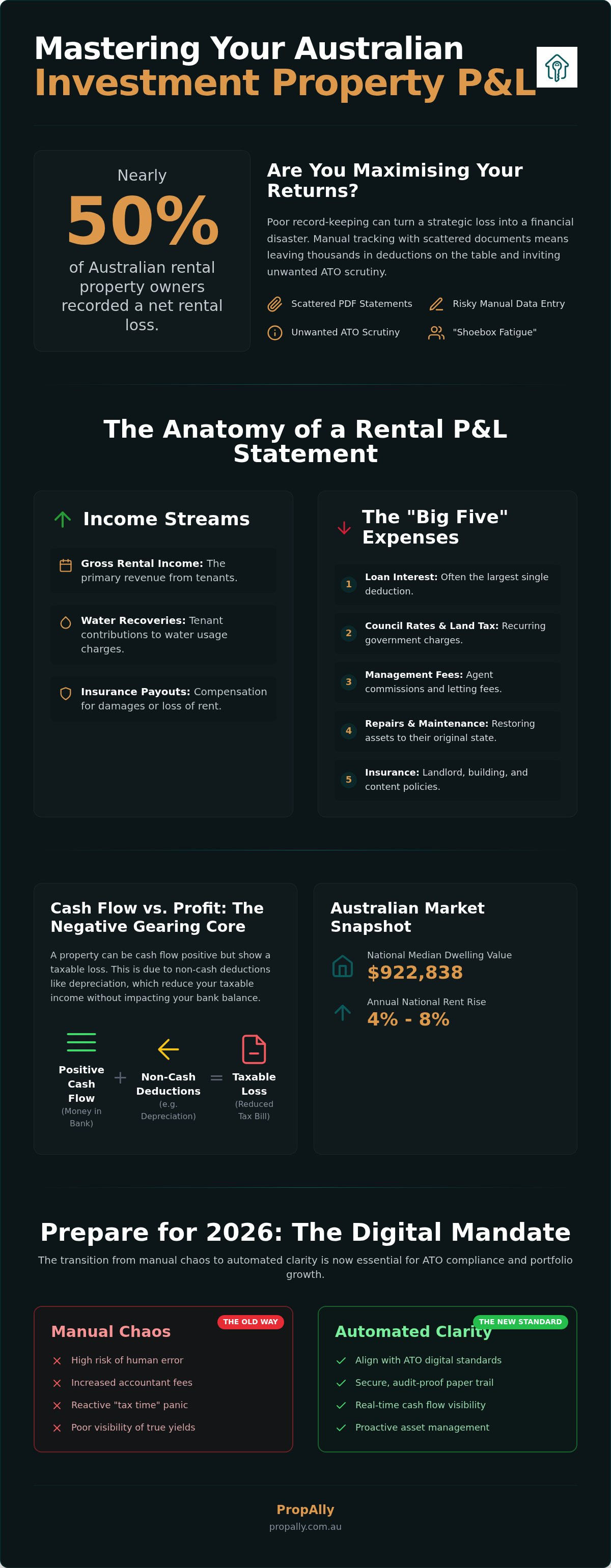
Nearly 50% of Australian rental property owners recorded a net rental loss in the latest tax figures. While this highlights the prevalence of negative gearing, it also exposes the thin margins where poor record-keeping can turn a strategic loss into a financial disaster. If your current investment property profit and loss tracking relies on manual data entry or a scattered collection of PDF statements, you’re likely leaving thousands of dollars in deductions on the table while inviting unwanted ATO scrutiny.
You shouldn't have to choose between growing your portfolio and maintaining your sanity. We know that managing multiple state-based compliance rules and rising costs is a heavy administrative burden. This guide will empower you to master your investment property profit and loss statement to maximise tax returns and take total command of your portfolio cash flow. We will preview the 2026 tax landscape, including proposed changes to negative gearing and CGT grandfathering rules. By the end, you’ll have a clear roadmap to audit-proof records and real-time visibility over your true yields.
Key Takeaways
- Identify the "Big Five" deductible expenses and diverse income streams to ensure every financial detail is captured accurately.
- Master your investment property profit and loss statement to gain a clear view of real-time cash flow and maximise your potential tax returns.
- Align your portfolio with the ATO’s 2026 digital record-keeping standards to create a secure, audit-proof paper trail for every asset.
- Replace high-risk manual data entry with automated tracking to eliminate "shoebox fatigue" and significantly improve reporting accuracy.
- Leverage professional-grade dashboards to gain the administrative clarity required to manage multiple properties across different Australian states.
Mastering Your Investment Property Profit and Loss in 2026
Your profit and loss (P&L) statement is the heartbeat of your investment strategy. It isn't just a document for tax time; it's a real-time pulse check on your asset's health. In 2026, the Australian market presents a unique set of challenges. Interest rates remain a primary concern for borrowing capacity, while national rents are rising between 4% and 8% annually. With these shifting variables, maintaining a precise investment property profit and loss record is vital for survival. You cannot manage what you do not measure. Administrative clarity replaces the chaos of guesswork, allowing you to see exactly where your money goes. With national median dwelling values reaching $922,838, the stakes for accuracy have never been higher.
The transition from manual spreadsheets to automated digital hubs is no longer optional. It's a requirement for those looking to scale. Digital systems eliminate the risk of human error and provide a central hub for complex data. This systematic organisation ensures you stay in total command of your portfolio. It moves you away from reactive "tax time" panic and into a state of proactive asset management.
The Difference Between Cash Flow and Profit
Understanding the gap between your bank balance and your tax return is essential. A property can be cash flow positive on a weekly basis but show a taxable loss on paper. This is the core of the Australian negative gearing strategy. Non-cash deductions, particularly depreciation, allow you to reduce your taxable income without physically spending more money. This creates a scenario where you can build wealth through capital growth while the tax system supports your holding costs. Tracking gross vs. net yield in real-time ensures you aren't blinded by high rental returns that are actually being consumed by rising council rates or land tax.
Why Your Accountant Will Love a Clean P&L
A clean, digital P&L saves more than just time; it saves money. Accountants charge for their expertise, not for sorting through a shoebox of receipts. By providing structured data from a digital dashboard, you reduce billable hours and ensure every deductible cent is captured throughout the financial year. This proactive approach provides peace of mind. If the ATO requests evidence, you have contemporaneous, audit-proof records ready at a click. It’s about building a robust foundation for your financial success. You gain the certainty of a specialist who understands their numbers, making tax season a non-event rather than a stressor.
The Anatomy of an Australian Rental P&L: Income and Outgoings
A robust investment property profit and loss statement is more than a list of rent coming in. It is a detailed map of every financial movement within your portfolio. To achieve administrative clarity, you must look beyond the monthly rent. Income also includes tenant water recoveries and insurance payouts for damages or loss of rent. If you own a holiday rental, you must subtract "private use" portions from your deductions. This is a common area of focus for the ATO. If you stay in your coastal holiday apartment for two weeks, those costs aren't deductible. You need to be meticulous here. Every cent must be accounted for to ensure your records are beyond reproach.
To ensure every dollar is accounted for without the manual headache, you can centralise your tracking through a dedicated digital dashboard that organises these complex data points automatically.
Categorising Your Property Expenses
Categorising your expenses correctly is the difference between a smooth tax season and a stressful audit. Australian landlords typically deal with the "Big Five": loan interest, council rates and land tax, property management fees, repairs, and insurance. Operating expenses like strata levies and council rates are recurring and predictable. Management costs, including agent commissions and letting fees, are essential for passive income. With national median house rents rising, management fees can add up quickly. However, the distinction between a "repair" and "capital works" is where many stumble. A repair restores something to its original state, while capital works improve it. For specific definitions, refer to the ATO guidelines on rental properties. Getting this wrong can lead to a rejected claim.
Interest and Borrowing Costs
Interest and borrowing costs often represent the largest outgoing on an investment property profit and loss statement. With the current interest rate environment, tracking these accurately is non-negotiable. You must distinguish between the interest component and the principal repayment. Only the interest is deductible. Principal repayments are an increase in your equity, not an expense. Don't forget to include loan establishment fees and annual bank charges. Some borrowing costs, like mortgage insurance, must be claimed over five years rather than all at once. Your annual mortgage statement is your primary source of truth here. Reconciling this statement against your digital records ensures no borrowing costs are overlooked. This systematic approach replaces the chaos of manual oversight with total financial control.
Beyond the Spreadsheet: Automating Your Portfolio Data
The "Death of the Shoebox" is a necessary evolution for any serious landlord. Manual data entry is not just a time-sink; it is a direct risk to your wealth. When managing high-value assets, administrative errors can lead to missed deductions or incorrect reporting. An automated investment property profit and loss system provides the administrative clarity required to scale your portfolio without increasing your workload. It replaces the chaos of manual oversight with a systematic, professional-grade tracking solution.
Modern investors require real-time visibility. Static spreadsheets are outdated the moment you save them. They fail to provide the dynamic insights needed to navigate a fast-moving market. Automated platforms offer a central hub for complex data, ensuring your financial position is always current. This shift from reactive to proactive management is what separates successful investors from those who struggle during tax season. You gain unwavering control over your assets without the administrative fatigue.
The High Cost of Manual Entry Errors
Manual entry is inherently prone to failure. Typo errors, missed receipts, and double-counted income are frequent occurrences in manual systems. These aren't just minor annoyances; they are direct threats to your tax return. Consider the time cost. Calculating the "hourly rate" you spend on manual admin often reveals a hidden expense that eats into your net yield. Automation removes this burden. It ensures every transaction is tracked as it happens, creating the contemporaneous records required by the ATO Rental Properties Guide. You gain total command of your data without the manual fatigue. It's a stress-reducing approach that ensures every deductible cent is captured accurately.
Consolidating Multiple Properties and States
Managing a diverse portfolio across different regions introduces a unique challenge. Agent statements vary wildly across the country, with no national standard format. This inconsistency makes it difficult to maintain a clear overview of your total performance. Centralising this data into a single source of truth is vital for visibility. Automated agent statement reading technology bridges this gap by extracting relevant data from any PDF, regardless of the agency's layout. This level of integration simplifies compliance with various local rules. You can learn how to automate rental property data entry to consolidate your records efficiently. It turns a fragmented portfolio into a streamlined, high-performance machine where you see the big picture in one place.
ATO Compliance and Record-Keeping: Audit-Proofing Your P&L
The ATO’s 2026 record-keeping standards prioritise digital validity and administrative clarity. For investors nationwide, building a robust investment property profit and loss trail is about more than just tax; it's about regulatory adherence. The requirement to keep records for five years from the lodgement date is non-negotiable. These documents must be in English and demonstrate every financial movement within your portfolio. If your records are part of a net rental loss claim, your evidence must be flawless to withstand scrutiny during a random audit.
Contemporaneous tracking is the gold standard for modern compliance. This means documenting events and expenses as they occur rather than reconstructing the financial year in June. This proactive approach ensures your P&L remains a live, accurate document. It moves you from a state of reactive panic to one of unwavering control. By capturing data in real-time, you create a systematic history that is grounded in practical reality.
Digital Receipts and the ATO
Digital copies are now fully accepted by the ATO as primary evidence. You no longer need to store physical thermal paper slips that degrade or fade over time. However, a disorganised folder of smartphone photos is not an audit-proof system. You must integrate these receipts into your financial records, sorted by property and financial year. You can find more detail in our ATO rental property records app guide. This systematic filing ensures every deduction on your investment property profit and loss statement is backed by verified, retrievable evidence.
State-Specific Compliance Checklists
Your financial tracking must reflect the mandatory safety outgoings required by various state authorities. While regulations vary across different jurisdictions, the need to track smoke alarm servicing, gas safety checks, and electrical inspections is universal. These are fully deductible operating expenses that must be logged correctly. Using a comprehensive investment property compliance checklist allows you to monitor these recurring costs. It ensures your P&L is not just a tax document, but a log of your property’s legal standing.
Handling bond lodgements also requires precision. When a bond is used to cover repairs or cleaning, it must be recorded as income and then offset by the actual expense. This keeps your records balanced and transparent. To secure your digital audit trail and ensure total compliance across all your assets, start using PropAlly’s compliance-ready dashboard today.
PropAlly: Your Central Hub for Real-Time P&L Control
PropAlly is the definitive central hub for Australian property data. It replaces fragmented systems with administrative clarity. The dashboard integrates your cash flow, tax obligations, and state-specific compliance into a single source of truth. One of its most powerful features is automated document reading. This technology scans your agent statements, extracts the data, and populates your investment property profit and loss records instantly. It removes the human error associated with manual entry and ensures your data is always current. You gain unwavering control over your portfolio through systematic organisation.
Administrative clarity is the foundation of a successful investment strategy. PropAlly provides the tools to replace the chaos of manual oversight with the calm of automated tracking. It is a strategic partner that understands the specific pressures of the Australian market, from rising interest rates to complex state-based regulations. By centralising your data, you eliminate the administrative fatigue that often leads to missed deductions and tax-time stress.
Taking Command with the Starter Plan
The modern Australian investor needs more than just a spreadsheet. The PropAlly Starter Plan is designed to be your professional-grade tracking hub. It moves you from reactive tax preparation to proactive portfolio management. Instead of waiting until July to see your performance, you have real-time visibility every month. You see your actual yields, track every deduction, and monitor your cash flow as it happens. It is about taking total command of your financial future with a systematic, user-centric interface. This plan offers the essential features required to maintain audit-proof records without the complexity of traditional enterprise software.
Scaling Your Portfolio with Confidence
Your administrative needs change as your portfolio grows. PropAlly is built to scale with you, whether you own one property in Perth or twenty across the country. For high-volume investors, the Email Unlimited Add-on ensures that every digital receipt and statement is captured without friction. This level of integration is essential for maintaining a clean investment property profit and loss statement as complexity increases. You gain the steadfast reliability of a digital architect that grows alongside your success. It ensures that your record-keeping remains robust and professional, regardless of how many assets you manage. Start your journey to portfolio control with PropAlly and experience the clarity of a truly organised investment strategy.
Secure Your Portfolio's Financial Future
Success in the 2026 Australian property market demands more than just ownership. It requires administrative clarity. You have learned that your investment property profit and loss statement is a strategic command centre, not a tax-time chore. By moving beyond manual spreadsheets, you eliminate the high cost of human error and ensure every deductible cent is captured. Real-time visibility over your actual yields allows you to make informed decisions in a shifting interest rate environment.
Replacing the chaos of manual oversight with systematic organisation is the only way to scale with confidence. PropAlly provides the definitive hub for this transition. With ATO-aligned tax calculations, state-specific compliance checklists, and automated agent statement reading, you gain a robust foundation for your financial success. Don't let administrative fatigue hold back your portfolio growth.
Get started with the PropAlly Starter Plan and take control of your property data today. It's time to replace the shoebox of receipts with the certainty of professional-grade tracking. Your future self will thank you for the stress-free tax seasons and the unwavering control you establish now.
Frequently Asked Questions
How do I set up a profit and loss statement for my investment property?
You set up a statement by categorising all rental income against deductible outgoings. While manual templates exist, using a digital dashboard like PropAlly provides immediate administrative clarity. You simply integrate your data sources to generate a real-time view of your performance. This systematic approach replaces the chaos of manual entry with a structured central hub. It ensures you capture every transaction as it happens for a complete financial overview of your Australian assets.
What expenses can I include in my rental property P&L?
You can include all costs associated with earning rental income. This typically covers:
- Loan interest and bank fees
- Council rates and land tax
- Property insurance
- Management fees and commissions
- Repairs and maintenance
Can I use a spreadsheet for my property profit and loss tracking?
You can use a spreadsheet, but it is a high-risk strategy for serious investors. Manual spreadsheets are prone to typo errors and broken formulas that can compromise your data integrity. They also lack the ability to read agent statements or provide state-specific compliance alerts. Moving to an automated dashboard replaces this potential chaos with systematic organisation. It provides a more robust foundation for your portfolio, offering real-time visibility that a static spreadsheet cannot match.
How long do I need to keep property P&L records for the ATO?
The ATO requires you to keep records for five years from the date you lodge your tax return. This includes your investment property profit and loss statements, receipts, and bank records. If you are claiming capital works deductions, you may need to keep records for even longer. Maintaining these in a secure digital format ensures they remain legible and accessible. A digital audit trail provides the peace of mind that you can respond with confidence.
Does the ATO accept digital receipts for rental property expenses?
Yes, the ATO accepts digital receipts as valid evidence for your rental expenses. You don't need to store fading thermal paper slips in a shoebox. A clear, legible digital copy that shows the supplier, amount, nature of the goods, and date is sufficient. Organising these files by property and financial year within a central hub ensures you are always audit-ready. This modern approach reduces administrative fatigue and keeps your records safe from physical loss.
What is the difference between a repair and a capital improvement on a P&L?
A repair restores an item to its original condition, while a capital improvement makes it better than it was. Repairs, like fixing a broken fence, are typically deductible in the year they occur. Improvements, such as replacing a whole fence with a superior material, are usually claimed over several years as capital works. Getting this distinction right is vital for your P&L accuracy. It ensures your tax calculations align with current ATO guidelines and prevents compliance issues.
How does negative gearing show up on an investment property P&L?
Negative gearing appears as a net rental loss when your deductible expenses exceed your rental income. On your P&L, this shows up as a negative figure at the bottom line. This loss can often be offset against your other taxable income, like your salary, to reduce your overall tax liability. Tracking this in real-time allows you to understand the true cost of holding the asset. It transforms a paper loss into a strategic wealth-building tool.
How can automation help with my property manager statements?
Automation eliminates the need for manual data entry from agent statements. Platforms like PropAlly use automated document reading to extract income and expense data directly from PDF statements. This technology populates your dashboard instantly, regardless of the agency's format. It saves hours of administrative work and ensures your records are always contemporaneous. You gain a clear view of your cash flow without the stress of deciphering complex statements or manually updating your records every month.