

The cheapest-looking property platform can become the wrong choice if its workflows don’t match Australian tax, bond evidence and state-by-state administration. That’s the key question behind doorloop australia pricing and alternatives: DoorLoop offers broad property operations tools, but Australian investors need to weigh local workflow fit alongside plan inclusions and billing terms.
Comparing headline prices alone won’t show whether you’re paying for features your portfolio doesn’t need, or whether the software supports the records and processes you rely on. Before deciding, check current plan limits, add-on costs and billing currency, then assess how each platform handles Australian investor administration.
This guide compares DoorLoop with Australian options using practical criteria: portfolio size, cash-flow and tax tracking, compliance checklists, bond evidence and day-to-day workload. You’ll also see how agency-focused systems differ from investor dashboards, so you can choose a setup that fits your needs. The aim is to identify what to compare, assess the workflows that matter and find a better fit for your portfolio.
Key Takeaways
- Compare DoorLoop’s subscription, billing frequency, unit limits and add-ons separately to understand the full cost structure.
- Judge platforms by Australian investor workflows, including tax records, bond evidence and state-specific compliance checklists, not feature counts alone.
- Use a practical scorecard to match your tasks, portfolio size and document-handling needs to the right type of system.
- Explore doorloop australia pricing and alternatives through three lenses: property-management platforms, investor dashboards and manual record systems.
- See whether an investor-focused dashboard such as PropAlly’s suits your need to bring cash flow, tax, compliance and bond evidence together.
DoorLoop Australia pricing: what investors should verify before comparing
DoorLoop’s pricing and plan terms can change, so check its current official pricing information before comparing costs. Confirm the currency, billing terms, plan limits and inclusions that apply to your account. Record the details and date checked so you’re comparing current information rather than an outdated figure.
Break the cost into clear parts: subscription price, billing frequency, included properties or units, charges for additional units and paid add-ons. A low headline price may apply only to a particular billing term or portfolio size, or exclude features your workflow relies on. Compare like with like, and work out the cost in Australian dollars without assuming a displayed foreign-currency price is the amount you’ll pay.
Which DoorLoop pricing details matter to Australian investors?
Make a simple record before comparing options. Check the displayed currency, whether the price is monthly or tied to an annual billing commitment, the number of properties included and any thresholds that change the plan cost. Note which features are included, whether integrations affect your setup and whether optional tools carry separate charges. Save the pricing details with the date checked, as plans and terms can change.
Local fit matters as much as the subscription. Check DoorLoop’s current information about Australian availability, local support and relevant workflows. Don’t infer support for local tax records, bond evidence or state-based compliance from a general feature description. These details affect how much administration the software can consolidate for your portfolio.
How to compare plans without relying on headline prices
Start with the work you do repeatedly, not the longest feature list. An investor may need to organise agent statements, monitor portfolio cash flow and keep compliance documents accessible. A property-management operation may prioritise tenant communication, maintenance coordination or leasing processes. Property-management systems can serve different operational needs; What is a Property Management System? offers background on the category, but your comparison should reflect your own tasks.
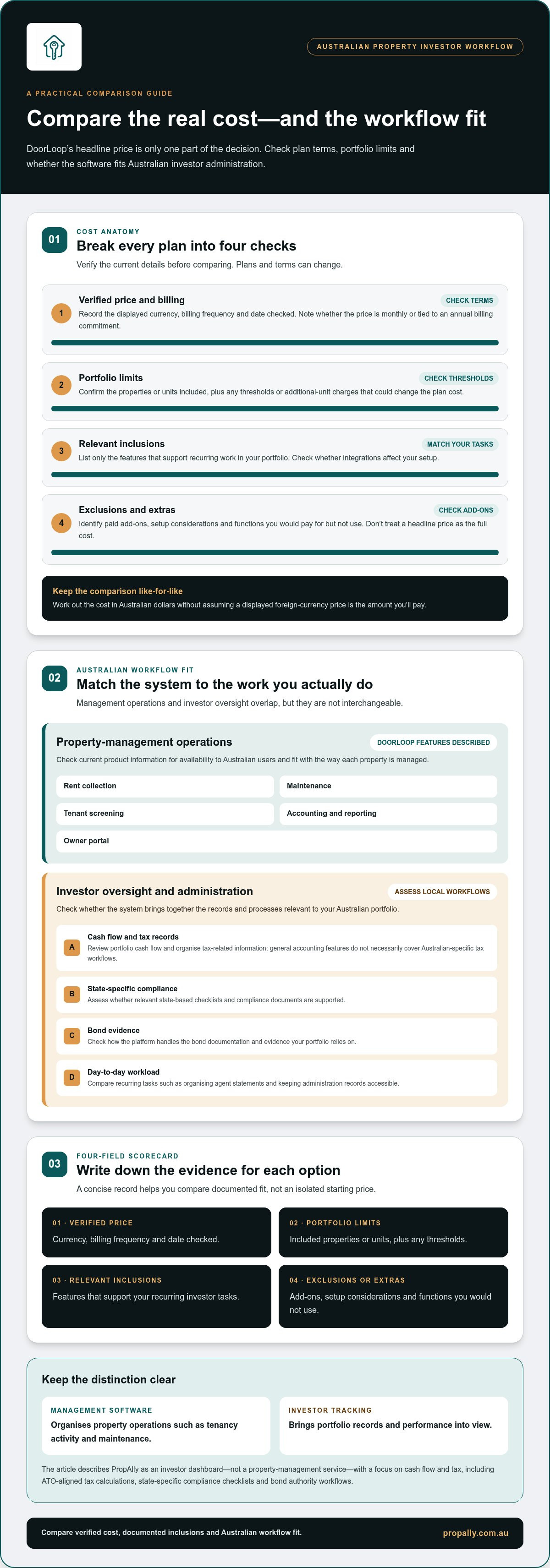
For each plan, make a concise, evidence-based summary with four fields:
- Verified price: currency, billing frequency and date checked.
- Portfolio limits: included properties or units and any thresholds.
- Relevant inclusions: features that support your recurring investor tasks.
- Exclusions or extras: add-ons, setup considerations and functions you’d pay for but not use.
This gives the phrase doorloop australia pricing and alternatives a practical meaning: compare the verified cost and documented fit, not an isolated starting price. If a plan is built around property-management operations you don’t handle, its extra capability may not improve your investor workflow. Keep that distinction in view when weighing DoorLoop against Australian-focused options.
DoorLoop features versus Australian investor workflows
Property software can organise day-to-day management, track an owner’s investment position, or attempt to do both. Those jobs overlap, but they aren’t interchangeable. DoorLoop describes features across operational areas such as rent collection, maintenance, tenant screening, accounting, reporting and an owner portal. Check its current product information to see which features are available to Australian users and suitable for your needs.
Property-management operations and portfolio oversight are different jobs
Operational tools focus on managing activity around a tenancy or property. Investor oversight brings financial and administrative information together across a portfolio. A system can be strong at the first and still leave an investor needing a separate process for tax records, bond evidence or state-specific checklists. PropAlly is an investor dashboard for organising those records, not a property-management service.
Management software organises property operations; investor tracking brings portfolio records and performance into view. Use that distinction to judge whether a feature solves a recurring task or simply adds capability you won’t use.
Workflow comparison
Management operations: DoorLoop describes features including rent collection, maintenance, tenant screening and an owner portal. Check how those functions fit the way each property is managed.
Accounting and reporting: DoorLoop also describes accounting and reporting features. Review what those functions produce and whether the records suit your Australian portfolio administration. A general accounting feature doesn’t necessarily cover Australian-specific tax workflows.
Cash flow and tax records: Investor administration needs a clear way to review cash flow and organise tax-related information across properties. PropAlly’s dashboard focuses on cash flow and tax, including ATO-aligned tax calculations.
Compliance and bond evidence: Assess whether a platform supports the state-specific checklists and bond documentation relevant to your portfolio. PropAlly provides state-specific compliance checklists and bond authority workflows.
Which Australian workflows should the comparison cover?
Map each platform against the records you maintain: cash flow, tax calculations, compliance tasks and bond evidence. If you hold properties across different states, assess whether information can be organised around state-specific workflows rather than relying on one generic checklist. Broader context on Australian property-sector priorities is available through Australian Property Industry Insights.
A longer feature list isn’t automatically a better fit for an individual investor. If you don’t manage leasing or maintenance yourself, operational tools may add little to your routine. If your priority is consolidating agent statements and portfolio records, focus on those tasks. Compare each documented capability with a real workflow, then note what remains manual. That gives your doorloop australia pricing and alternatives comparison a practical foundation, without confusing platform breadth with local investor fit.
For an investor-focused view of Australian cash flow, tax, compliance and bond evidence, explore the PropAlly property-investor dashboard.
DoorLoop alternatives: compare tools by investor needs
The useful alternative depends on the work you need to organise. An investor coordinating tenancy operations has different requirements from one who mainly wants a clear view of cash flow, tax records and documents across a portfolio. Identify the job first, then choose the software category. No single option is the right fit for every Australian investor.
When a full property-management platform may be the better fit
A full operational platform may suit investors or businesses that coordinate tenant-facing workflows, maintenance and rent collection. DoorLoop describes features in those areas, along with tenant screening, accounting, reporting and an owner portal. Check its current product information and plan details to understand how those features fit your requirements.
The distinction matters if you delegate management operations but still need to track your own investment information. A platform designed around tenancy activity may help organise that workload, but it won’t automatically meet every need for Australian tax records, bond evidence or state-specific compliance tracking. Map the required workflows before assuming one broad system covers them all.
When an investor-focused dashboard may fit better
If your priority is portfolio administration, an investor dashboard may be more directly aligned. PropAlly brings cash flow, tax, compliance and bond evidence into an Australian-focused dashboard. It reads information from agent statements and inboxes to consolidate data across multiple properties. This can reduce the need to gather records from separate sources, while investors remain responsible for reviewing their information and managing their own obligations.
PropAlly also provides state-specific compliance checklists, bond authority workflows and ATO-aligned tax calculations. These are investor-administration features, not tenant management services. For more context on software choices for Australian landlords and investors, see this Australian property-management software guide.
When a manual record system may be enough
Spreadsheets, folders and email may suit a small or straightforward portfolio if you’re comfortable updating records yourself. This approach lets you shape categories around your own tracking needs, but you’re responsible for keeping documents organised and maintaining a consistent process. As properties, statements or compliance tasks accumulate, assess whether manual upkeep still gives you a dependable overview.
- Full property-management platform: consider it when coordinating operational and tenant-facing activity is central to your workload.
- Investor dashboard: consider it when consolidating portfolio cash flow, tax, compliance and bond records is the priority.
- Manual records: consider them when your tracking needs are limited and you can maintain the process consistently.
Use these categories to make doorloop australia pricing and alternatives a workload comparison, not a contest for the most features. Write down which tasks you handle, which are managed for you and where your records currently sit. Then compare each option against that list, including any gaps you’d still need to manage manually. The best fit supports your defined workload without adding unnecessary operational complexity.
A practical scorecard for choosing DoorLoop or an alternative
Turn the comparison into a decision, not a feature hunt. Start with your actual portfolio workload, then assess how well each platform supports it. This helps reveal whether a tool fits Australian records and recurring administration, or simply offers capabilities that look impressive on a plan page.
Turn your property workload into comparison criteria
First, list how many properties you need to track and the tasks you repeat, such as reviewing agent statements, filing receipts, organising tax records and keeping bond evidence accessible. Note where each document currently lives. If your portfolio spans different states, include state-specific compliance workflows rather than treating compliance as one generic task.
Next, use a consistent scorecard. Rate each platform against the criteria below as not supported, partly supported or supported. Use product documentation and a practical walkthrough as evidence, not assumptions based on a feature name.
- Local records: Can you organise the cash-flow, tax and property records you need to review?
- State-specific checklists: Can your process account for relevant state-based compliance tasks?
- Document handling: Can you bring agent statements, receipts and bond evidence together without creating duplicate filing work?
- Portfolio scale: Do the documented property limits suit your current holdings and likely portfolio needs?
- Workflow fit: Does the system support your recurring investor tasks, or focus mainly on operations you don’t manage?
For a more detailed view of compliance considerations, use this Australian property compliance checklist to identify the records and processes to include in your assessment.
Check plan fit, document limits and future portfolio needs
Compare documented plan limits, included document processing and optional add-ons against your list. A feature is essential only if it supports a real task you perform or an important record you need to maintain. Separate those requirements from attractive extras, then consider whether the plan will still fit if your property count or administration workload changes.
- Define tasks. Write down the recurring work the platform must support.
- Count properties. Record your current portfolio size and the capacity you need.
- Map workflows. Trace how statements, receipts, tax records and bond evidence move from source to storage and review.
- Compare plans. Match verified inclusions, limits and add-ons to those workflows.
- Test the fit. Use a representative task to see whether the platform consolidates records or leaves you maintaining duplicate processes.
Decision rule: Choose the plan that supports your essential portfolio workflows at your required scale, not the one with the longest feature list. Apply that rule to doorloop australia pricing and alternatives and the comparison becomes easier to explain and repeat.
If an Australian investor dashboard aligns with your scorecard, explore PropAlly’s portfolio-tracking plans.
PropAlly as a DoorLoop alternative for Australian property investors
For investors whose main task is keeping portfolio administration organised, PropAlly offers a different focus from a broad property-management operations platform. Its Australian-focused dashboard brings cash flow, tax, compliance and bond evidence together. Rather than centring the comparison on how many operational features a system lists, consider whether it helps keep the records and recurring tasks that matter to your investment portfolio in one place.
What PropAlly brings to Australian portfolio administration
PropAlly automatically reads information from agent statements and inboxes, helping consolidate data across properties. It also provides ATO-aligned tax calculations, state-specific compliance checklists and bond authority workflows. This combination is designed around investor administration, keeping relevant information together so you can review your portfolio. Automatic document reading helps organise incoming information, while you should still review the records for accuracy.
PropAlly is software, not tax advice or a property-management service. Its dashboard and calculations support record-keeping and oversight; investors remain responsible for their own decisions and obligations. That distinction matters in a comparison with DoorLoop: the better fit depends on whether your priority is coordinating operational management or organising your Australian portfolio records.
Choose a starting point that matches your portfolio
The Free Plan covers one property. Paid plans support portfolios of up to twenty properties, giving investors a choice based on portfolio size. Optional email document add-ons are also available. Compare plan scope with the way you receive and organise records, rather than paying for operational functions that don’t address your administration needs.
A practical test is to follow one set of records from arrival to review. For example, consider how an agent statement or a document received by email fits into your portfolio administration. Then assess whether bringing that information together with cash-flow, tax, compliance and bond evidence would make your oversight clearer. This keeps the decision grounded in your own workflow, not a feature checklist.
If you’re comparing doorloop australia pricing and alternatives, PropAlly is worth considering when Australian investor administration is the core requirement. The PropAlly Starter Plan is a relevant next step for investors assessing a paid option, while the free tier offers a one-property starting point. Choose according to the portfolio and document workflow you need to manage.
Explore PropAlly to see how its investor-focused dashboard could fit your portfolio administration.
Make your next software decision with confidence
Turn the comparison into a clear record of what your portfolio needs. Keep a short list of must-have tasks, documents and workflows, then use it to assess whether a platform will reduce administrative friction or add tools you won’t use. That gives your doorloop australia pricing and alternatives decision a practical basis as your portfolio and record-keeping needs change.
For Australian investors who want portfolio administration in one place, PropAlly brings cash-flow, tax, compliance and bond-evidence tracking together, with automatic reading of agent statements and inbox documents. The free tier covers one property, while paid plans support portfolios up to twenty properties. Choose a starting point that fits your current workload, then review how well it supports the way you organise your records.
Explore PropAlly and organise your Australian property portfolio. A more structured view of your records can make the next investment decision easier to manage.
Frequently Asked Questions
How much does DoorLoop cost in Australia?
DoorLoop’s Australian price, currency and billing arrangement depend on its current pricing and account terms. Check its official pricing information and note the date, currency and billing term shown. Then compare the plan’s property limits and included features with any add-ons you’d need. Don’t assume a price displayed for another market automatically applies to an Australian account. That distinction is central to comparing doorloop australia pricing and alternatives accurately.
Is DoorLoop available for Australian property investors?
Check DoorLoop’s current product information for Australian availability, support arrangements and relevant plan details. Also distinguish general platform capabilities from support for Australian investor administration. For example, a feature labelled “accounting” doesn’t by itself show how your local property records will be handled.
What is a good alternative to DoorLoop for Australian landlords?
The right alternative depends on whether your main workload is managing tenancy operations or organising your investment records. PropAlly is an Australian investor dashboard for tracking cash flow, tax, compliance and bond evidence, but it isn’t a like-for-like replacement for every DoorLoop function. List your regular tasks first. An investor who mainly reviews agent statements may prioritise a different workflow from someone coordinating maintenance.
Can DoorLoop handle Australian tax and state compliance requirements?
Check DoorLoop’s current product documentation against the Australian tax records and state-based compliance tasks you need to manage. Don’t infer local suitability from general accounting or compliance claims. Software can help organise information, but it doesn’t replace professional tax or legal advice. Keep those responsibilities separate when assessing any platform.
What should I compare when choosing property software in Australia?
Compare how each platform handles the work behind your portfolio, not just the number of features. Check property limits, document handling, cash-flow tracking, tax records, bond evidence and state-specific checklists. Note which integrations and plan inclusions are essential for your process and which are optional. Then compare current pricing and billing terms from official product information, recording the date checked for reference.
Is property-management software the same as an investor portfolio tracker?
Not necessarily. Property-management software may centre on operational tasks such as rent collection, maintenance or tenant workflows. An investor tracker focuses on bringing financial and administrative information about investments together. Some platforms may cover parts of both, so look beyond the category name. If you hold properties across different states, assess whether your chosen tool helps organise tax records, bond evidence and state-specific administration alongside any operational tasks you handle.
Does PropAlly offer a free plan for Australian property investors?
Yes. PropAlly’s Free Plan covers one property, while paid plans support portfolios of up to twenty properties. Optional email document add-ons are also available. Before choosing, consider how many properties you need to track and how you receive documents, such as agent statements in your inbox. Match the plan and any add-ons to those workflows, and check the relevant plan information for document-processing limits.