

The platform with the longest feature list may be the wrong fit for your portfolio. If you’re weighing up buildium alternatives for australian private landlords, the key question isn’t how much software can do. It’s whether it supports the Australian tax, compliance and record-keeping workflows you actually need.
Buildium is a comprehensive property management platform, but Australian private landlords may need to check how well an overseas system fits local requirements. Statements from different agents, expense records, bond evidence and state-based compliance documents can quickly end up scattered across inboxes and spreadsheets. That’s a familiar frustration, especially if you manage some properties yourself and use agents for others.
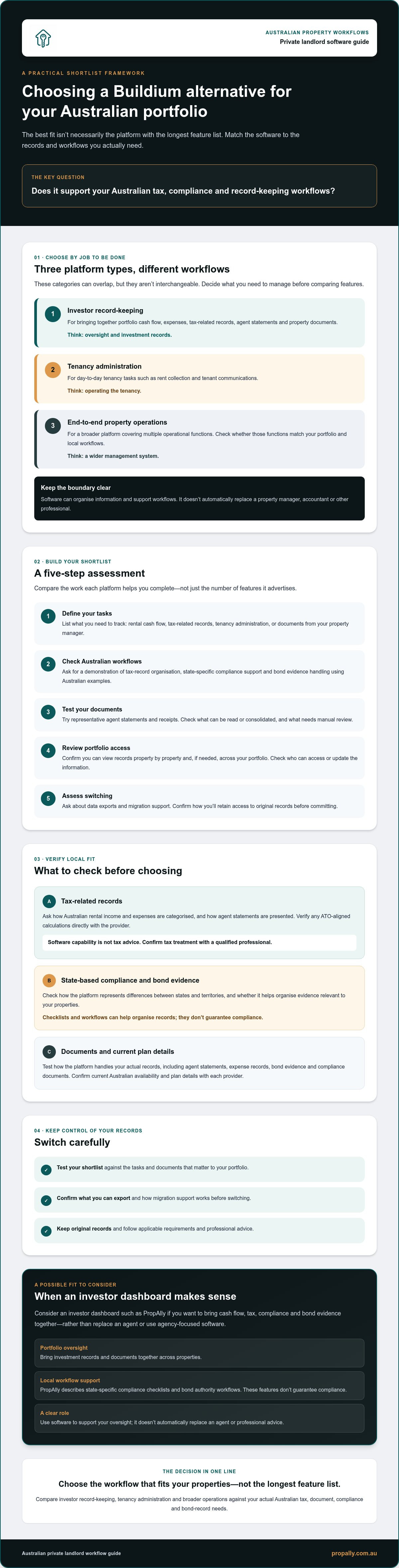
This guide compares alternatives by landlord type and portfolio workflow, not by feature count. You’ll see how agency-focused platforms differ from investor tracking tools, what to verify about ATO-aligned tax calculations, state-specific compliance checklists, document handling and current plan details, and where software can support your oversight without replacing an agent. The goal is a clear, practical shortlist, so you can choose a system that fits your properties without paying for functions you won’t use.
Key Takeaways
- Start by deciding whether you need investor record-keeping, tenancy administration or an end-to-end platform. Those tools serve different workflows.
- Compare buildium alternatives for australian private landlords against your actual tasks, including cash-flow tracking, tax records, agent statements, bond evidence and compliance organisation.
- Check how each option handles Australian documents and state-based workflows. Checklists and automated document reading can help organise records, but don’t guarantee compliance.
- Before switching, test your shortlist and confirm what you can export. Keep original records and follow applicable requirements and professional advice.
- Consider an investor dashboard such as PropAlly if you want to bring cash flow, tax, compliance and bond evidence together, rather than replace an agent or use agency-focused software.
Why Australian private landlords look for Buildium alternatives
Does software built for another market fit an Australian property portfolio? That’s the question to ask before comparing dashboards, payment tools or management platforms. The phrase buildium alternatives for australian private landlords covers several different needs: tracking investment records, administering tenancies or coordinating end-to-end property operations. Those categories overlap, but they aren’t interchangeable.
An Australian-focused landlord software alternative is a tool designed to support local property workflows, from organising investment records to handling tenancy tasks. The right fit depends on what you need to manage, not how many features appear on a product page.
Keep the boundaries clear. Software can organise information and support workflows, but it doesn’t automatically replace a property manager, accountant or other professional. Nor does a general feature checklist prove that a platform handles Australian tax records, state-based compliance tasks or bond evidence in a way that suits your circumstances.
What private landlords should expect from a Buildium alternative
Start with the work you want the software to do. Do you need to collect rent and manage tenant communications, or bring agent statements, expenses and tax records together across properties? These are different jobs. The broad functions of rental management software can include tenant screening, payment processing and accounting, but a private landlord may need stronger investment-level record organisation than an operations platform provides.
For example, an investor dashboard may help consolidate cash flow and documents without managing the tenancy itself. Conversely, a tenancy administration system may support day-to-day operations but not provide the portfolio-level tax and bond record view you want. Identify your priority before shortlisting.
When an overseas platform may not match Australian workflows
Don’t assume local suitability from a global product page. Ask the provider to demonstrate how the software categorises Australian rental income and expenses, handles agent statements, and presents tax-related records. Treat tax calculations as a software capability, not tax advice; confirm tax treatment with a qualified professional.
Check compliance and bond processes separately. Ask how the platform represents differences between states and territories, and whether its workflows help you organise the evidence relevant to your properties. Australian-focused tools such as PropAlly describe state-specific compliance checklists and bond authority workflows, but those features don’t guarantee compliance.
Finally, verify current Australian availability and suitability directly with each provider. Buildium’s overseas market focus is a reason to check how its workflows fit, not evidence that the platform is unavailable to Australian users. Test the tasks that matter to your portfolio before deciding.
How to assess Buildium alternatives for Australian landlord workflows
Compare the work each platform helps you complete, not the number of features it advertises. For a practical shortlist, follow these steps:
- Define your tasks. List what you need to track, such as rental cash flow, tax-related records, tenancy administration or documents from your property manager.
- Check Australian workflows. Ask the provider to demonstrate relevant tax-record organisation, state-specific compliance support and bond evidence handling using Australian examples.
- Test your documents. Try representative agent statements and receipts. Check whether information can be read or consolidated, and what needs manual review.
- Review portfolio access. Confirm you can see records property by property and, if needed, across your portfolio. Check who can access or update the information.
- Assess switching. Ask about data exports, migration support and how you’ll retain access to original records before committing.
A feature list alone can’t establish Australian suitability; only a demonstrated local workflow can show whether a platform fits your portfolio. For broader context on technology shifts in the local property sector, see Australian proptech industry trends.
Check Australian tax, compliance and bond workflows
Ask how the platform organises tax-related records and calculations, and what you can review or export for your accountant. Software can support record-keeping, but it isn’t tax advice. Check whether compliance tools reflect the states and territories where your properties are located, and whether bond evidence or authority workflows are relevant to your process. Use an Australian investment property compliance checklist and an ATO records guide alongside your provider checks.
Test statements, documents and portfolio visibility
Use a real, appropriately secured sample of an agent statement and receipt to see what the system can capture, what requires correction and where the records appear. Ask whether documents from different agents can be brought into a consistent property-level view. PropAlly, for example, is an Australian investor dashboard that can read agent statements and inbox documents; confirm current processing details directly. For practical ideas on reducing manual entry, consult a guide to automating rental property data entry.
Use this compact scorecard to separate proven fit from assumptions:
- Essential: cash-flow visibility, usable tax records, relevant document handling and access to records across your properties.
- Optional: features that support tasks you may add later, such as tenancy administration.
- Unverified: any claim about Australian tax treatment, state compliance, bond processes, exports or migration that the provider hasn’t demonstrated.
If you’re comparing an investor dashboard against your own workflow, explore PropAlly’s Australian property-investor dashboard as one option to assess.
Buildium alternatives compared: match the platform type to your needs
There’s no single winner for every Australian portfolio. An investor dashboard helps organise property and investment information. A property management platform may cover more tenancy operations. The right choice depends on whether you self-manage, use an agent or need a clearer view across both arrangements.
The table is a starting point, not a ranking. Confirm each provider’s current Australian availability, product scope and local workflows directly before relying on a capability.
| Platform type | Target user | Australian workflow fit | Capabilities to verify |
|---|---|---|---|
| PropAlly investor dashboard | Private landlords organising portfolio records | Designed for Australian investors. Its dashboard brings together cash flow, tax, compliance and bond evidence. | Confirm current plan details and document processing. Check how its ATO-aligned tax calculations and state-specific checklists fit your circumstances. |
| Buildium management platform | Landlords or property teams assessing a broader management system | Use it as a comparison baseline, then test how its workflows map to Australian requirements. | Verify Australian availability, current product scope, tax-record handling, state-based workflows and bond processes. |
| Private-landlord or self-management software | Landlords wanting tools for their own tenancy workflows | Options in this category may focus on self-management. Fit depends on the tasks each platform actually supports. | Check Australian support, tenancy features, document handling, tax records and compliance workflows with each provider. |
| Agency property management platforms | Professional agencies and property teams | These platforms are designed around agency operations. Their scope may exceed a private landlord’s needs. | Confirm whether individual landlords can use the platform, along with current Australian availability, relevant functions, integrations and data export options. |
Investor dashboards versus property management platforms
An investor dashboard focuses on visibility and organisation across a portfolio. A management platform may address operational tasks such as tenancy administration. They can serve different users, even if both display property information. PropAlly is an investor data and workflow hub, not a property management service or listing platform. Its stated functions include cash-flow tracking, tax calculations, compliance organisation and bond evidence.
If you use an agent, an investor dashboard may help bring records together without duplicating the agent’s operational role. If you self-manage, check whether a separate tool covers the tenant-facing tasks you handle.
What to verify for each alternative on your shortlist
Ask providers to demonstrate your actual Australian workflow. Check the tax-related records you can organise, how state and territory differences appear in compliance tools, what documents the platform can process, and how data is stored or exported. Treat unconfirmed integrations and feature claims as unknowns, not promises. This makes a shortlist of buildium alternatives for australian private landlords more useful than a feature-count comparison.
How to choose and switch from Buildium without losing control of records
Changing platforms should improve your oversight, not leave gaps in your records. Before choosing among buildium alternatives for australian private landlords, map what you currently store, what you need to retrieve and how you’ll keep original documents accessible. Don’t cancel an existing service until you’ve checked its export options and tested the replacement workflow.
Run a practical platform trial before changing systems
Use a representative set of property records to check whether a shortlisted platform fits your day-to-day needs. If you test agent statements, receipts or bond documents, use appropriate safeguards for sensitive information and ask the provider how submitted data is handled. Confirm the trial’s scope and what support is available directly with the provider.
Then check the result, not just the upload process. Can you review cash flow, tax-related records and compliance information by property? If you own properties in different states, can you find the relevant records and checklists without mixing up their context? For PropAlly, assess its stated dashboard functions for cash flow, tax, compliance and bond evidence against your own workflow. These tools can help organise information, but they don’t guarantee compliance or provide tax advice.
Plan a controlled transition of landlord records
Before switching, create an inventory. Include the systems where records live, the document types you hold, the reports you rely on and any information that must remain accessible. Ask each provider about export formats, import options, user permissions, document retention and support during a transition. Confirm what happens to your access and data if you stop using the existing platform.
Test an export before making a final decision. Check that files open, names and dates remain clear, and records can still be matched to the correct property. Keep original agent statements, receipts and other source documents, and follow applicable requirements and professional advice about retaining records. A platform change is not a reason to discard source evidence.
For a useful record-keeping framework, consult a guide to tracking rental property tax receipts. It can help you decide what to organise before moving information, even if you ultimately keep some records outside the new platform.
- Before choosing: list records, reports and workflows you rely on.
- Before committing: test representative documents and confirm exports, access and data handling.
- Before ending access: check that your records remain readable, organised and available where needed.
If PropAlly’s stated Australian investor workflow matches your requirements, review PropAlly’s cash-flow, tax and records dashboard as part of your shortlist.
Is PropAlly the right Buildium alternative for your Australian portfolio?
The best fit depends on the work you need the software to do. PropAlly is an Australian property-investor dashboard for landlords who want cash flow, tax-related records, compliance information and bond evidence organised across rental properties. It may suit a mixed portfolio where some properties are managed by agents and others are self-managed, and you want a clearer investor-level view.
That scope has limits. PropAlly isn’t a property management service, a listing platform, or a source of financial or tax advice. Its ATO-aligned tax calculations and state-specific workflows are software capabilities, not a substitute for professional advice or a guarantee that you meet every applicable requirement.
Who may benefit from PropAlly’s investor-focused approach
Consider it if you’re trying to bring records together rather than hand over tenancy operations. The dashboard can read agent statements and inbox documents, which may reduce manual consolidation. It also includes state-specific compliance checklists and bond authority workflows. Check how these functions handle your documents and properties before relying on them.
Review current plan details directly with the provider before deciding. Confirm the free-tier terms, paid-plan property limits and what document processing is included. Don’t assume plan names, limits or add-ons are unchanged.
When another software category may be a better fit
If you need software for leasing, tenant communications or broader day-to-day tenancy operations, verify those capabilities with providers whose platforms cover that scope. A commercial property team may need a system designed around its property type and operational requirements. An investor dashboard and an end-to-end management platform solve different problems, so compare workflows rather than feature counts.
Use this final fit check before choosing among buildium alternatives for australian private landlords:
- Records: Do you need a consolidated view of cash flow, tax-related information, compliance records and bond evidence?
- Operations: Do you also need to handle leasing or tenant workflows, or does an agent cover those tasks?
- Portfolio: Can the platform organise information across your properties and relevant state-based workflows?
- Plan fit: Have you checked current property limits, document processing and plan inclusions directly with the provider?
If those priorities align with your workflow, explore PropAlly’s investor dashboard and assess how its stated functions fit your properties before making a decision.
Choose the workflow that keeps your portfolio clear
The right choice depends on the job you need done. Compare buildium alternatives for australian private landlords by how well they support your records and property workflows, not by feature count alone. Check Australian tax-related records, state-based compliance support and document handling directly with each provider before you switch.
PropAlly may suit landlords who want an Australian-focused dashboard for cash flow, tax, compliance and bond evidence. Its stated capabilities include reading agent statements and inbox documents, plus state-specific compliance checklists and bond authority workflows. These features can help organise information, but they don’t replace an agent or professional advice, or guarantee compliance.
If that investor-focused approach matches your portfolio, explore PropAlly and see whether its investor dashboard fits your portfolio. Take the time to check the workflow against your properties and records. A considered choice can make your next steps clearer and easier to manage.
Frequently Asked Questions
Is Buildium available for Australian landlords?
Check current availability and support directly with Buildium before signing up. Access to an overseas platform doesn’t necessarily mean its workflows are suited to Australian rentals. Ask the provider to demonstrate how it handles Australian tax-related records, agent statements, bond evidence and state-based compliance tasks. Confirm any relevant integrations, data export options and support arrangements in writing, then assess whether the platform fits your portfolio and the work you expect it to do.
What is the best Buildium alternative for Australian private landlords?
There isn’t one best option for every landlord. The right choice depends on whether you need investment record-keeping, tenancy administration or broader property operations. PropAlly may suit landlords who want to organise cash flow, tax-related information, compliance and bond evidence in an Australian investor dashboard. Other platforms may fit different workflows. Compare buildium alternatives for australian private landlords by testing your actual tasks and confirming each provider’s current Australian features.
Can PropAlly replace a property manager or Buildium?
No. PropAlly is an investor dashboard, not a property management service, listing platform or source of financial or tax advice. It can help organise cash flow, tax-related information, compliance records and bond evidence, including information from agent statements and inbox documents. Whether it can replace Buildium depends on which Buildium functions you use. If you rely on tenancy operations, check that those tasks are covered by another suitable service or system.
How do I compare landlord software for properties in different Australian states?
Ask each provider to show how its system organises records and workflows for the states and territories where your properties are located. Check state-specific compliance checklists, bond processes, document storage and the ability to review records by property. Don’t assume one general compliance feature covers every location. Confirm what the software does and what you must manage separately, then check relevant requirements with appropriate professional or official sources.
Can landlord software calculate my rental property tax?
Some landlord software includes tax-related calculations or helps organise records, but that isn’t the same as tax advice. PropAlly states that it provides ATO-aligned tax calculations and tools for organising tax-related information. Check how calculations are produced, which records they use and whether the outputs suit your circumstances. Review tax positions with a qualified tax professional, particularly before relying on software outputs for reporting or decisions.
Can I move my property records from Buildium to another platform?
Possibly, but the process depends on the export options of your current platform and the import capabilities of the new one. Before switching, ask both providers which data and documents can be exported, in what formats, and whether importing is supported. Test sample files and confirm continued access to your records before ending an existing subscription. Keep original statements, receipts and source documents, and follow applicable requirements and professional advice on record retention.
Is landlord software suitable if I use a property manager?
Yes. An investor dashboard can help you maintain a portfolio-level view while an agent handles agreed property operations. You might use it to organise statements, track cash flow and keep tax-related, compliance or bond records together. First check how the software handles your agent’s documents and whether it duplicates tasks already covered by the agency. Confirm document processing and access arrangements with the provider before relying on a particular workflow.